
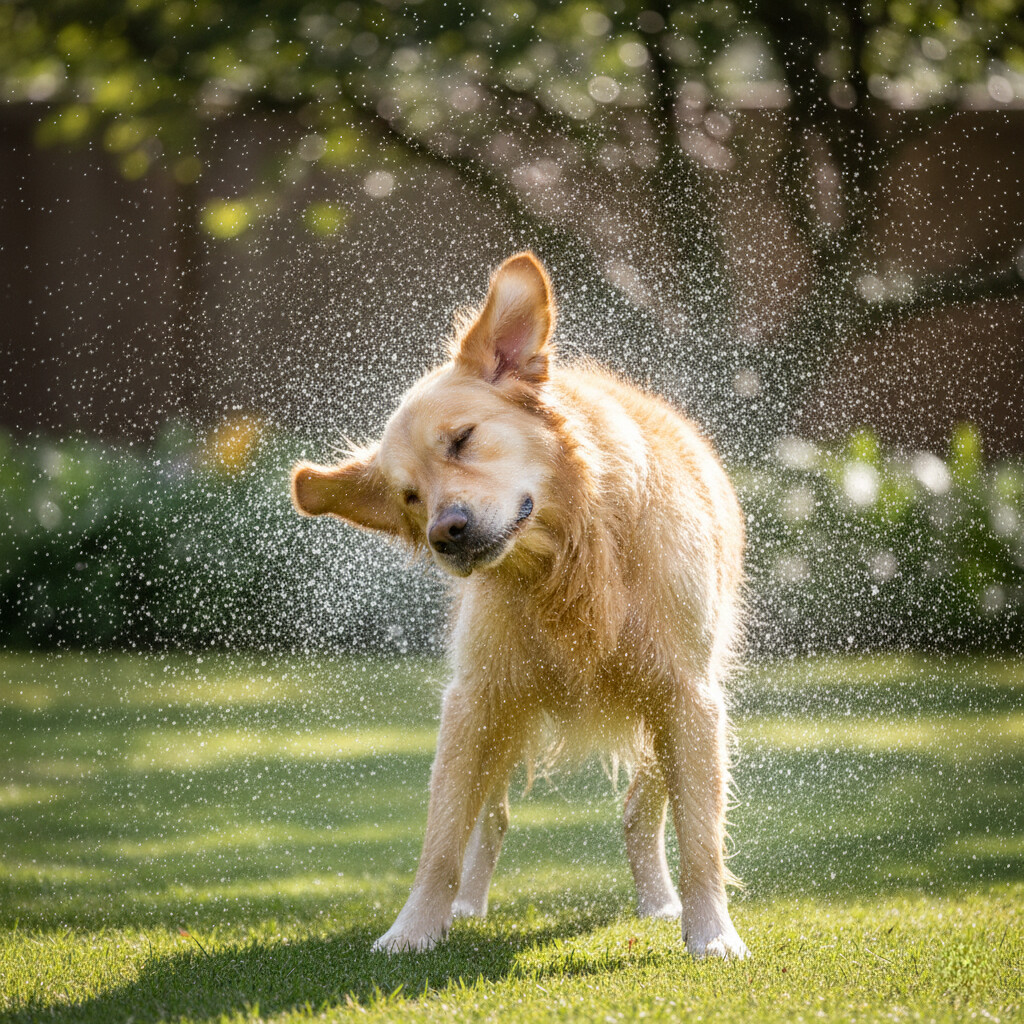
Dogs shake after a bath primarily to dry off quickly and prevent hypothermia. This “wet dog shake” is an instinctual reflex that removes up to 70% of water from their fur in seconds. After play, a dry shake serves as an emotional “reset button.” It signals that the intensity of the interaction is over, helping the dog release tension, lower adrenaline, and transition back to a calm state.
Summary Table
| Feature | Details |
| Primary Reason (Wet) | Survival instinct to remove water and maintain body heat. |
| Primary Reason (Dry) | Emotional regulation, stress relief, or ending a play session. |
| Efficiency | Can remove 70% of water in 4 seconds. |
| G-Force | A shaking dog can generate up to 27 Gs of force. |
| Medical Red Flags | Constant head shaking, scratching ears, whining. |
| When to see a Vet | If the shaking is persistent and focused only on the head/ears. |
Why Do Dogs Shake After Play or Baths?
Every dog owner knows the drill. You finish rinsing the shampoo off your dog, turn off the water, and reach for the towel. But before you can get close, it happens. Your dog starts at the head, ripples down the spine, and creates a chaotic sprinkler system in your bathroom. This is the classic “wet dog shake.”
However, you might have also noticed your dog doing the exact same movement when they are completely dry, often right after a wrestling match at the dog park or a stressful encounter with another dog.
While it looks like a simple movement, the shake is a complex evolutionary tool. It is not just about getting dry; it is a critical part of how dogs communicate and manage their own stress levels.
This guide explores the science, psychology, and health reasons behind why your dog shakes.
Read Also: What It Means When a Dog Sighs?
The Physics of the Wet Dog Shake
To understand why dogs shake, you first have to respect how efficient the movement is. If a dog relied solely on evaporation to dry off (like humans often do), it would take a massive amount of energy.
For a dog with thick fur, the energy required to evaporate all that water would consume about 20% of their daily caloric intake. In the wild, wasting that much energy could be fatal. Instead, they shake.
The Mechanics of the Movement
The shake is not a random wiggle. It is a highly tuned motor pattern.
- The Chain Reaction: The shake almost always begins at the head and travels down the spine to the tail.
- Loose Skin: Dogs have loose skin for a reason. When they shake, the skin travels much faster than the body underneath. This “whip-like” action generates massive force.
- G-Force: Research has shown that large dogs generate about 4 Gs of force while shaking. Smaller dogs, who have to shake faster to get water out, can generate up to 27 Gs.
This allows them to remove 70% of the water in their fur in just four seconds. No towel in the world is that efficient.
Reason 1: Survival and Temperature Regulation
The most obvious reason dogs shake after a bath or a swim is to prevent hypothermia. Fur is heavy when wet. For wild ancestors of the modern dog, carrying around pounds of water slowed them down, making them vulnerable to predators.
More importantly, wet fur traps cold against the skin. By shaking immediately, the dog restores the insulating properties of their coat. The air pockets between the hairs can once again trap body heat, keeping the dog warm.
Reason 2: The Emotional Reset Button
If the dog is dry, why are they shaking? This is one of the most misunderstood aspects of canine behavior. When a dog shakes after playing, hugging, or a training session, they are hitting a “reset button.”
Shaking After Play
Watch two dogs wrestling. It can look intense, with growling, biting, and tumbling. Suddenly, they both stop, separate, and shake their bodies.
This shake signals a transition. It tells the other dog:
- “The intense part is over.”
- “I am taking a break.”
- “We are still friends, let’s calm down.”
If you see your dog shake after a rough play session, it is a healthy sign. It means they are self-regulating their excitement levels so the play doesn’t escalate into aggression.
Shaking After Stress
You will often see this behavior at the vet or after a scary situation. Once the vet stops examining them, or after a large dog passes them on the sidewalk, your dog might shake.
This is literally “shaking it off.” The dog has built up adrenaline and cortisol (stress hormones) during the tense event. The physical act of shaking helps release that muscle tension and signals to the brain that the threat is gone. It is a coping mechanism to return to a baseline emotional state.
Read Also: Why Do Dogs Stare at Their Owners?
Reason 3: Medical Causes for Shaking
While shaking is usually normal, it can sometimes indicate a health problem. You need to distinguish between a “whole body shake” and a “head shake.”
If your dog is only shaking their head or flapping their ears repeatedly, this is rarely behavioral. It is usually physical discomfort.
Ear Infections (Otitis Externa)
This is the most common cause of head shaking. Yeast or bacterial infections cause itching and inflammation deep in the ear canal. The dog shakes their head to try to dislodge the feeling of fluid or debris.
Signs to look for:
- Redness inside the ear flap.
- A yeasty or foul odor coming from the ears.
- Brown or black discharge.
Ear Mites
These are microscopic parasites that live in the ear canal. They are extremely itchy. A dog with mites will shake their head violently and scratch at their ears, often causing bleeding or scabs behind the ears.
Foreign Objects
Grass seeds, foxtails, or water trapped in the ear can drive a dog crazy. If your dog suddenly starts shaking their head frantically after a walk in tall grass, check their ears immediately. Foxtails can burrow into the skin and require surgical removal.
When to Consult a Veterinarian
You should schedule a vet visit if the shaking is accompanied by other symptoms. Use this checklist to decide if you need professional help:
- Focus: Is the dog shaking their whole body or just the head? (Head-only is usually medical.
- Frequency: Is it happening constantly, even when the dog is resting?
- Vocalization: Is the dog whining or groaning while shaking?
- Touch: Does the dog shy away when you try to touch their ears or head?
- Appearance: Are the ears swollen, puffy, or smelling bad?
Read Also: What Causes Sudden Fear in Dogs?
Breed Differences: Who Shakes the Most?
Not all dogs shake the same way. The efficiency and frequency of the shake depend heavily on the breed’s physical traits.
Loose Skin Breeds
Breeds like Shar-Peis, Bloodhounds, and Basset Hounds have excessive loose skin. This skin acts like a whip, allowing them to generate massive force with less effort. However, this also means they tend to fling saliva and water much further than other breeds.
Double Coated Breeds
Huskies, Golden Retrievers, and German Shepherds have thick double coats that trap significant water. These dogs have a stronger instinct to shake because air-drying is almost impossible for them.
Water Dogs
Breeds like Labradors and Portuguese Water Dogs have oily, water-resistant coats. While they still shake, their fur is designed to repel water, so they often dry much faster than a standard double-coated dog.
How to Manage the “Wet Dog Shake”
If you are tired of getting soaked every time you bathe your dog, there are techniques to manage the shake. You cannot stop the instinct, but you can control when it happens.
The “Hold the Snout” Technique
The shake reflex almost always starts at the head. If you gently place your hand on the top of your dog’s head or hold their snout gently while bathing, they often will not shake.
- Step 1: Turn off the water.
- Step 2: Keep a hand on their head or neck.
- Step 3: Drape a towel over their back immediately.
- Step 4: Release their head only when the towel is covering them.
The Designated Shake Zone
Train your dog to shake on command. This is easier than it sounds.
- Keep your dog on a leash during the bath.
- Lead them to a specific spot (like inside the shower stall with the curtain drawn or a spot in the yard).
- Wait for them to shake (they naturally will).
- As they shake, say a cue word like “Shake!” or “Dry off!”
- Reward them with a treat immediately.
- Eventually, you can ask them to wait until they are in the “safe zone” to shake.
Conclusion
Understanding why your dog shakes helps you be a better owner. It is not just about making a mess; it is a vital function for their health and happiness.
- It is efficient: Nature’s best way to dry off without wasting energy.
- It is communication: A signal that play is over or stress is released.
- It is a diagnostic tool: Persistent head shaking means check the ears.
Next time your dog shakes off after a romp in the park, don’t just ignore it. Recognize that they are hitting their internal reset button, telling you they are ready for the next calm activity.