
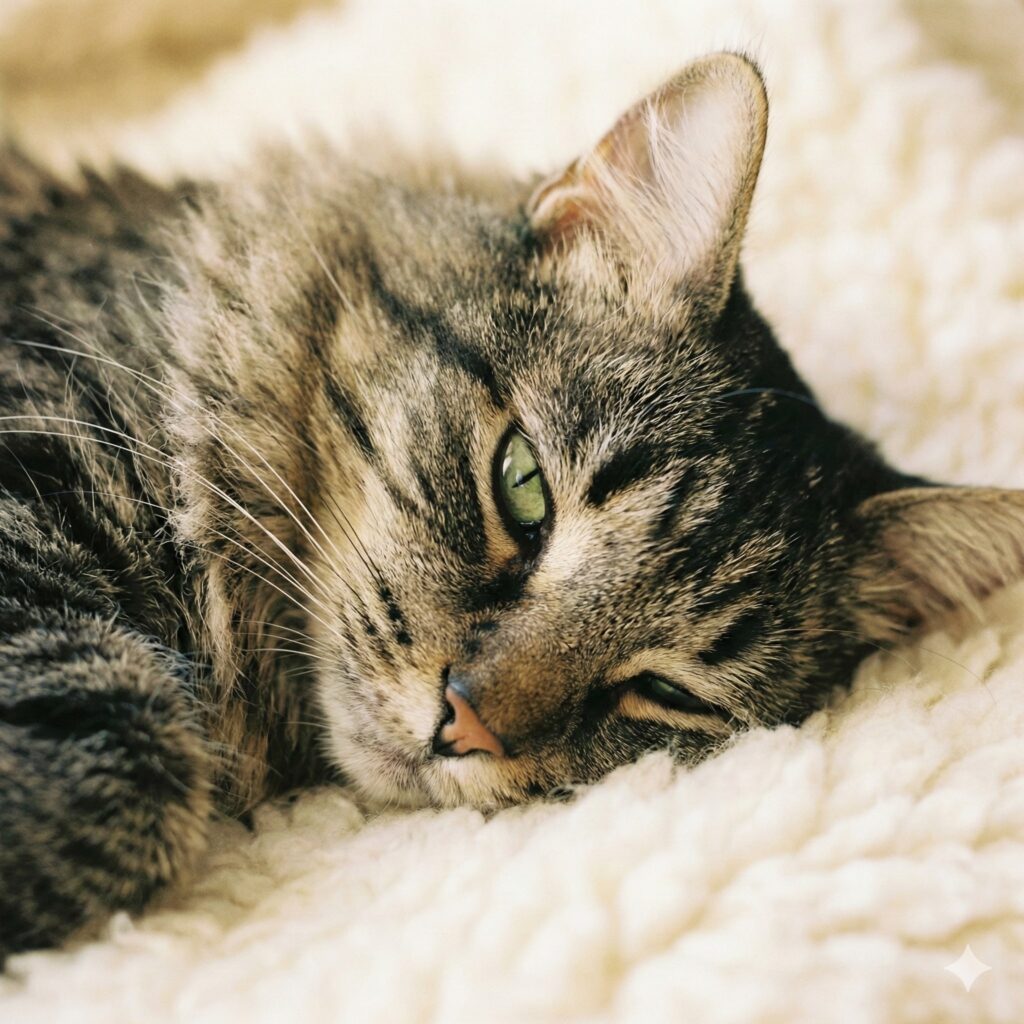
Cats sleep with their eyes half open primarily due to their evolutionary instincts as predators. This behavior allows them to stay alert to potential threats or prey even while resting. Additionally, the visibility of the “third eyelid” (nictitating membrane) creates a barrier that protects the eye from dryness and injury while maintaining a level of situational awareness.
Summary Table
| Feature | Description | Concern Level |
| Instinct | Evolutionary trait to monitor surroundings for danger or prey. | Low (Normal) |
| Light Sleep | Occurs during “cat naps” where the cat is resting but not fully asleep. | Low (Normal) |
| Third Eyelid | The nictitating membrane partially covers the eye for protection. | Low (Normal) |
| Injury/Illness | Accompanied by redness, discharge, or behavioral changes. | High (Consult Vet) |
| REM Sleep | Eye twitching or partial opening during dream cycles. | Low (Normal) |
Why Do Cats Sleep With Their Eyes Half Open?
Have you ever looked over at your cat dozing on the couch, only to find them staring back at you through barely open slits? It can be a little unsettling. You might wonder if they are actually asleep or just faking it.
This behavior is extremely common in the feline world. While it might look creepy to us humans who usually close our eyes tightly to sleep, for a cat, it is a survival mechanism. Your cat isn’t just trying to trick you; they are balancing the need for rest with the need to stay alive.
This guide explains the biology, evolution, and health reasons behind why cats sleep with their eyes partially open.
Read Also: Why Do Cats Sit in Loaves?
1. The Evolutionary Need for Alertness
The primary reason cats keep their eyes cracked open is evolution. In the wild, cats are mesopredators. This means they are hunters, catching mice and birds, but they are also prey for larger animals like coyotes or owls.
Because they sit in the middle of the food chain, cats cannot afford to completely zone out. Even when they are tired, a part of their brain remains on high alert.
Sleeping with eyes half open allows them to detect sudden movements or changes in light. If a predator approaches, they can bolt instantly. If a potential meal scurries by, they can wake up and pounce.
Even though your house cat faces no dangers larger than a vacuum cleaner, this instinct remains hardwired into their DNA.
2. Understanding Cat Sleep Cycles
Cats do not sleep the same way humans do. We tend to have one long block of sleep at night. Cats are crepuscular, meaning they are most active at dawn and dusk, and they sleep in multiple short bursts throughout the day. This is where the term “cat nap” comes from.
Light Sleep vs. Deep Sleep
- Light Sleep: This makes up the majority of a cat’s downtime. During this phase, their ears will swivel toward noises, and their eyes may remain partially open. They are resting their bodies, but their brains are gathering information.
- Deep Sleep: This is when a cat is fully relaxed. They might curl up tight, and their eyes usually close completely. This is critical for physical recovery.
If your cat’s eyes are half open, they are likely in the light sleep stage. They are conserving energy but are ready to “turn on” at a moment’s notice.
Read Also: What Cat Purring Really Means
3. The Nictitating Membrane (The Third Eyelid)
Sometimes, what you are seeing isn’t the eyeball itself, but the nictitating membrane. This is often called the “third eyelid.” It is a translucent inner eyelid that moves diagonally across the eye from the inner corner.
Humans have a tiny remnant of this in the corner of our eyes, but in cats, it is fully functional.
Functions of the Third Eyelid:
- Protection: It acts like a shield, protecting the cornea (the surface of the eye) from scratches or dust while the cat moves through tall grass or brush.
- Moisture: It helps spread tears across the eye to keep it moist.
- Sleep Defense: When a cat sleeps, this membrane can slide across to protect the eye without blocking out all vision.
If you see a whitish or pinkish film covering part of your cat’s eye while they sleep, you are looking at this membrane. It is perfectly normal anatomy.
4. Rapid Eye Movement (REM) Sleep
Just like humans, cats dream. This happens during Rapid Eye Movement (REM) sleep. During this cycle, your cat’s brain activity is very similar to when they are awake.
You might notice:
- Whiskers twitching.
- Paws paddling as if they are running.
- Mouth chattering.
- Eyes moving behind the lids or lids fluttering open.
During REM, the muscles that control the eyelids relax. This can cause the eyes to slide open slightly. It doesn’t mean the cat is awake; in fact, they are likely in a very deep sleep state dreaming about chasing a laser pointer.
5. When Should You Worry? (Medical Concerns)
While sleeping with eyes half open is usually normal, there are times when it indicates a medical problem. You need to observe your cat’s eyes when they are awake to tell the difference.
Signs of Trouble:
- Prolapsed Third Eyelid: If the third eyelid is visible when the cat is wide awake and alert, this is not normal. It can indicate a condition called “Haw Syndrome,” parasites, or viral infections.
- Discharge: Look for yellow or green pus, or excessive tearing. Crusty eyes are a sign of infection.
- Redness or Swelling: If the eye looks angry, red, or the tissue around it is puffy, they may have conjunctivitis (pink eye) or an injury from a scratch.
- Cloudiness: If the surface of the eye looks milky or blue, it could be a sign of a corneal ulcer or glaucoma.
- Behavioral Changes: Is your cat hiding more? Are they pawing at their eyes? Do they seem lethargic?
If you notice any of these symptoms accompanying open-eye sleeping, you should schedule a visit with your veterinarian immediately.
Read Also: How to Help a Shy or Timid Cat Gain Confidence
6. How to Ensure Your Cat Gets Good Rest
Even though light sleeping is natural, cats still need deep, restorative sleep to stay healthy. If your cat seems to never close their eyes fully, they might feel unsafe in their environment.
Tips for a Cat-Friendly Sleep Environment:
- High Vantage Points: Cats feel safer when they are high up. A cat tree or a shelf allows them to sleep without worrying about being ambushed from behind.
- Quiet Zones: Unexpected loud noises trigger their instinct to stay alert. specific a quiet corner of the house for their bed.
- Warmth: Cats burn energy to stay warm. A cozy, enclosed bed (like a cave bed) helps them feel secure and warm, encouraging deeper sleep.
- Play Therapy: A tired cat is a sleepy cat. Engage in 15 minutes of heavy play with a wand toy before bed. This mimics the “hunt” and allows them to enter the “eat, groom, sleep” cycle more naturally.
Frequently Asked Questions
Can cats see when they sleep with their eyes open?
Yes, partially. Their brain is processing visual changes. If you walk past them, they will likely register the movement even if they don’t fully wake up.
Do all cats do this?
Most cats do this to some extent, but it is more noticeable in older cats or cats that have high anxiety. Kittens also do this frequently as their nervous systems are still developing.
Is it painful for their eyes to be open?
No. Because of the third eyelid and their tear production, their eyes do not dry out as quickly as human eyes would. However, if they sleep like this for hours without blinking, they might wake up with slightly dry eyes, which they will fix by blinking and grooming.
Conclusion
Seeing your cat sleep with their eyes half open is a reminder that your cuddly pet is, at heart, a wild hunter. It is a biological trick that has kept their species alive for thousands of years. It allows them to rest while remaining vigilant against threats.
Unless you see signs of infection, injury, or illness, there is no need to intervene. Let your cat snooze in their own weird, watchful way. They are just keeping an eye out for you and maybe a midnight snack.