
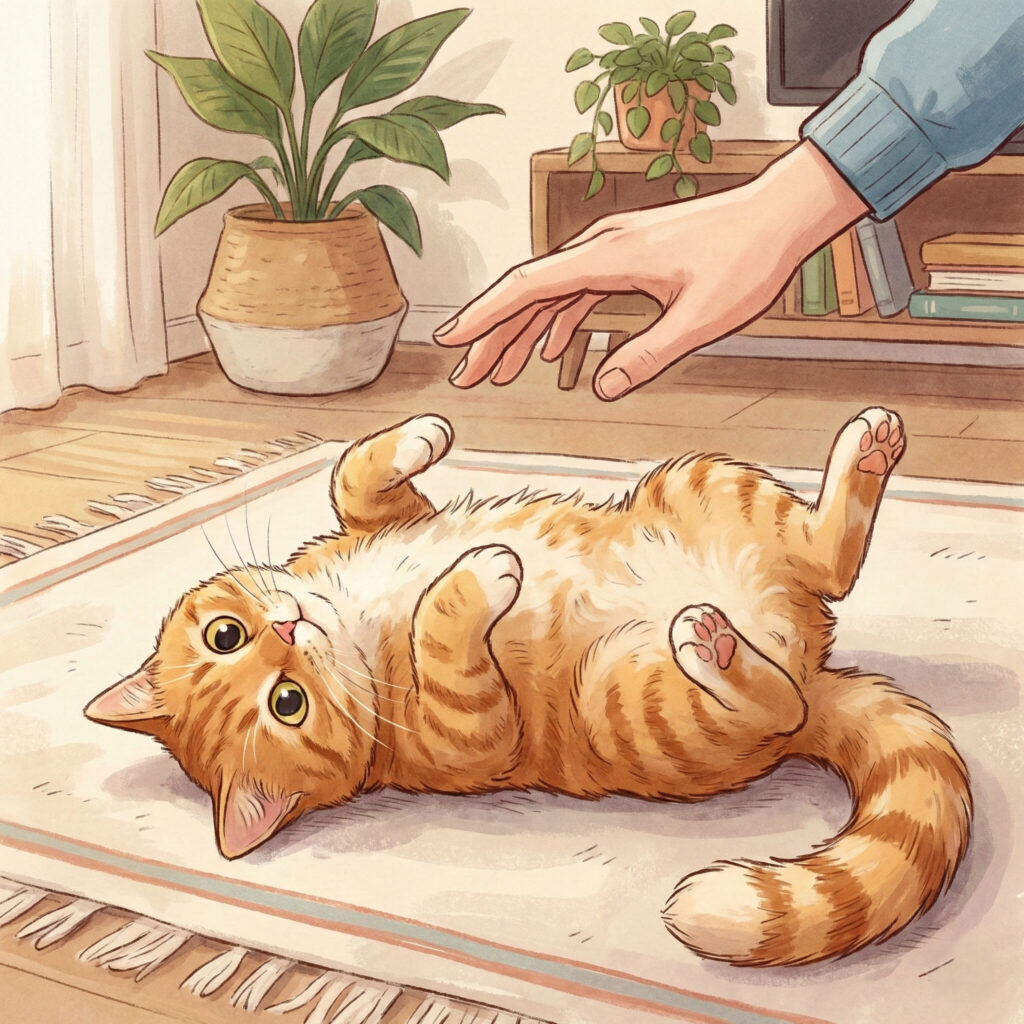
Cats roll on their backs primarily as a way to communicate safety and trust. By exposing their stomach, they are signaling that they feel completely relaxed in your presence. However, this is usually a visual greeting rather than an invitation for a belly rub. Because a cat’s vital organs are located in the abdomen, their instinct is to protect this area. Touching it often triggers a defensive reflex, biting or “bunny kicking”, even if they initiated the interaction.
Summary Table: Understanding the “Belly Trap”
| Behavior | What It Means | Recommended Action |
| Rolling on back | “I trust you” or “I am relaxed.” | Acknowledge them verbally or pet their head. |
| Exposing belly | Showing vulnerability and comfort. | Look, but do not touch the stomach area. |
| Ears back/Tail twitching | Irritation or impending aggression. | Stop touching immediately and give space. |
| Bunny Kicking | Defensive reflex to disembowel prey/threats. | Withdraw your hand slowly; do not punish. |
Why Do Cats Roll on Their Backs but Hate Belly Rubs?
It is one of the most confusing behaviors in the feline world. You walk into a room, and your cat flops dramatically onto the floor, rolling over to expose a fluffy, inviting belly. It looks exactly like a dog asking for a scratch. But the moment you reach down to pet them, you are met with claws and teeth.
Many owners jokingly call this “the belly trap,” assuming their cat is being malicious or moody. In reality, your cat is communicating two very different things: a high level of trust and a strong instinct for self-preservation.
Understanding the difference between a greeting and an invitation is the key to avoiding scratches.
Read More: Why Do Cats Flick Their Tails While Lying Down?
The Meaning of the Roll: It’s a Greeting
When a cat sees you and immediately drops to the ground to roll, they are performing a “social roll.” This is a positive social signal. In feral cat colonies, cats do this to greet family members or allies after being apart.
Why They Do It
- Safety Signal: They are telling you they do not see you as a threat.
- Relaxation: A tense or frightened cat will curl up or crouch. An exposed belly proves they are totally at ease.
- Attention Seeking: They know this behavior gets a reaction from you, whether it’s looking at them or talking to them.
- Marking Territory: By rolling around, they get their scent on the floor and pick up the scent of the home, reinforcing that this is their space.
If your cat rolls over when you walk in, take it as a compliment. They are saying, “I feel safe enough with you to drop my guard completely.”
The Anatomy of Vulnerability
To understand why the “pet” part goes wrong, you have to look at cat anatomy. Unlike dogs, who have a rib cage that extends fairly far down, a cat’s abdomen is soft and unprotected.
Behind that soft belly fur lie the most critical vital organs: the liver, spleen, kidneys, and intestines. In the wild, an injury to this area is almost always fatal.
The Instinctive trigger
Because this area is so critical, cats have a hair-trigger defensive instinct to protect it. Even if your cat loves you, touching this area can cause an automatic reaction. It isn’t a thoughtful decision to bite you; it is a reflex.
- The Touch: You touch the soft underbelly.
- The Alarm: The cat’s nervous system registers a threat to vital organs.
- The Reaction: The cat grabs the “attacker” (your hand) with front claws and kicks with powerful back legs.
Read More: Why Do Cats Hate Closed Doors?
Why Dogs Like It but Cats Don’t
This confusion often stems from comparing cats to dogs. Dogs and cats have very different social structures and play styles.
Dogs
- Submissive Gesture: When a dog exposes its belly, it is often a sign of submission. They are asking you to be the leader and offering the belly as a sign of compliance.
- Play Style: Dogs often wrestle and tumble in a way that makes belly touches less threatening.
Cats
- Defensive Posture: Interestingly, a cat on its back is not submissive. In a fight, a cat will roll onto its back so it can use all four sets of claws and its teeth against an opponent.
- Predatory Instinct: The “bunny kick” behavior is how cats kill prey. When you touch their belly, you might accidentally trigger this predatory play mode.
Signs You Are About to Be Bitten
Your cat usually warns you before they strike. The shift from “relaxed greeting” to “defensive attack” can happen in seconds. Watch for these body language cues that say, “Stop touching me.”
The Warning Signs
- Tail Twitching: If the tip of the tail starts flicking, irritation is building.
- Skin Rippling: This often happens on the back and indicates overstimulation.
- Ears Turning: Ears rotating backward or flattening (“airplane ears”) is a clear sign to back off.
- Dilated Pupils: If their eyes suddenly go wide and black, they have likely switched into “hunt” or “fear” mode.
- Tense Body: If the cat stops purring and their body goes rigid, freeze.
Read More: Why Do Cats Sit in Loaves?
How to React to the Roll (Without Getting Scratched)
So, if you shouldn’t rub the belly, what should you do? You want to acknowledge their greeting without triggering their defense.
The Safe Zones
Focus your affection on the areas where cats have scent glands. These are the places they usually groom each other and rub against objects.
- Cheeks and Chin: Scratches behind the whiskers or under the chin are almost always welcome.
- Behind the Ears: A gentle rub at the base of the ears is very relaxing for most cats.
- Base of the Tail: Some cats enjoy scratches at the base of the tail, though this can be overstimulating for others.
The Correct Response to a Roll
- Verbal Praise: Talk to them in a high, soft voice. Say, “I see you!” or “Good kitty.”
- The Head Scratch: Approach slowly and pet the top of their head or cheek.
- The Slow Blink: Look at them and slowly close and open your eyes. This signals trust in cat language.
- Play: If they seem energetic, toss a toy. The roll might be an invitation to play, not to be petted.
Exceptions: The Cats Who Love Belly Rubs
You might read this and think, “But my cat loves belly rubs!” There are exceptions. Every cat has a unique personality.
Some cats have been desensitized to belly touches since kittenhood. Others simply have a very high tolerance for handling or a lower defensive drive (common in breeds like Ragdolls).
How to Test Your Cat
If you aren’t sure if your cat is an exception, proceed with extreme caution.
- Touch the side of their flank first, not the center of the belly.
- Watch their reaction closely.
- If they relax and purr, you might have a belly-rub lover.
- If they tense up or their claws extend, stick to head scratches.
Summary
The next time your cat flops over in front of you, remember: it is a visual compliment, not a physical invitation. They are showing you their most vulnerable spot because they trust you not to target it. Respect that trust by keeping your hands on their head and chin, and you will avoid the “belly trap” entirely.