
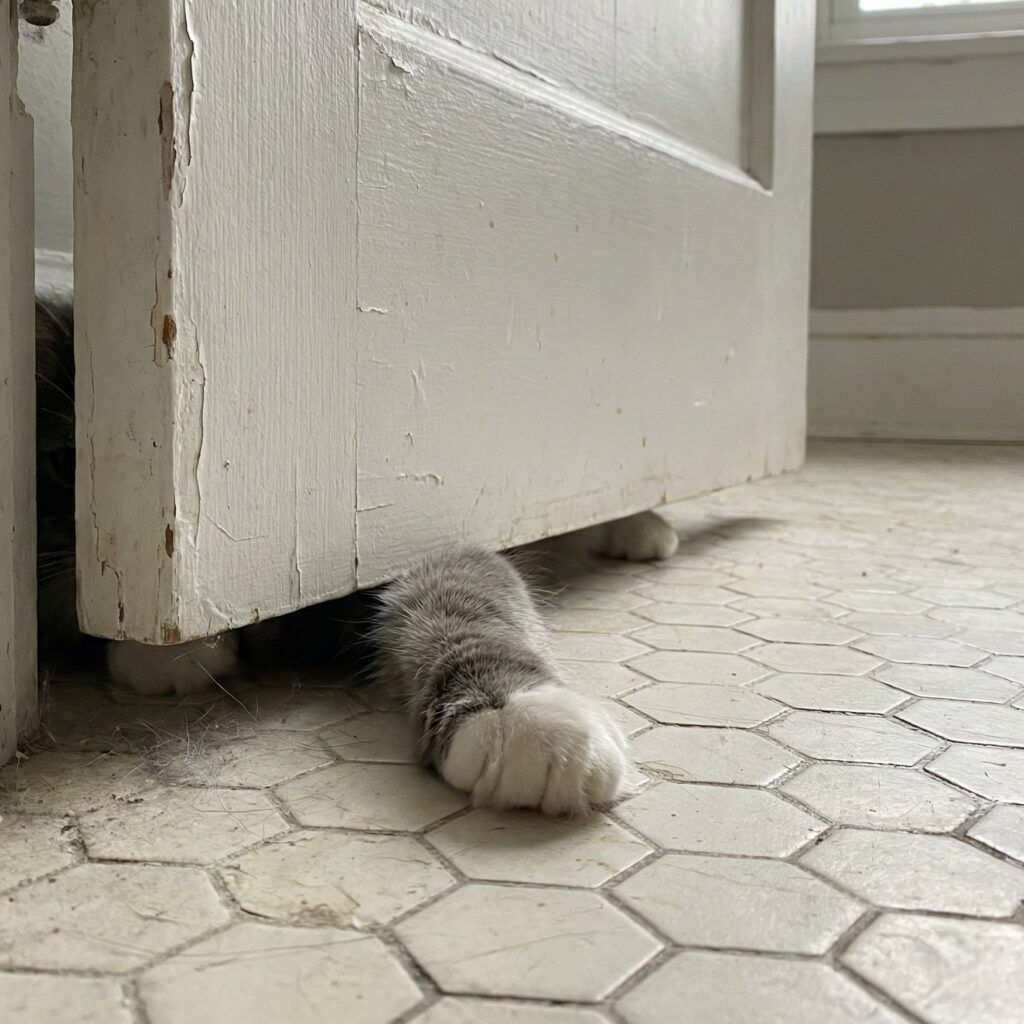
Cats hate closed doors primarily because they are territorial animals that need to patrol and control their environment. A closed door blocks their access to part of their territory, causing stress and curiosity. Additionally, cats are social creatures who experience “Fear of Missing Out” (FOMO) and often view a closed door as a barrier separating them from their owners or potential resources.
Summary Table: Why Cats Dislike Closed Doors
| Reason | Explanation | Solution |
| Territorial Instinct | They own the house and need to patrol every room to feel safe. | Leave doors ajar or install cat doors. |
| Curiosity | Cats are natural investigators; a blocked view implies hidden activity. | Allow brief supervised access to satisfy curiosity. |
| Social Bonding | They view you as part of their colony and want to be where you are. | Create a comfortable spot for them in the room with you. |
| Loss of Control | A closed door removes their choice to enter or leave, causing anxiety. | Avoid locking them in or out for long periods unexpectedly. |
Why Do Cats Hate Closed Doors?
If you are a cat owner, you know the struggle. You go to the bathroom and close the door, only to see a paw reach underneath a few seconds later. You close your bedroom door for privacy, and your cat scratches at the wood or meows loudly until you open it.
It can feel like your cat is just trying to be annoying, but that is not the case. There are deep-rooted biological and psychological reasons for this behavior. Cats are not just being difficult; they are following their instincts.
Read Also: Why Do Cats Sleep With Their Eyes Half Open?
This guide explains exactly why your feline friend cannot stand a shut door and what it says about their love for you.
1. The Territorial Instinct
The biggest reason cats hate closed doors is that they are territorial animals. In the wild, a cat’s survival depends on knowing its territory perfectly. They need to know where the food is, where the predators are, and where they can hide.
In your home, your house is their territory. When you close a door, you are cutting off a piece of their land. This confuses and frustrates them. They feel the need to patrol their entire territory to ensure it is safe. A closed door stops this patrol.
The Need to Patrol
Cats often walk a set path around the house multiple times a day. They rub their cheeks on corners, furniture, and doorframes to leave their scent. This is called “scent marking.” It tells other animals (and reminds the cat) that “this space is mine.”
When a door is closed, the scent trail is broken. They cannot refresh their mark on the items inside that room. This can make them feel insecure about their ownership of the space.
Resource Guarding
Even if there is no food or litter box behind the closed door, your cat might perceive the room itself as a resource.
It is a space for sleeping, hiding, or hunting (even if they are just hunting dust bunnies). By closing the door, you are hoarding a resource that they believe belongs to them.
2. Curiosity and the Unknown
There is an old saying: “Curiosity killed the cat.” While that is a bit dark, it highlights a truth: cats are naturally curious. They are predators who hunt by detecting small movements and sounds.
When a door is closed, your cat can hear sounds on the other side but cannot see what is causing them.
- Is it a mouse?
- Is it a new toy?
- Is it another cat?
- Are you eating something delicious without them?
The unknown drives them crazy. Their survival instinct tells them to investigate every noise to determine if it is a threat or a meal. A closed door creates a mystery that they feel compelled to solve immediately.
Read Also: Why Cats Love Boxes
The “Jack-in-the-Box” Effect
Imagine if there was a box in your living room that made noise, but you were never allowed to open it. You would be obsessed with it. That is how a cat feels about a closed room.
The moment you open the door, they often just walk in, look around for two seconds, and leave. They didn’t want to be in the room; they just wanted to know what was happening in the room.
3. They Are Social Creatures (FOMO)
Many people think cats are solitary and aloof, but that is a myth. While they hunt alone, they often live in groups (colonies) and form very strong social bonds with their humans.
Your cat loves you. They view you as a key member of their family or colony. If you are behind a closed door, you are separated from them. This causes a phenomenon often called “FOMO” (Fear Of Missing Out).
The Bathroom Phenomenon
Why do cats always want to come into the bathroom with you? It is one of the most common questions cat owners ask.
- Vulnerability: In the wild, going to the bathroom is a vulnerable time for an animal. Your cat might be trying to “guard” you while you are defenseless.
- Attention: The bathroom is one of the few places where you sit still and do nothing for a few minutes. To a cat, this looks like the perfect time for petting and attention.
- Water: Some cats are fascinated by running water, toilets flushing, or the bathtub.
When you shut them out of the bathroom, you are denying them a social activity and a chance to bond with you.
4. Loss of Control and Choice
Cats are control freaks. They are both predators (they hunt mice) and prey (larger animals hunt them). To survive, they need to feel in control of their environment and their escape routes.
A closed door represents a loss of control. It removes their choice.
- Open Door: The cat can choose to come in or stay out. They are happy.
- Closed Door: The choice is made for them. They are unhappy.
You will often notice that if you leave a door wide open, your cat will ignore the room entirely. But the second you close it, they are scratching to get in. They don’t necessarily want to enter; they just want the option to enter.
This is also why cats often beg to be let out, and then immediately beg to be let back in. They are testing the barrier to ensure they still have the freedom to move.
Read Also: Signs of Anxiety in Cats and How to Manage It
5. Separation Anxiety
For some cats, hating closed doors is a sign of separation anxiety. If your cat becomes frantic, destructive, or vocalizes loudly the moment you close a door, they might be overly dependent on you.
Signs that it might be anxiety rather than just curiosity:
- Excessive Vocalization: Howling or crying, not just a simple meow.
- Destruction: Scratching the carpet or wood until their paws bleed.
- Pacing: Walking back and forth nervously in front of the door.
If your cat displays these signs, they aren’t just annoyed by the door; they are panicked because they cannot reach you. This requires a different approach, often involving training and desensitization.
How to Manage the Behavior
Now that you know why they do it, how do you stop them from scratching up your doors or waking you up at night? Here are practical solutions.
1. Leave the Door Ajar
The simplest solution is often the best. If you don’t strictly need privacy, leave the door cracked open slightly. This allows the cat to peek in, verify that everything is okay, and go back to sleep. Often, a crack is all they need to feel secure.
2. Install a Cat Door
If you own your home and are handy with tools, installing an interior cat door is a game-changer. You can keep your bedroom or basement door closed for temperature control or noise, but the cat can still patrol freely.
There are many types of cat doors:
- Basic Flap: A simple plastic flap.
- Hollow Core Insert: A cute archway (without a flap) cut into the door.
- Electronic Door: Opens only for your cat’s microchip (good if you want to keep dogs or kids out).
3. Create a Distraction
If you need the door closed (for example, during a work meeting), you need to give the cat something better to do than scratch the door.
- Puzzle Toys: Fill a toy with treats.
- Window Perch: Open the curtains so they can watch birds.
- Automatic Laser: Turn on a toy that moves on its own.
Engaging their hunting instinct elsewhere will make them forget about the blocked territory.
Read Also: Why Cats Scratch Furniture
4. The “Ignore” Technique
If your cat scratches the bedroom door at night, you must not give in.
- Don’t open the door.
- Don’t yell at them.
- Don’t talk to them.
Any reaction, even yelling, is considered attention. If you open the door after 10 minutes of scratching, you have taught the cat that “10 minutes of scratching = door opens.” You have to be patient. Eventually, the behavior will stop if it yields no results.
5. Scent Soakers
If a cat is anxious about a specific room, place items that smell like them (a blanket or bed they use) near the door. You can also use synthetic pheromone diffusers (like Feliway).
These mimic the “happy markings” cats leave with their cheeks and can help calm them down, making them feel like the territory is already marked and safe.
Frequently Asked Questions
Why does my cat scratch the door only at night?
Cats are crepuscular, meaning they are most active at dawn and dusk. However, many house cats adjust to being awake when you are awake. If they scratch at night, they might be bored, hungry, or just lonely. They know you are in there sleeping, and they want to check on you or wake you up for play.
Should I punish my cat for scratching the door?
No. Punishment rarely works with cats and can damage your bond. Spraying water or yelling will just make them afraid of you, not the door. Instead, use double-sided sticky tape on the door (cats hate the sticky feeling) to deter scratching without you needing to be involved.
Does breed matter?
Yes, some breeds are more “velcro” than others. Siamese, Burmese, and Ragdoll cats are known for being very attached to their owners and vocal. These breeds are more likely to hate closed doors than more independent breeds like the Russian Blue or British Shorthair.
Conclusion
It is easy to get frustrated when your cat won’t let you have five minutes of privacy. But try to reframe the behavior. Your cat hates closed doors because they love you, they want to protect you, and they want to keep their home safe.
They aren’t trying to be pests; they are trying to be participants in your life. By understanding their need for control and territory, you can find a compromise like a door left slightly ajar that keeps everyone happy.