
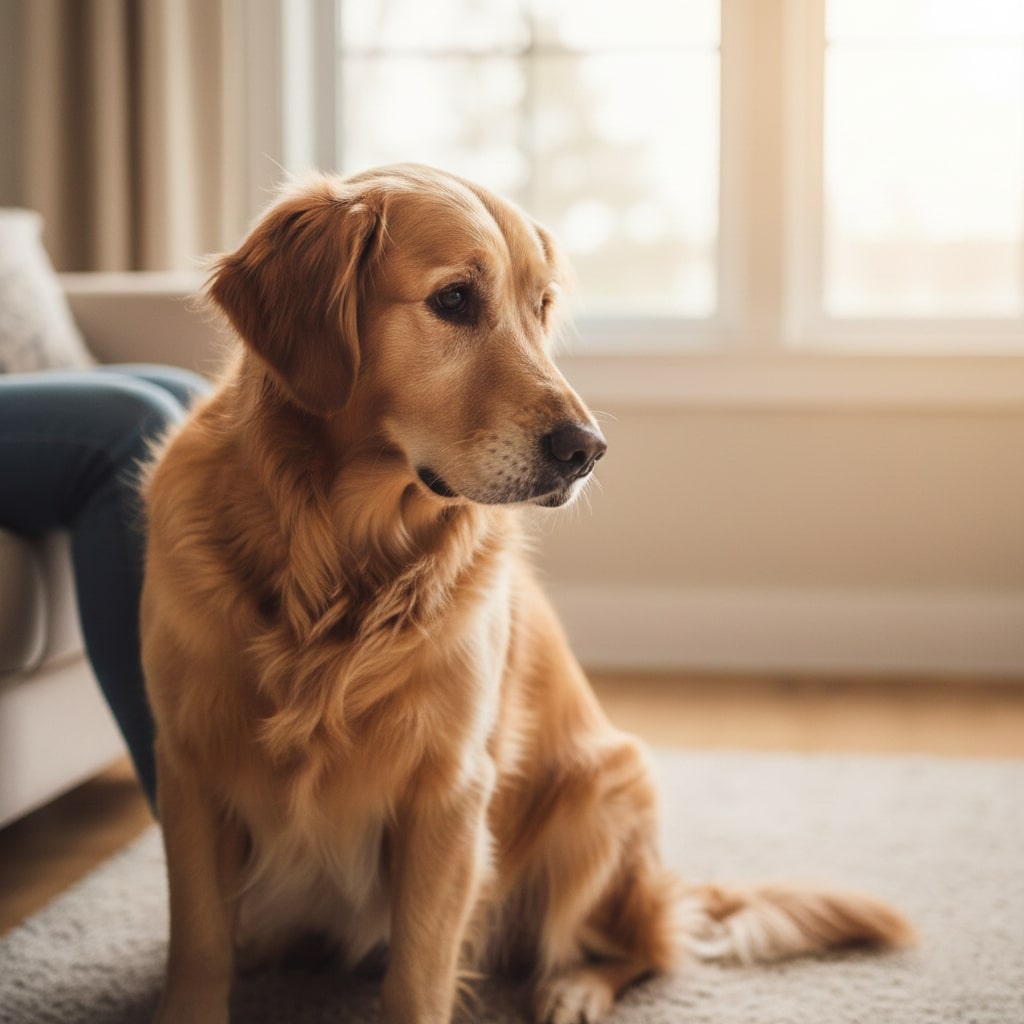
When a dog avoids eye contact, it is usually a sign of submission, anxiety, or fear. In dog language, a direct stare can be interpreted as a threat or a challenge. By looking away, your dog is actively signaling that they are not a threat and want to avoid conflict. It can also indicate stress, confusion during training, or, in rare cases, a medical issue like eye pain or cognitive decline.
Summary Table
| Reason | Context Clues | What You Should Do |
| Submission/Respect | Relaxed body, low tail, squinty eyes. | Interpret it as politeness; speak softly. |
| Fear or Anxiety | Tucked tail, trembling, lip licking, whale eye. | Back off, give space, and remove the stressor. |
| Guilt (Perceived) | Ears back, cowering after doing something “bad.” | They are reacting to your tone, not moral guilt. Stop scolding. |
| Confusion | Head tilt, furrowed brow during training. | Simplify the command or reset the training session. |
| Medical Issue | Cloudiness in eyes, bumping into things, lethargy. | Visit a veterinarian immediately. |
What Does It Mean When a Dog Avoids Eye Contact?
Humans value eye contact. We are taught that looking someone in the eye shows honesty, confidence, and attention. If a person refuses to look at us, we think they are being shifty, rude, or ignoring us.
Dogs, however, operate on a completely different set of social rules. In the animal kingdom, and specifically among canines, a direct, prolonged stare (often called a “hard stare”) is an act of aggression. It is a challenge. It says, “I am dominant, and I am threatening you.”
Therefore, when your dog refuses to meet your gaze, they are not being rude. They are actually speaking fluent “dog.” They are likely trying to de-escalate a situation, show you respect, or express that they are uncomfortable.
To understand your dog, you have to stop thinking like a human and start observing like a canine.
Read Also: Why Do Dogs Tilt Their Heads?
1. Submission and Appeasement Signals
The most common reason a dog looks away is to show submission. This is not “submission” in a weak or sad way, but rather a social tool to keep the peace.
The Peace Offering
Behaviorists call looking away a “calming signal.” Turid Rugaas, a renowned dog trainer, coined this term. When a dog feels that a situation is getting tense, perhaps you are leaning over them, or your voice has gotten loud, they will deliberately turn their head to the side.
This is their way of saying: “I come in peace. Please calm down.”
If you continue to stare at them or force them to look at you, you are ignoring their polite request for space, which can increase their stress.
2. Fear, Anxiety, and Stress
While submission is a voluntary social gesture, fear is an involuntary emotional reaction. A scared dog will almost always avoid eye contact because looking at the scary thing (you, a stranger, or another dog) might invite an attack.
Signs It Is Fear, Not Just Politeness
You can tell the difference between submission and fear by looking at the rest of the dog’s body. If the dog is avoiding eye contact AND displaying these signs, they are afraid:
- Whale Eye: You can see the whites of their eyes (sclera) as they look away from you but keep their head still.
- Lip Licking: Quick, repetitive flicks of the tongue.
- Yawning: Yawning when not tired is a major stress signal.
- Tucked Tail: The tail is clamped between the legs.
- Frozen Posture: The dog goes stiff.
If you see these signs, do not force interaction. Do not grab the dog’s chin to make them look at you. This could trigger a fear-bite because the dog feels cornered.
3. The “Guilty” Look
We have all seen the viral videos. A owner comes home to a shredded couch. They point the camera at the dog and say, “Did you do this?” The dog looks away, squints, and cowers. We laugh and say, “Look, he knows he did wrong! He feels guilty.”
The Truth About Dog Guilt
Science tells us that dogs likely do not experience “guilt” in the complex moral sense that humans do. They live in the moment. If they ate the couch three hours ago, they have already forgotten it.
When they look away and cower, they are reacting to you right now.
- They hear the anger or edge in your voice.
- They see your stiff body language.
- They see you pointing a finger or a phone.
They anticipate punishment. The eye aversion is a fear response to your current behavior, not an admission of past crimes. They are trying to appease you so you don’t yell.
Read Also: When Do Dogs Stop Growing?
4. Confusion and Training Pressure
During training sessions, you might notice your dog looking everywhere except at you. They might sniff the ground, look at the sky, or scratch their ear.
Displacement Behaviors
This is often interpreted as the dog being “stubborn” or “distracted.” In reality, it is often a sign of mental exhaustion or confusion.
If you are repeating a command like “Sit” over and over, and the dog doesn’t understand what you want, they feel social pressure. To relieve that pressure, they engage in displacement behaviors. Sniffing the ground or looking away is like a human scratching their head or checking their phone when they don’t know the answer to a question.
It is a sign that you need to lower the difficulty of the training or take a break.
5. Medical Causes for Avoiding Eye Contact
Sometimes, the behavior isn’t psychological; it is physical. If your dog used to make great eye contact and suddenly stops, or if they seem to be “looking through you,” it requires a vet visit.
Vision Loss
As dogs age, they can develop cataracts (cloudy lenses) or glaucoma.
If a dog cannot see you clearly, they may not orient their face toward yours. They might look past you or at your movement rather than your eyes.
Cognitive Dysfunction Syndrome (CDS)
Often called “doggie dementia,” this affects senior dogs. Symptoms include:
- Disorientation (getting lost in corners).
- Staring blankly at walls.
- Failure to recognize owners.
- Changes in sleep cycles.If your senior dog seems “spaced out” and avoids engagement, this is a neurological issue, not a behavioral one.
Autism in Dogs
Recent research has explored whether dogs can have autism-like conditions. Some studies on Bull Terriers have shown behaviors similar to autism, such as repetitive tail chasing and a lack of social connection/eye contact. While rare and not fully understood, some dogs simply lack the biological drive for intense social bonding via gaze.
Read Also: How Many Bones Does a Dog Have?
How to Build Healthy Eye Contact
If you want your dog to look at you more, you must make eye contact rewarding, not intimidating. You want a “soft gaze,” not a “hard stare.”
The “Look at Me” Game
You can train your dog to check in with you visually. This is essential for safety (so they look to you for direction on walks).
- Prepare: Have small, tasty treats ready.
- Lure: Hold a treat near your dog’s nose to get their interest.
- Move: Slowly move the treat up toward your forehead, right between your eyes. Your dog’s eyes will follow the treat.
- Mark: The moment their eyes meet yours, say “Yes!” or click a clicker.
- Reward: Give them the treat immediately.
- Repeat: Do this 10 times.
- Add the Cue: Once they are doing it automatically, say “Look” or “Watch me” right before you move the treat.
Avoid the “Alpha” Stare
Old-school training advice sometimes suggested staring a dog down to “show them who is boss.” Do not do this.
Staring down a dog forces them into a fight-or-flight state. It damages your relationship and breaks trust. You want your dog to look at you because they love you and look to you for guidance, not because they are terrified of looking away.
Context: When is Eye Avoidance Normal?
There are specific situations where avoiding eye contact is 100% normal and healthy.
1. Eating or Chewing
When a dog is eating or chewing a bone, they are vulnerable. If you stare at them while they eat, they may think you are challenging them for their food (resource guarding). They will often hunch over and turn their head to block your view. Give them space.
2. Hugging
Most dogs do not like hugs. If you wrap your arms around a dog, you will notice they almost always turn their head away from your face. This is because being restrained is stressful, and a face-to-face proximity is very intense in dog language. They turn away to say, “I am tolerating this, but please stop.”
3. New Rescue Dogs
A newly adopted dog is often in a state of shutdown or high anxiety. They do not know you yet. Staring at them to try to “bond” will backfire. Ignore them. Let them observe you from a distance. When they feel safe, they will choose to look at you.
Summary of Body Language Clusters
Understanding eye contact requires looking at the whole dog.
- Relaxed Dog: Mouth slightly open (smile), loose tail wag, soft eyes that blink often. Verdict: Happy and comfortable.
- Alert Dog: Ears pricked forward, mouth closed, hard stare, stiff tail. Verdict: Assessing a threat or focused on prey.
- Anxious Dog: Yawning, lip licking, turning head away, low tail. Verdict: Needs space and reassurance.
Conclusion
When your dog avoids eye contact, they are communicating with you. They are usually saying, “I respect you,” “I am uncomfortable,” or “I am trying to calm this situation down.”
It is rarely an insult. In fact, a dog that constantly looks away when you are upset is showing a high level of social intelligence. They are trying to defuse conflict. By understanding these signals, you can stop taking it personally and start responding with the reassurance your dog needs.
Build trust through positive reinforcement, respect their need for space, and if the behavior seems sudden or accompanied by other symptoms, consult your veterinarian. The goal is a relationship where your dog looks at you not out of fear, but out of love and readiness for the next adventure.