
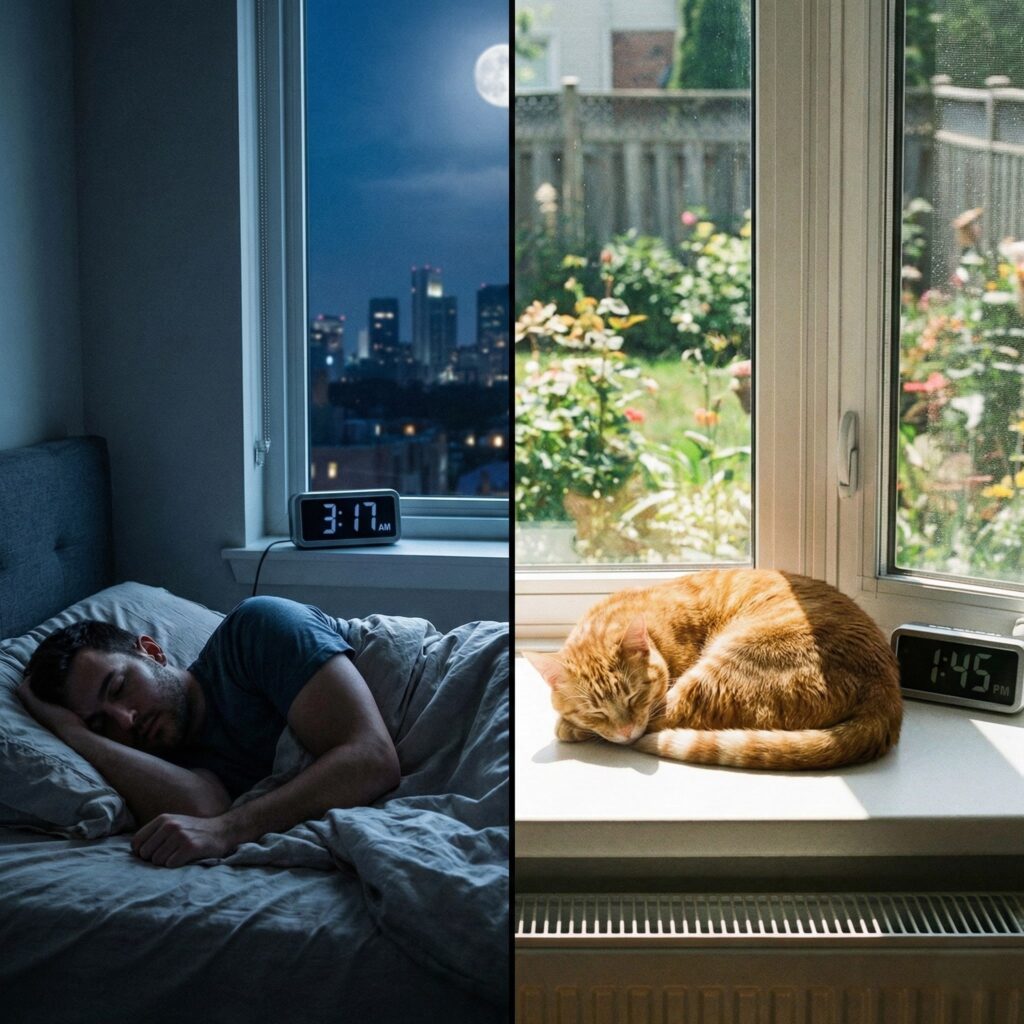
The primary difference between cat and human sleep lies in the structure and timing. Humans are diurnal and monophasic sleepers, typically resting for one consolidated 7 – 9 hour block at night. Cats are crepuscular and polyphasic, sleeping in multiple short bursts totaling 12 – 16 hours, with peak activity at dawn and dusk. While both species experience REM and deep sleep, cats cycle through these stages much faster (every ~25 minutes) compared to the human 90-minute cycle.
Sleep Comparison Table: Cats vs. Humans
| Feature | Humans | Domestic Cats |
| Total Sleep Time | 7–9 hours per day | 12–16 hours (up to 20 for kittens/seniors) |
| Sleep Pattern | Monophasic (one long block) | Polyphasic (multiple short bursts) |
| Activity Peak | Diurnal (Daytime) | Crepuscular (Dawn and Dusk) |
| Sleep Cycle Length | ~90 minutes | ~15–25 minutes |
| REM Sleep % | ~20–25% of total sleep | ~20–25% (but frequent rapid entry) |
| Deep Sleep | Consolidated deep stages | Frequent light sleep (“vigilant rest”) |
| Dreaming | Occurs mostly in REM | Likely occurs (paws twitching/vocalizing) |
Cats vs Human Sleep Comparison
If you have ever watched your cat snooze the afternoon away while you struggle to stay awake at your desk, you have likely wondered about the vast divide between feline and human rest.
Sleep is a universal biological need, but the way we approach it is dictated by millions of years of distinct evolutionary pressures.
While you arrange your life around a single long night of rest, your cat operates on a schedule designed for a stealthy, energy-conserving predator.
Understanding these differences not only answers the question of why your cat wakes you up at 4:00 AM but also offers a fascinating glimpse into the biology of two very different mammals.
Read Also: Can Cats Sleep Under Blankets?
Total Sleep Duration: The Energy Equation
The most obvious difference is the sheer volume of sleep. Humans typically require between seven and nine hours of restorative sleep to function optimally. This duration allows for memory consolidation, muscle repair, and toxin clearance from the brain.
Cats, however, are champions of rest, averaging between 12 and 16 hours a day. It is not uncommon for kittens or geriatric cats to sleep up to 20 hours.
This disparity is rooted in diet and physiology. As obligate carnivores, cats in the wild rely on short bursts of explosive energy to hunt.
This hunting style requires massive caloric expenditure followed by long periods of recovery to conserve energy for the next chase. Humans, historically hunter-gatherers with more endurance-based activities, did not require such extreme energy conservation measures.
Sleep Architecture: Monophasic vs. Polyphasic
Sleep architecture refers to the structure of sleep cycles. Humans are monophasic sleepers. We have evolved to consolidate our rest into one long, continuous period, usually timed with the absence of sunlight.
This consolidation is relatively rare in the animal kingdom and likely evolved because early humans were safer sleeping in groups for a long duration rather than waking frequently.
Cats exhibit a polyphasic sleep pattern. They do not sleep in one long block but rather in multiple short bouts throughout the day and night. This is why a cat seems to be napping constantly but is rarely “out cold” for eight hours straight.
Their sleep is fragmented, allowing them to wake frequently to check for threats or prey. This biological wiring is why your cat might nap from 10:00 AM to 1:00 PM, play for twenty minutes, and then go back to sleep.
Read Also: How to Stop Cat Sleeping on Bed?
Circadian Rhythms: Diurnal vs. Crepuscular
One of the biggest friction points between cat owners and their pets is the mismatch in circadian rhythms, the internal body clock that regulates the sleep-wake cycle.
Humans are diurnal. Our biological systems are primed to be alert when the sun is up and to rest when it is dark. Light exposure triggers the release of cortisol (the wake-up hormone) in the morning and suppresses melatonin (the sleep hormone).
Cats are crepuscular. Contrary to the popular belief that cats are nocturnal (active at night), they are actually hardwired to be most active at dawn and dusk.
In the wild, these twilight hours are when prey species like rodents and birds are most active. Your domestic house cat still retains this ancestral programming.
When you are in your deepest sleep phase just before your alarm goes off, your cat is hitting their peak energy levels, leading to the infamous “zoomies” or the paw-to-the-face wake-up call.
The Sleep Cycle: REM and Deep Sleep
Both humans and cats cycle through two main types of sleep: NREM (Non-Rapid Eye Movement) and REM (Rapid Eye Movement). However, the timing is drastically different.
The Human Cycle
A human sleep cycle lasts approximately 90 minutes. We drift from light sleep into deep, restorative slow-wave sleep, and finally into REM sleep (where most dreaming occurs). We repeat this cycle 4 – 6 times a night.
The Feline Cycle
A cat’s sleep cycle is much shorter and more compressed, lasting only about 15 to 25 minutes.
- Light Sleep (Vigilant Rest): This makes up the bulk of a cat’s downtime. Their muscles relax, but their senses remain sharp. Their ears will swivel toward sounds, and they can spring into action instantly. This is the “cat nap.”
- Deep Sleep: Cats do enter deep sleep, but for much shorter periods than humans, often only five minutes at a time.
- REM Sleep: Feline REM sleep is characterized by rapid eye movements, twitching whiskers, and “running” paws. While humans have muscle atonia (paralysis) during REM to prevent acting out dreams, cats also experience this, though the twitching suggests the motor inhibition isn’t as absolute as in humans or simply that the neural signals are very strong.
Read Also: Why Cats Groom So Much
Evolutionary Drivers: Predator and Prey
To understand why these patterns differ, you must look at the evolutionary niche each species occupies.
The Human Strategy
Humans have few natural defenses (no claws, fangs, or armor). Our safety historically relied on social structures and building secure shelters.
Sleeping in one long shift allowed maximum daylight hours for foraging, building, and socializing. The night was dangerous and offered little utility for a species with poor night vision, so staying asleep and quiet was an evolutionary advantage.
The Cat Strategy
Cats occupy a unique position as both predator and prey. They hunt small animals, but they are small enough to be hunted by coyotes, owls, or larger raptors. This duality shaped their sleep:
- Predatory Instinct: Requires peak energy at twilight (crepuscular).
- Prey Instinct: Requires light sleeping. A cat in deep sleep is vulnerable. The ability to doze lightly (vigilant rest) allows them to recover energy while remaining ready to flee if a larger predator approaches.
Do Cats Dream Like Humans?
Since the 1960s, researchers have confirmed that cats enter REM sleep, the stage associated with dreaming in humans. During this phase, the feline brain shows electrical activity remarkably similar to a waking state, just like a human brain.
When you see your cat paddling their paws or chattering in their sleep, they are almost certainly reacting to dream stimuli, stalking a mouse, fighting a rival, or exploring their territory.
While we cannot ask them what they dream about, the physical evidence suggests their dream world is as active and vivid as ours, likely replaying the physical activities of their day.
Read Also: Why Do Cats Meow More at Night?
Age-Related Changes in Sleep
Both species experience shifts in sleep patterns as they age, though the manifestations differ.
Infancy
- Humans: Babies are polyphasic, sleeping in multiple bursts day and night, gradually consolidating into a monophasic pattern as they mature.
- Cats: Kittens sleep almost constantly (up to 90% of the day) because their bodies release growth hormones exclusively during sleep.
Adulthood
- Humans: Ideally stable monophasic sleep, though stress and artificial light often disrupt this.
- Cats: Establish their routine of “zoomies” and naps, often adapting slightly to their owner’s schedule (social sleeping).
Senior Years
- Humans: Sleep becomes more fragmented. We spend less time in deep sleep and wake up more often.
- Cats: Total sleep time increases again. An elderly cat may return to sleeping 18 – 20 hours a day as their metabolism slows and cognitive function changes.
Health Indicators in Sleep Patterns
Monitoring sleep is crucial for the health of both species, but the red flags differ.
For Humans
Insomnia (inability to sleep) or hypersomnia (excessive sleep) are primary indicators of stress, depression, or physical illness. Disruptions in the circadian rhythm are linked to metabolic disorders and heart disease.
For Cats
Because cats sleep so much naturally, it can be harder to spot illness. However, subtle changes are key:
- Sleeping Less: A cat that is suddenly awake more often, pacing at night, or vocalizing may be suffering from hyperthyroidism or hypertension.
- Sleeping More: While hard to judge, if a cat sleeps through their usual mealtime or play times, it can indicate lethargy caused by infection, diabetes, or arthritis (pain makes moving difficult, so they stay in one spot).
- Sleeping in Strange Places: A cat that stops sleeping in high places (cat trees) and starts sleeping under the bed may be hiding due to pain or illness.
Co-Sleeping: Can We Adapt to Each Other?
Many cat owners try to bridge the gap by letting cats sleep in bed with them. Studies show mixed results. While the rhythmic sound of a cat purring can facilitate falling asleep for humans (purring vibrates at a frequency that promotes relaxation), the mismatch in cycles often leads to sleep fragmentation for the owner.
Cats are adaptable, however. Social sleeping is a phenomenon where domestic cats adjust their schedule to align more closely with their owners. While they will never be truly diurnal, a house cat often learns that “lights out” means the humans are boring and inactive, prompting them to settle down for a longer block of rest than they might in the wild.
Conclusion
The difference between cat and human sleep is a testament to the diversity of biological engineering. We sleep to maintain a high-functioning brain capable of complex tasks and social interaction during the day. Cats sleep to fuel a high-performance physical machine designed for explosive speed and stealth at twilight.
Recognizing that your cat is not “lazy” but rather efficiently charging a different type of battery can change how you view their daily routine. It helps us appreciate that while we share a home, we are living in two very different time zones, ours governed by the sun, theirs by the shadows.