
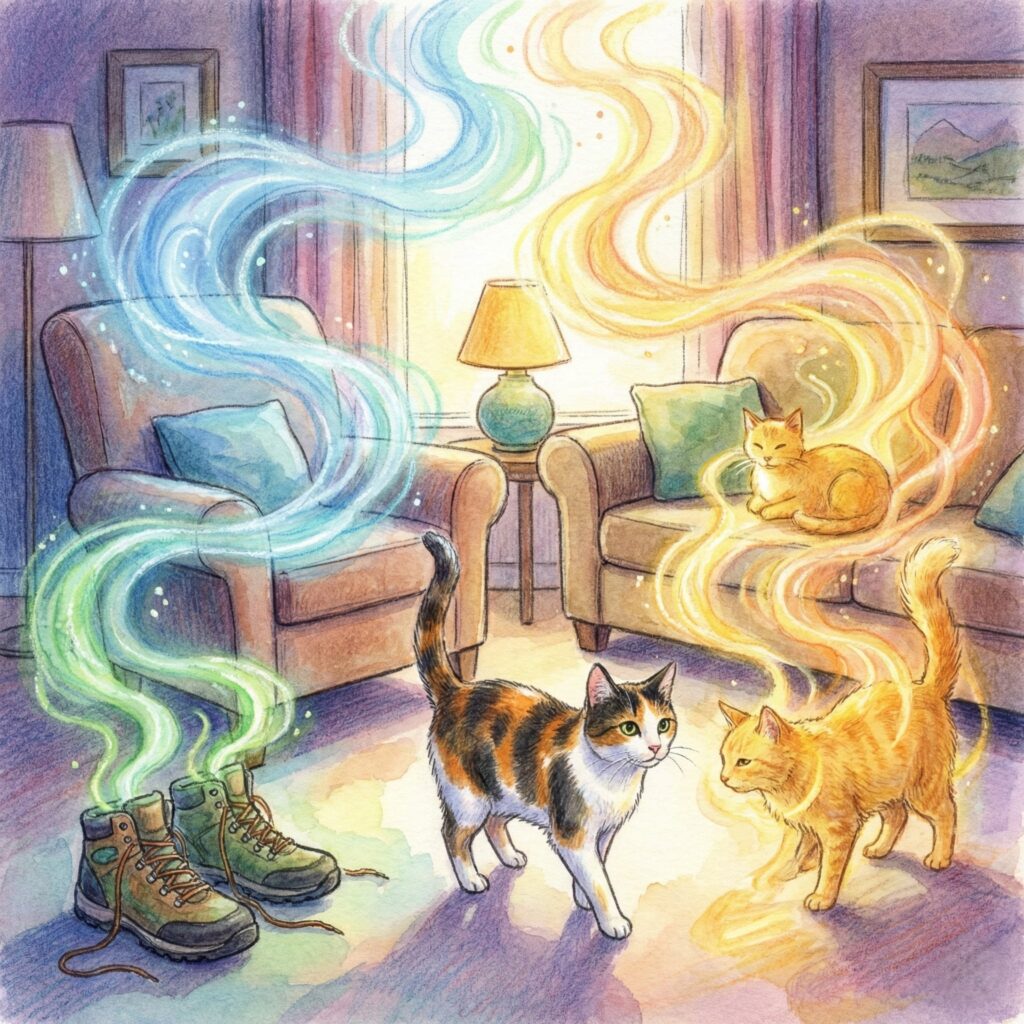
Cats communicate primarily through a complex chemical language involving pheromones and scent marking. By rubbing their faces on objects (bunting), scratching surfaces, or spraying urine, they leave behind unique olfactory messages. These scents convey vital information to other cats about territory, reproductive status, health, and social rank. This silent communication system allows cats to avoid physical conflict and maintain social bonds within their colony.
Summary Table: Key Facts About Feline Scent Communication
| Feature | Description | Primary Purpose |
| Pheromones | Chemical signals released by the body | Convey emotional state, status, and identity |
| Jacobson’s Organ | Specialized sensor in the roof of the mouth | Analyzes intense scents (Flehmen response) |
| Bunting | Rubbing head/cheeks on items | Marks territory as “safe” and friendly |
| Scratching | Clawing surfaces | Visual mark + scent deposit from paws |
| Spraying | Urinating on vertical surfaces | Territorial warning or stress signal |
| Group Scent | Mixing scents via grooming | Establishes a communal family bond |
How Cats Use Scent to Communicate
Humans live in a world of sight and sound. We recognize friends by their faces and communicate with words. Cats, however, live in a world of smell. While their vision and hearing are excellent, their sense of smell is their primary tool for understanding the environment.
For a cat, walking into a room is like reading a detailed newspaper. They can smell who has been there, how long ago, if that intruder was stressed, or if they were looking for a mate.
This chemical communication is essential for their survival. It helps them find food, avoid predators, and navigate complex social relationships without needing to fight.
Read Also: How Much Sleep Do Cats Really Need?
The Hardware: How Cats Smell
To understand how cats communicate, you must first understand their tools. A cat’s nose is far more powerful than a human’s. They have roughly 200 million scent receptors, whereas humans have only about 5 million. But the nose isn’t their only tool.
The Vomeronasal Organ (Jacobson’s Organ)
This is the cat’s secret weapon. Located on the roof of the mouth, just behind the front teeth, this organ acts as a secondary nose. It is specifically designed to detect pheromones, chemical messengers that carry specific meanings.
When a cat smells something interesting, you might see them grimace. They lift their upper lip and open their mouth slightly. This is called the Flehmen Response. It looks like a sneer, but they are actually trapping the scent and flicking it up towards the Jacobson’s organ for a high-definition analysis.
Where Scent Comes From: The Scent Glands
Cats are covered in scent-producing factories called sebaceous glands. These glands produce oils that carry the cat’s unique pheromones.
Major Scent Gland Locations:
- Temporal: On the side of the forehead.
- Perioral: Around the lips and corners of the mouth.
- Cheek: On the sides of the face.
- Submandibular: Under the chin.
- Interdigital: Between the toe pads.
- Anal Glands: On either side of the rectum.
- Caudal: Along the tail and at the base of the tail.
Each of these areas produces a slightly different scent profile used for different messages. Facial pheromones are generally friendly and comforting, while scents from the back end are often related to territory, fear, or reproduction.
Read Also: Indoor vs Outdoor Cats
Bunting: The Friendly Mark
Have you ever had a cat rub their cheek against your leg or head-butt your hand? This behavior is called bunting.
When a cat bunts, they are activating the glands on their face. They deposit “familiarity pheromones” onto the object or person. This is not just a sign of affection; it is a way of claiming you.
The cat is essentially labeling you as “safe.” By spreading their scent on you, the furniture, and the walls, they create a map of safety within their home. When they walk by that spot later, they smell their own mark and feel secure. This reduces their anxiety.
Why Cats Bunt:
- To reinforce social bonds.
- To self-soothe by making the environment smell like them.
- To greet other members of their social group.
Scratching: More Than Just a Manicure
Many cat owners believe cats scratch furniture just to sharpen their claws. While claw maintenance is part of it, scratching is also a major form of long-distance communication.
Cats have scent glands tucked between their paw pads (interdigital glands). When they scratch a scratching post or your sofa, they are doing two things:
- Visual Marking: The shredding marks are a visual signal to other cats that “someone lives here.”
- Scent Marking: The sweat and oils from their paws leave a strong chemical signature deep in the fibers of the material.
This is why cats often return to the exact same spot to scratch. They are refreshing the scent marker. It acts like a boundary sign or a community bulletin board.
Urine Spraying: The Serious Message
Urine marking, or spraying, is distinct from regular urination. When a cat needs to pee, they squat. When a cat sprays, they stand up, tread with their back feet, quiver their tail, and spray a small amount of urine backwards onto a vertical surface (like a wall or doorframe).
What Spraying Means:
- Territory: “I own this space.” This is common in unneutered male cats warning off rivals.
- Stress: “I am anxious.” If a cat feels threatened by a new pet, a baby, or a neighborhood cat outside the window, they spray to surround themselves with their own scent. It acts as a stress-relief barrier.
- Mating: Female cats in heat spray to advertise their availability to males. Male cats spray to answer them.
Neutering and spaying significantly reduce spraying behavior, but high stress can still trigger it in fixed cats.
Read Also: Why Regular Vet Visits Matter for Indoor Cats
The Group Scent: How Cats Define Family
In the wild, cats that live in colonies need a way to distinguish friends from strangers. They achieve this through the “group scent.”
When cats groom each other (allogrooming), they are not just cleaning. They are mixing their scents together. By rubbing heads and licking each other, they blend their individual pheromones into a communal odor.
This is why a cat might hiss at their sibling after the sibling returns from the vet. The vet-visiting cat smells like antiseptic, strangers, and fear. They have lost the “group scent.” The cat at home no longer recognizes them by smell. Once the returning cat grooms themselves and re-absorbs the home smells, the relationship usually returns to normal.
How Humans Fit Into the Scent World
Your cat relies on your scent for comfort. This explains several behaviors that humans often find odd or annoying.
Why does my cat sleep on my laundry?
Dirty laundry smells strongly of you. For a cat, sleeping in a pile of your gym clothes is like sleeping in a hug. It is a concentrated source of your pheromones, which makes them feel safe.
Why does my cat lick me?
Licking creates a scent exchange. They are tasting your scent and depositing their own saliva on your skin. It creates a bond similar to the group scent in a cat colony.
Why does my cat smell my shoes?
Shoes carry intense scents from the outside world. Your cat is investigating where you have been, what you walked on, and if you brought back any messages from other animals.
Disrupting the Scent Balance
Because scent is so important, changing the smell of a home can cause behavior problems.
Cleaning Products
Strong cleaners, specifically those with bleach or ammonia, can upset cats. Ammonia smells very similar to urine. If you clean a urine accident with an ammonia-based cleaner, the cat may think another cat has marked there and will spray over it again to cover the scent. Enzymatic cleaners are the only way to truly break down the chemical structure of cat urine.
Read Also: Signs of Anxiety in Cats and How to Manage It
New Furniture
New furniture brings foreign chemical smells (off-gassing). A cat may scratch or spray the new item to cover that strange smell with their own familiar scent. You can help by rubbing a soft cloth on your cat’s cheeks (gathering happy pheromones) and then rubbing that cloth on the new furniture.
Synthetic Pheromones
Science has learned to mimic cat communication. Products like Feliway use synthetic versions of feline facial pheromones.
When you plug in a diffuser, it releases a chemical signal that mimics the “happy/safe” bunting pheromones. To a human, it smells like nothing. To a cat, the air suddenly smells like “everything is okay.” These tools are very effective for treating anxiety, moving to a new house, or introducing new pets.
Frequently Asked Questions
Do cats have a better sense of smell than dogs?
Generally, dogs have a better sense of smell than cats, especially tracking breeds. However, cats are far superior to humans and have a highly specialized vomeronasal organ that dogs also possess but use differently. Cats are more tuned into specific territorial and social pheromones.
Why does my cat open their mouth when smelling something?
This is the Flehmen response. They are drawing air into the Jacobson’s organ to analyze complex scents, usually related to mating or identifying other animals.
Can I smell cat pheromones?
No. Pheromones are species-specific. Humans cannot consciously smell or detect feline pheromones. We can only smell the byproducts, like the ammonia in urine or the musk from anal glands.
How long does a scent mark last?
It varies. Facial rubbing marks may fade in a few hours or days. Urine spraying can last for weeks or even months if not cleaned, continuing to signal to the cat long after the initial event.
Conclusion
Cats are not just being quirky when they rub your leg or sniff your shoes. They are engaging in a sophisticated conversation. Their world is painted in scents that tell the story of their safety, their family, and their territory.
By understanding how cats use scent, you can solve behavioral issues and deepen your bond. You learn to respect their need for scratching (and provide the right posts), you understand why they panic at the vet, and you appreciate that when they head-butt you, they are paying you the ultimate compliment: you are part of their tribe.