
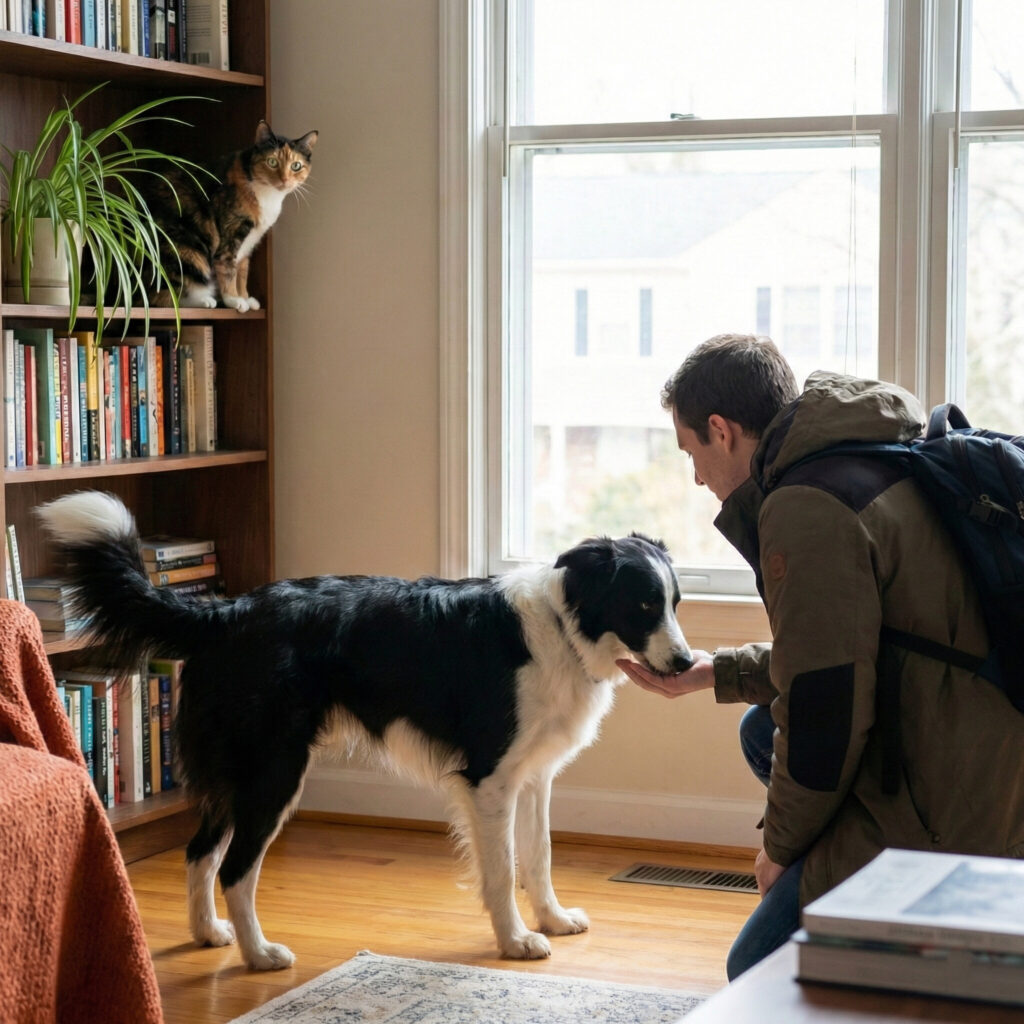
Cats and dogs react to strangers differently due to their evolutionary history and social instincts. Dogs, as pack animals, generally look to their owners for cues; they may react with excitement, curiosity, or protective barking depending on their breed and socialization. Cats, being solitary hunters, are typically more cautious and observant. They often prefer to assess a stranger from a distance before deciding to engage or hide. While dogs often seek immediate interaction, cats prioritize safety and control.
Summary Table
| Feature | Dogs | Cats |
| Primary Instinct | Social/Pack-oriented | Solitary/Territorial |
| Initial Reaction | Barking, tail wagging, sniffing | Hiding, observing from high ground |
| Body Language | Ears perked, loose body, wagging tail | Tense body, flattened ears, dilated pupils |
| Greeting Style | Direct approach, jumping, licking | Slow approach, cheek rubbing, scent checking |
| Territoriality | Protects the “pack” and home | Protects personal space and resources |
| Best Approach | Let them sniff your hand; stay calm | Ignore them; let them come to you |
How Cats and Dogs React to Strangers
Understanding the differences between how our two most popular pets greet new people is essential for pet owners and guests alike. While every animal has a unique personality, their species, Canis lupus familiaris (dog) and Felis catus (cat), dictates general behavioral patterns rooted in thousands of years of evolution.
This guide explores the “why” and “how” of these reactions.
Read Also: Dogs vs. Cats: Which Gets Bored Faster
The Evolutionary Background
To understand why your Golden Retriever jumps on guests while your Siamese hides under the bed, you have to look at their history.
Dogs
Dogs are naturally inclined to view strangers in two ways: potential new pack members (friends) or threats to the existing pack (foes). They look to their alpha (you) for guidance on how to react.
Cats
Cats are naturally risk-averse. A stranger represents an unknown variable that could be dangerous. Their instinct is not to make friends immediately, but to survive and assess the threat level.
How Dogs React to Strangers
Dogs wear their hearts on their sleeves. Their reaction to strangers is usually immediate and obvious.
1. The Excited Greeter
Many dogs, especially breeds like Labradors and Spaniels, view strangers as friends they haven’t met yet.
- Body Language: Wiggle-butt (whole body wagging), relaxed ears, open mouth (smiling), and jumping up.
- Vocalization: Whining or excited yipping.
- Behavior: They may bring a toy to the guest or try to lick their face. This is an appeasement gesture and a way to gather social information.
2. The Watchful Protector
Breeds like German Shepherds or Rottweilers are bred to guard. They may not be aggressive, but they will be alert.
- Body Language: Stiff posture, high tail, ears forward, intense staring.
- Vocalization: Deep, alert barking (a “who goes there?” bark).
- Behavior: They might stand between their owner and the stranger (blocking).
3. The Anxious or Fearful Dog
Poorly socialized dogs or those with past trauma may fear strangers.
- Body Language: Tucked tail, cowering, ears pinned back, lip licking (a sign of stress).
- Behavior: Hiding behind the owner or “fear biting” if cornered.
Read Also: Why Dogs Crave Attention While Cats Prefer Space
How Cats React to Strangers
Cat reactions are subtle and often misunderstood as “aloofness.” In reality, they are calculating safety.
1. The “Ghost” Cat
This is the most common reaction for many indoor cats. When the doorbell rings, the cat vanishes.
- Location: Under beds, atop high cabinets, or in closets.
- Reasoning: If they can’t see the threat, and the threat can’t see them, they are safe. They will often emerge only after the stranger has settled down or left.
2. The High-Ground Observer
Cats feel confident when they are high up.
- Behavior: Watching from a cat tree, shelf, or the back of a sofa.
- Significance: This position gives them a vantage point to survey the room and an easy escape route if needed. It is a sign of a confident but cautious cat.
3. The Social Butterfly
Some breeds, like Ragdolls or Maine Coons, are more dog-like.
- Behavior: They may walk right up to a stranger, tail held high with a little hook at the end (a sign of friendliness).
- Scent Marking: Rubbing their cheek or side against the stranger’s leg. This deposits pheromones, effectively claiming the stranger as “part of the territory.”
The Role of Scent in Greetings
Both species rely heavily on their nose, but they use it differently.
Dogs: The Direct Sniff
Dogs have a vomeronasal organ (Jacobson’s organ) that processes pheromones. When a dog sniffs a stranger’s crotch or shoes, they are reading a biochemical resume. They can tell:
- Where the person has been.
- If they have other pets.
- Their gender and approximate mood (stress hormones have a scent).
Cats: The Distance Sniff
Cats also have a Jacobson’s organ, often using the “flehmen response” (open mouth grimace) to analyze scents. However, they prefer to smell you from a few feet away first. If they approach, they usually sniff an extended finger or an object the stranger is holding before making contact.
Factors That Influence Reactions
Why does your dog hate men with hats? Why does your cat love your loud aunt? Several variables are at play.
1. Socialization Window
- Puppies: The critical socialization period is 3 to 14 weeks. Puppies exposed to diverse people (tall, short, wearing hats, carrying umbrellas) during this time are usually calmer adults.
- Kittens: The window is shorter, usually 2 to 7 weeks. Kittens handled by different people during this time are much more likely to be friendly adult cats.
2. Breed Genetics
- Guard Breeds (e.g., Doberman): Genetically predisposed to suspicion.
- Companion Breeds (e.g., Pug): Genetically predisposed to affection.
- “Stranger Danger” Cats: Domestic Shorthairs (mixed breeds) have varied genetics, while specific breeds like the Burmese are known for being people-oriented.
3. The “Uncanny Valley” for Pets
Pets rely on reading human faces and silhouettes. Accessories can confuse them.
- Hats and Sunglasses: obscure the eyes and change the head shape. This often triggers fear in dogs.
- Walking Sticks/Umbrellas: Can look like weapons or extensions of the arm, causing anxiety.
- Deep Voices: Dogs may find deep male voices more threatening (similar to a growl), while cats often prefer higher-pitched, softer voices.
Read Also: How Cats and Dogs Show Affection Differently
How to Introduce Strangers to Your Pets
If you are having guests over, you can manage the interaction to ensure safety and comfort.
For Dogs: The “No Touch, No Talk, No Eye Contact” Rule
This famous dog training mantra works well.
- Ignore the Dog: Tell guests not to look at or speak to the dog initially. This lowers the excitement level.
- Let the Dog Approach: Allow the dog to sniff the guest.
- Low Hands: Ask guests to keep their hands low. Reaching over a dog’s head can be seen as a dominance gesture or threat.
- Treats: Have the guest toss a treat on the floor away from them. This rewards the dog but doesn’t force interaction.
For Cats: The “Invisible Guest” Technique
- Ignore the Cat: This is crucial. Eye contact is aggressive to cats. If a guest stares at a cat to say “Here kitty,” the cat feels threatened.
- The Slow Blink: If the cat looks at the guest, the guest should slowly close and open their eyes. This signals, “I am not hunting you.”
- Let Them Be: Do not drag a cat out from under the bed. Let them come out on their own timeline.
- The Finger Tip: If a cat approaches, extend one finger. If the cat rubs against it, you are allowed to pet them. If they just sniff and walk away, do not pursue.
Common Mistakes Humans Make
We often project primate behavior onto our pets, which causes miscommunication.
- Hugging: Primates hug to show affection. Dogs often view hugging (arms around the neck) as dominance or entrapment. This is a common cause of bites in children.
- Smiling: Showing teeth is a threat in the animal kingdom. While domesticated dogs understand human smiles, a nervous dog might misinterpret a wide, toothy grin as aggression.
- Looming: Standing directly over a small dog or cat is intimidating. Squatting down to their level makes you appear smaller and safer.
When Reactions Become Problems
Sometimes, a pet’s reaction goes beyond normal excitement or caution.
Reactive Dogs
If a dog lunges, barks incessantly, or snaps at strangers, this is “reactivity.” It is usually fear-based, not dominance-based. This requires professional training (counter-conditioning) to change the dog’s emotional response to strangers.
Aggressive Cats
“Redirected aggression” can occur when a cat sees a stranger (or a stray cat outside) and gets so agitated that they attack the nearest person or pet. If a cat hisses, growls, or swats at guests, they should be confined to a quiet room before guests arrive.
Conclusion
Cats and dogs perceive the world through different lenses. Dogs are checking credentials to see if you can join the party; cats are running a background check to ensure you aren’t an assassin. By respecting these biological differences and following proper introduction protocols, we can help our pets feel safe and ensure our guests keep all their fingers.