
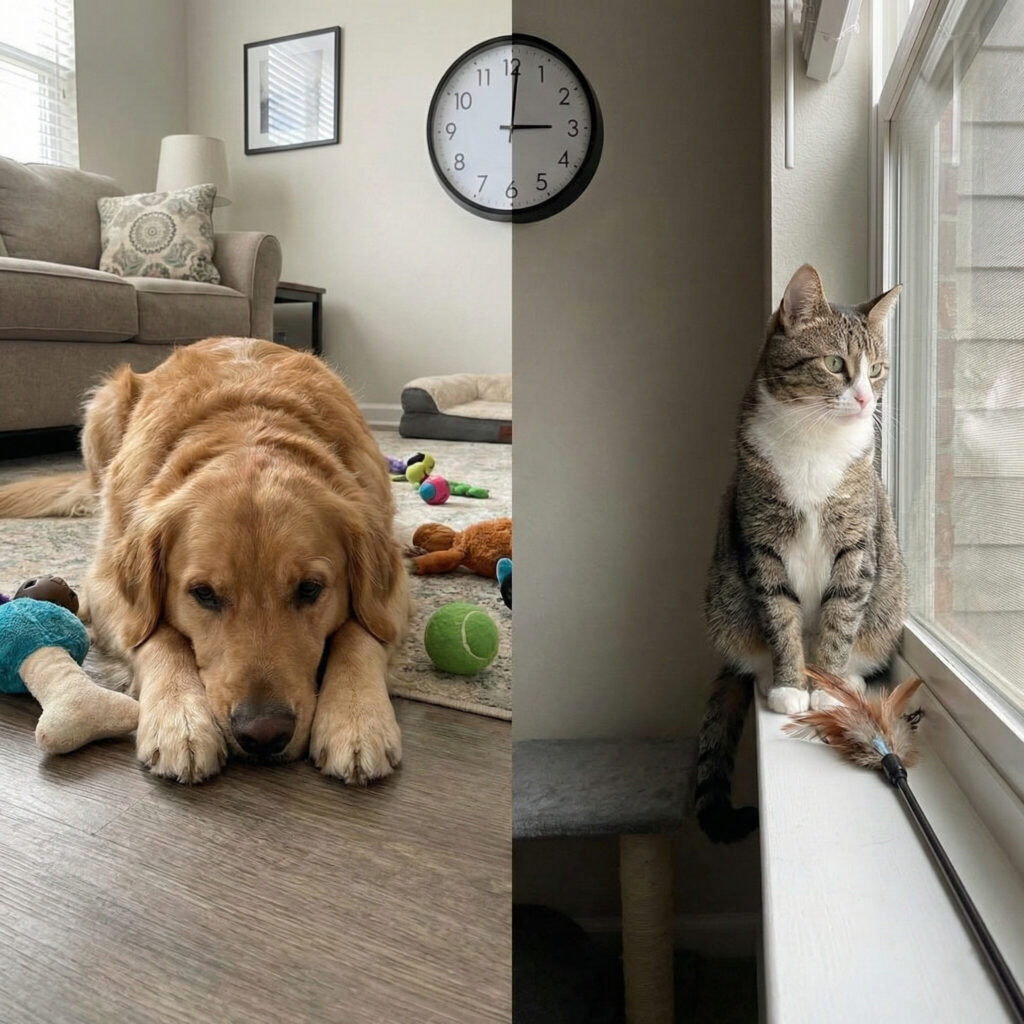
Generally, dogs get bored faster than cats. Because dogs are social pack animals evolved to work alongside humans, they require constant interaction, mental engagement, and physical exercise. When left alone or without a “job,” they become restless quickly. Cats are solitary ambush predators who naturally spend up to 16 hours a day sleeping to conserve energy for hunting bursts. While cats do get bored, especially indoor-only cats, their threshold for boredom is higher, and they are better equipped to entertain themselves or nap through idle time.
Summary Table
| Feature | Dogs | Cats |
| Boredom Speed | High (Get bored quickly) | Moderate (Content to nap longer) |
| Primary Cause | Lack of social interaction or physical work | Lack of hunting stimulation (prey drive) |
| Main Sign | Over-grooming, scratching furniture, and bullying | Puzzle toys, exercise, and training |
| Activity Need | High (Walks, fetch, training) | Moderate (Short bursts of play) |
| Independence | Low (Need pack/owner) | High (Independent nature) |
| Best Solution | Puzzle toys, exercise, training | Vertical climbing space, interactive wands |
Dogs vs. Cats: Which Gets Bored Faster?
Pet owners often wonder what their animals do when they leave the house. Do they sit by the window pining for a return, or do they sleep the day away?
The concept of boredom in pets is real and plays a massive role in their behavioral health. Understanding who gets bored faster, dogs or cats, can help you choose the right pet for your lifestyle and save your furniture from destruction.
While every animal is an individual, biology and evolutionary history give us a clear winner in the race to boredom.
This guide breaks down why dogs generally struggle more with idle time, why cats aren’t immune to it, and how to keep both happy.
Read Also: Why Dogs Crave Attention While Cats Prefer Space
The Science of Boredom
To understand boredom, you have to understand how these animals evolved. Boredom isn’t just a feeling; it is a biological signal that the animal isn’t doing what nature intended it to do.
Why Dogs Need Constant Input
In the wild, wolves (the ancestors of dogs) spend their entire lives surrounded by family. They hunt together, sleep together, and play together. Solitude is unnatural for a canine.
When you take an animal designed for high-intensity work and social connection and put them in a quiet living room for eight hours, their brain panics. They have energy and intelligence with nowhere to direct it. This manifests as boredom very quickly, often within a few hours of inactivity.
Why Cats Handle Silence Better
Biologically, cats are wired to conserve energy. They sleep 12 to 16 hours a day, not because they are lazy, but because they are recharging for a burst of hunting activity. This “nap and wait” evolutionary strategy makes them much more tolerant of downtime. They don’t need a pack to feel safe, and they don’t need constant direction to feel content.
Signs of a Bored Dog
Because dogs are expressive and often larger, their boredom is usually loud and destructive. A bored dog is a stressed dog. If your dog is under-stimulated, they will create their own fun, and you probably won’t like it.
1. Destructive Chewing
This is the number one sign. If you come home to chewed shoes, baseboards, or sofa cushions, your dog isn’t being “bad” or vindictive. Chewing releases endorphins in a dog’s brain. It is a self-soothing activity. When they are bored, they chew to relieve the anxiety of doing nothing.
2. Excessive Barking or Whining
Dogs use vocalization to communicate. If they are bored, they may bark at a falling leaf, a passerby, or literally nothing just to hear their own voice and release tension.
3. Pacing and Restlessness
If your dog cannot settle down, walks in circles, or follows you from room to room, constantly panting, they are bored. This is common in high-energy breeds like Shepherds and Pointers.
4. Digging
If they can’t dig outside, they might try to “dig” on your carpet or bed sheets. This is an attempt to expend physical energy.
Read Also: Dog vs Cat Sleeping Habits Compared
Signs of a Bored Cat
Cats are subtle. While a dog destroys your house, a bored cat might destroy their own health or mental state. Because they are quieter, cat boredom often goes unnoticed by owners until it becomes a serious medical or behavioral issue.
1. Over-Grooming
This is the feline equivalent of biting your nails. A bored cat may lick their fur until they create bald spots or skin infections (psychogenic alopecia). It is a repetitive behavior used to soothe stress.
2. Aggression or “Bullying”
If you have multiple pets, a bored cat often becomes the bully. They may swat at the dog, ambush the other cat, or attack your ankles as you walk by. They are trying to create a “hunt” because they haven’t had any stimulation.
3. Excessive Sleeping or Lethargy
While cats sleep a lot, a bored cat sleeps too much. If your cat has zero interest in toys, food, or looking out the window, they may be depressed due to a lack of enrichment.
4. Litter Box Issues
Sometimes, urinating outside the box is a behavioral protest. It marks territory and adds a new scent to the environment, which is the cat’s way of trying to change their boring surroundings.
The Intelligence Factor: Does Smart Mean Bored?
There is a direct link between intelligence and boredom. In both dogs and cats, the smarter the animal, the faster they get bored.
The “Working Dog” Curse
Breeds that are ranked as the “smartest,” such as Border Collies, Poodles, and German Shepherds, have the lowest tolerance for boredom. Their brains are like supercomputers.
If you don’t give them software to run (training, tricks, jobs), they glitch. A Bulldog might be happy sleeping on the rug for 6 hours, but a Border Collie will start deconstructing your drywall after 45 minutes.
The Curiosity of Bengals and Siamese
The same rule applies to cats. High-intelligence breeds like Bengals, Siamese, and Savannah cats are notorious for getting bored. These cats can learn to open doors, flush toilets, and turn on faucets. If you leave a Bengal alone with no toys, it will likely dismantle your house. Standard domestic shorthairs are generally more chill, but smart cats need “dog-level” entertainment.
Read Also: Why Dogs Seek Approval but Cats Don’t
Environmental Differences: Indoor vs. Outdoor
The environment plays a massive role in how fast boredom sets in.
The Indoor Cat Dilemma
Most dogs go outside several times a day. They get to smell new smells, see new people, and feel the grass. Even a 15-minute walk is an explosion of sensory data.
Many cats, however, live 100% indoors. If a cat spends their entire life in a 900-square-foot apartment with the same furniture and the same smells, boredom is inevitable. This is why “environmental enrichment” is critical for cats. Without windows to look out of or vertical spaces to climb, an indoor cat is living in a sensory deprivation tank.
The Backyard Trap for Dogs
A common myth is that if a dog has a big backyard, they won’t get bored. This is false. A backyard is just a big, empty room if there is no one there to play with. A dog left alone in a yard for 8 hours is just as bored as a dog in a crate. They just have more room to pace. They need interaction, not just square footage.
How to Cure Boredom: Actionable Tips
You cannot quit your job to entertain your pet, but you can change how you feed them and what you leave behind. The goal is to make them “work” for their rewards.
Enrichment for Dogs
- Ditch the Bowl: Never feed a bored dog from a standard bowl. Use puzzle feeders, snuffle mats, or treat-dispensing balls. Make them use their nose and paws to get their breakfast. This burns mental energy.
- Rotate Toys: If a dog has access to 20 toys, they are boring. Keep 15 in a closet and only leave 5 out. Rotate them every week so they seem “new.”
- Scent Work: Hide treats around the living room before you leave. Dogs navigate the world through smell. Hunting for kibble is a great game.
- Doggy Daycare: Even one day a week at a daycare can exhaust a high-energy dog enough to keep them calm for the following day.
Enrichment for Cats
- Vertical Space: Cats need to climb. Install shelves, cat trees, or window perches. Being high up gives them a vantage point to survey their “territory,” which is mentally engaging.
- Bird Feeders: Place a bird feeder outside a window that your cat can access. This is “Cat TV.” Watching birds triggers their prey drive and keeps them focused for hours.
- Food Puzzles: Yes, these exist for cats, too. Mice-shaped feeders that they have to bat around to release kibble simulate the hunting experience.
- Paper Bags and Boxes: You don’t need expensive toys. A cardboard box with a hole cut in it is a fascinating cave for a predator.
Summary: Who Wins the Boredom War?
If we are measuring who reaches the state of boredom faster, the dog wins (or loses, depending on how you look at it).
Dogs are emotionally dependent on you. They are your shadow. When the sun goes away (you leave), their world becomes dull. Their biological drive to work and cooperate makes a sedentary, lonely lifestyle very difficult for them to manage without acting out.
Cats are the masters of patience. While they absolutely can get bored and suffer from it, their natural rhythm of “hunt, eat, sleep, repeat” makes them more suited to long periods of inactivity. As long as their environment has some height and some scratching surfaces, they can manage an 8-hour workday much better than their canine counterparts.
If you work long hours and have a low-energy lifestyle, a cat (or a Greyhound, the couch potato of the dog world) is likely the better choice. If you want a partner who demands activity and forces you to get off the couch to cure their boredom, get a dog.