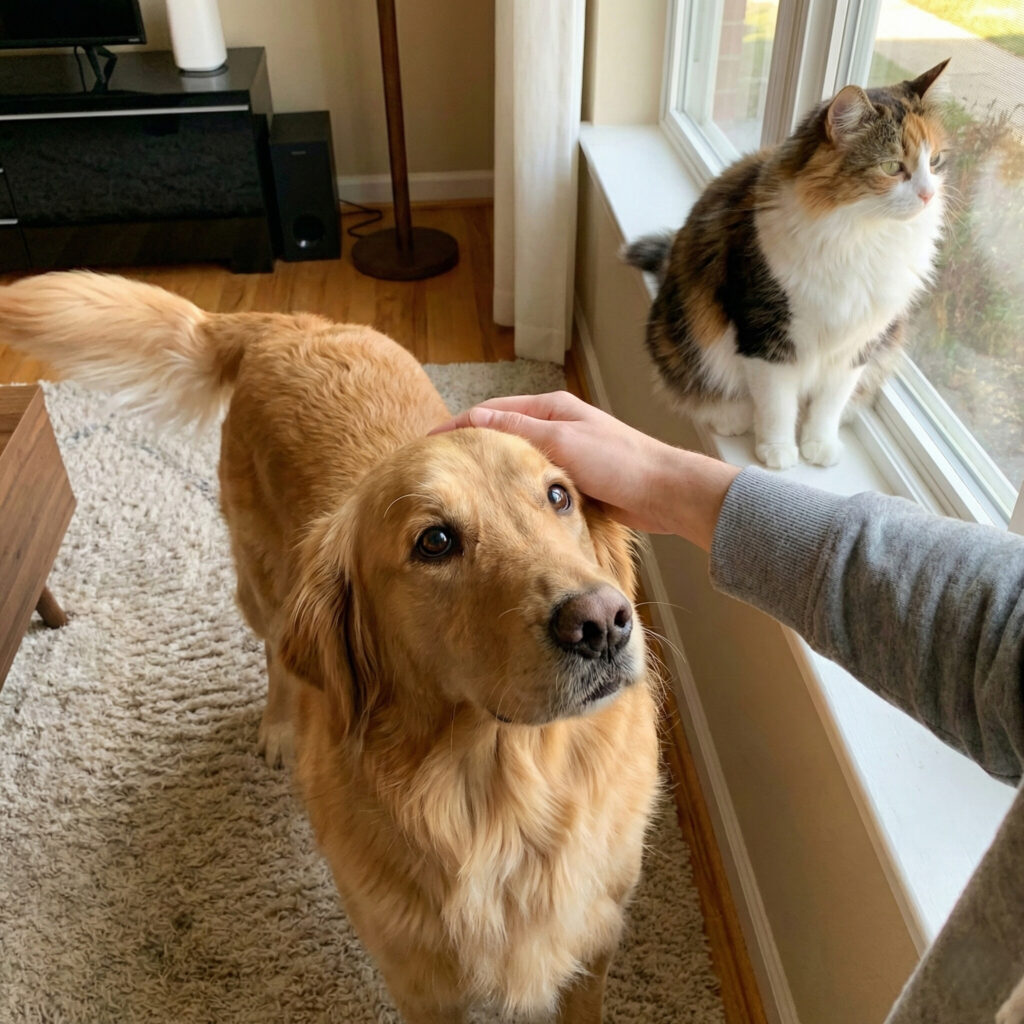
Dogs seek approval because they evolved from wolves, which are pack animals that rely on social hierarchy and cooperation to survive. They view humans as part of their pack and look to them for direction and validation. Cats, however, evolved from solitary hunters who needed to rely entirely on themselves for survival. They bond with humans out of affection rather than biological necessity, meaning they do not require external validation to feel secure or successful.
Summary Table
| Feature | Dogs (Canis lupus familiaris) | Cats (Felis catus) |
| Ancestry | Gray Wolf (Pack Hunters) | African Wildcat (Solitary Hunters) |
| Social Structure | Hierarchical; relies on leaders | Territorial; independent territory |
| Domestication | Active; bred for specific jobs/tasks | Passive; self-domesticated for pest control |
| Motivation | External (praise, treats, pleasing the leader) | Internal (instinct, immediate self-reward) |
| Communication | Complex facial/body cues for group harmony | Scent/subtle cues for territory boundaries |
| Attachment Style | “Secure Base” (relys on owner for safety) | Autonomous (affectionate but self-sufficient) |
Why Dogs Seek Approval but Cats Don’t
Every pet owner knows the scenario. You come home after a long day. Your dog meets you at the door, tail wagging furiously, body wiggling, eyes locked on yours, desperate for a “Good boy!” or a pat on the head. You could have been gone for five minutes or five hours; the reaction is the same. They need to know you are happy with them.
Then there is the cat. They might glance up from the sofa. If you are lucky, you get a slow blink or a gentle rub against your leg before they walk away to check their food bowl. They are happy you are home, but they don’t seem to care if you approve of what they were doing while you were gone.
This difference isn’t just a personality quirk. It is hardwired into their DNA. It stems from millions of years of evolution, different survival strategies, and the unique history of how each species came to live alongside humans.
Understanding these differences helps us appreciate our pets for who they really are.
The Evolutionary Split: Pack vs. Solitary
To understand why your dog craves your praise and your cat ignores it, we have to look at their ancestors.
The Dog: Born to Cooperate
Dogs descended from the Gray Wolf (Canis lupus). Wolves are obligate pack animals. This means they cannot survive well on their own. In the wild, taking down large prey like an elk or bison requires teamwork.
- Cooperation is vital: If a wolf doesn’t follow the pack’s cues, the hunt fails, and everyone starves.
- Hierarchy matters: Knowing who is in charge and following their lead prevents fighting and energy waste.
- Social glue: Wolves use grooming, play, and submissive behaviors to keep the family unit strong.
When we domesticated dogs, we stepped into the role of the “pack leader.” Dogs naturally look to us for instructions on how to behave because their biology tells them that following the leader ensures survival.
The Cat: Born to Hunt Alone
Cats descended from the African Wildcat (Felis lybica). These ancestors were solitary hunters in the desert. They hunted small prey like mice, birds, and lizards.
- Solo survival: A cat does not need a team to catch a mouse. In fact, another cat would just be competition.
- Self-reliance: If a wildcat gets into trouble, there is no pack to back them up. They must make their own decisions instantly.
- Territory focus: Their security comes from controlling a physical space, not from social relationships.
Because of this, modern cats do not have a biological “slot” in their brain for a leader. They don’t look to you for approval because, in their evolutionary history, another being’s opinion never helped them catch dinner.
Read Also: Why Cats Ignore Commands but Dogs Follow Them
The Science of Social Intelligence
When we talk about approval, we are talking about social cognition. How do these animals understand human signals?
The “Gaze” Difference
If you put a treat inside a puzzle box that is impossible to open:
- The Dog: Will try for a few seconds, then stop and look at their human. They are asking for help. They view the human as a problem-solver.
- The Cat: Will keep trying to open the box until they either succeed or get bored. They rarely look to the human for assistance.
This doesn’t mean dogs are “dumber.” It means their intelligence is socially dependent. They know that you have the thumbs and the knowledge. The cat’s intelligence is autonomous. They assume they are the only ones who can solve the problem.
Reading Human Cues
Dogs are masters of reading human body language. They can read our pointing gestures better than chimpanzees (our closest relatives). If you point at a bowl of food, a dog will look at the bowl. A cat will often look at your finger.
This ability to read cues is tied to the need for approval. A dog is constantly scanning your face to see if they are “good.” A cat is scanning the environment to see if it is safe.
Neurochemistry and Emotions
Is it just instinct, or do they feel differently?
The Brain Reward System
In dogs, the reward center of the brain lights up more when they hear their owner’s voice than when they receive food. This suggests that for many dogs, social praise is a primary reward.
For cats, while they enjoy affection, their motivation is often internal. They do things because it feels good to them (scratching a post, chasing a toy), not because it makes you happy. This is why “negative punishment” (yelling or spraying water) rarely works on cats. They don’t associate your anger with their action; they just think you have become a scary person.
Secure Base vs. Independent Explorer
Psychologists use the “Strange Situation Test” to measure attachment. This test involves placing a toddler (or pet) in a new room with their caregiver, then having the caregiver leave.
- Dogs: Like human children, dogs use their owner as a “secure base.” They explore more when you are there and get distressed when you leave. Your presence gives them confidence.
- Cats: Most cats (though not all) do not change their behavior much based on whether the owner is present. They are just as cautious or confident whether you are there or not. They are securely attached, but they don’t need you to hold their paw.
Read Also: Cats vs Dogs: Who Is More Independent?
Training Implications: Why “Good Boy” Doesn’t Work on Fluffy
Understanding the “approval gap” is critical for training. You cannot train a cat the same way you train a dog.
Training Dogs:
- Use Praise: Verbal praise and physical touch are highly effective.
- Eye Contact: Engage with them. They want to work with you.
- Correction: A simple “No” or withholding attention is usually enough because the dog dislikes the loss of approval.
Training Cats:
- Use High-Value Rewards: Praise means little. You need tuna, chicken, or a really fun toy.
- Bribery, Not Command: You are not giving an order; you are making a trade. “If you sit, you get the fish.”
- Ignore Bad Behavior: Since cats don’t seek approval, they also don’t care about disapproval. Yelling gives them attention. It is better to make the bad behavior impossible (e.g., covering the scratchable sofa with tape).
The Misconception of “Love”
A common mistake is assuming that because cats don’t seek approval, they don’t love us. This is false. It is simply a different language of love.
A dog says “I love you” by asking: “What can I do for you today?”
A cat says “I love you” by saying: “I trust you enough to sleep with my back to you.”
In the wild, a solitary hunter is extremely vulnerable when asleep or relaxed. If a cat sits on your lap or sleeps on your chest, they are displaying the ultimate trust. They are lowering their defenses in your presence. That is their version of approval, not asking for yours, but granting you theirs.
When Roles Reverse
While biology is strong, individual personality plays a huge role. We are seeing changes in modern pets.
The “Dog-Like” Cat
Some breeds, like Maine Coons, Siamese, and Ragdolls, are known to be more social. Cats that are hand-reared by humans from kittenhood often display more approval-seeking behaviors.
They may chirp for attention or follow owners from room to room. As we continue to breed cats more for companionship than mouse-hunting, their social intelligence is slowly shifting closer to that of dogs.
The “Cat-Like” Dog
Breeds like the Shiba Inu, Chow Chow, or Afghan Hound are ancient breeds that are genetically closer to the wolf but developed for independent work (like hunting alone or guarding).
These dogs are often described as “cat-like.” They are aloof, independent, and less desperate for human validation than a Golden Retriever.
Conclusion
We shouldn’t judge a fish by its ability to climb a tree, and we shouldn’t judge a cat by its ability to act like a dog.
When your dog looks at you with those big, pleading eyes, give them the validation they crave. They are fulfilling their ancient contract to work with you. When your cat walks past you with their tail in the air, ignoring your calls, admire their independence. They are a wild spirit that has chosen to share their territory with you.
By understanding why dogs seek approval and cats don’t, we stop being frustrated by our cats’ aloofness or overwhelmed by our dogs’ neediness. We can simply enjoy the unique companionship that each species brings to our lives.