
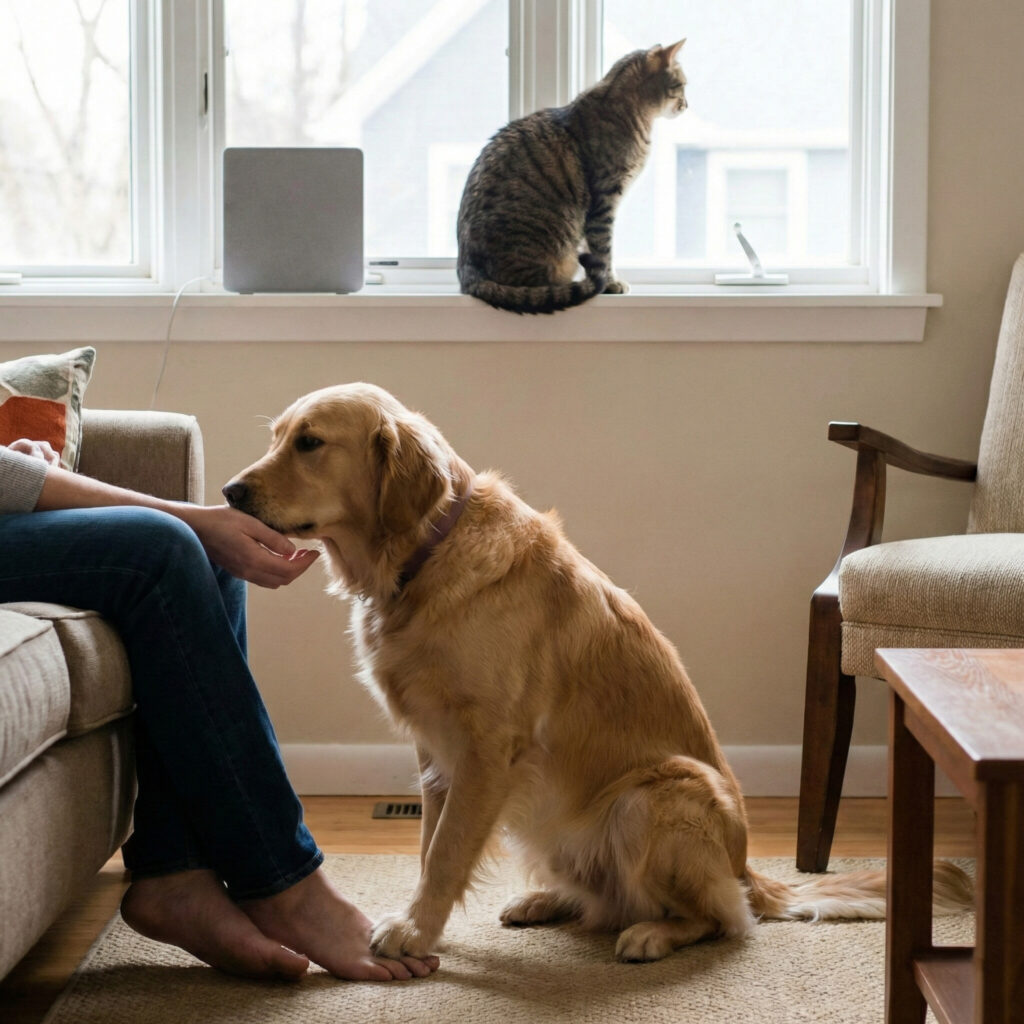
W bred dogs to look to humans for guidance and companionship. Conversely, cats evolved from solitary wild hunters. Their survival depended on self-reliance, stealth, and owning territory, not on group dynamics. Therefore, a dog sees you as a vital pack member, while a cat sees you as a useful, but not essential, part of their independent environment.
Summary Table
| Feature | Dogs (Canine) | Cats (Feline) |
| Ancestry | Wolves (Social predators) | African Wildcats (Solitary hunters) |
| Survival Strategy | Cooperative pack hunting | Lone ambush hunting |
| Social Structure | Solitary, territorial and self-reliant | Solitary, territorial, and self-reliant |
| Domestication Goal | Bred to work with humans (herding, hunting) | Mostly “self-domesticated” to control pests |
| View of Humans | Pack leader, provider, social partner | A resource provider within their territory |
| Expression of Needs | Vocalizing, staring, physical touch, following | Hiding, observing from afar, subtle cues |
| Primary Need | Social connection and direction | Security and control over territory |
Why Dogs Crave Attention While Cats Prefer Space
It is one of the oldest debates in pet ownership. Dog owners often boast about their loyal companion who greets them at the door with a wagging tail, desperate for a pat. Cat owners often defend their pet’s independence, explaining that the cat will come around when it feels like it.
These stereotypes exist for a reason. While every animal is an individual, there are fundamental differences in how dogs and cats interact with their human families. It is easy to misinterpret these behaviors through human eyes. We might see a dog as “loving” and a cat as “jerk.”
However, these behaviors are not about loving you more or less. They are deeply rooted in evolutionary history and the process of domestication.
Understanding why your dog follows you into the bathroom and why your cat ignores you when you call their name is key to having a better relationship with them. It helps us respect their true natures rather than forcing human expectations onto them.
Read Also: Dog vs Cat Sleeping Habits Compared
Decoding Canine Clinginess
When we look at a dog’s behavior through the lens of a social pack animal, their “needy” actions make sense.
- Following you everywhere: This is maintaining pack cohesion. In the wild, if you get separated from the pack, you die. Your dog follows you to the kitchen, the bathroom, and the bedroom because their instinct says staying together is safe.
- Constant staring: Dogs have evolved to read human faces better than almost any other animal. They watch you to anticipate your next move. Are we going for a walk? Are you mad? Are you going to drop food? They need this information to feel secure.
- Physical touch: leaning against you, nudging your hand, or curling up at your feet are ways of reinforcing social bonds. It is reassuring for them to physically feel their pack members.
The Downside: Separation Anxiety
Because dogs are so hardwired for company, modern life can be very hard on them. Leaving a highly social animal alone in an apartment for eight or ten hours a day goes against their biology. This is why separation anxiety is common in dogs, resulting in destructive behavior like chewing or barking. They are panicking because their pack has abandoned them.
Understanding Feline Aloofness
When a cat ignores you, it isn’t being arrogant. It is being a cat. Their behaviors are focused on their environment rather than the people in it.
- The importance of territory: For a solitary hunter, territory is everything. A cat needs to feel completely secure in its physical space before it can relax enough to socialize. If things in the house change, new furniture, new smells, visitors, the cat’s priority is re-establishing security, not cuddling with you.
- Affection on their terms: Because they are self-reliant, cats choose when to interact. If you force attention on a cat, you become a threat to their autonomy. They prefer to initiate contact when they feel safe and in control.
- Hiding and high places: When a cat is stressed, their instinct isn’t to run to you for comfort (like a dog); it is to hide or get up high. High vantage points allow this solitary predator to survey their territory for threats without being vulnerable.
How Cats Show Love
Cats do form strong bonds with humans, but they show it differently. They show affection in ways that respect personal space.
- The Slow Blink: This is a massive sign of trust. A predator never closes its eyes in the presence of a threat. If a cat looks at you and slowly closes its eyes, it is saying, “I trust you enough to lower my defenses.”
- Hanging out nearby: A cat may not sit on your lap, but they might sleep on the other end of the couch. For a solitary animal, choosing to sleep near another creature is a significant compliment. They are sharing their space with you.
Read Also: How Cats and Dogs Show Affection Differently
Exceptions to the Rules
It is important to remember that these are generalizations based on species biology. There is a massive variation in individual animals.
Genetics plays a role. Some dog breeds, like Huskies or Shiba Inus, are known for being more independent and “cat-like.” Some cat breeds, like Siamese or Ragdolls, are known for being incredibly vocal, clingy, and “dog-like.”
Furthermore, how an animal is raised matters. A kitten handled gently by humans from birth will be more social than a feral kitten tamed later in life. A dog that was never properly socialized might be fearful rather than friendly.
However, even a clingy cat usually has limits on affection that a typical Golden Retriever does not possess. And even an aloof dog will usually look to humans for direction more often than the average cat.
Conclusion
The difference between dogs and cats isn’t that one loves humans, and the other merely tolerates them. The difference is in how they are wired to survive.
Dogs are creatures of connection. They need direction, physical closeness, and reassurance that they are part of the group. Cats are creatures of the environment. They need ownership of their space, the ability to control interactions, and the freedom to observe before participating.
When we understand these fundamental differences, we stop punishing cats for not being dogs, and we stop getting frustrated with dogs for being needy. We can appreciate the dog’s enthusiastic loyalty and respect the cat’s dignified independence. By meeting them where they are biologically, we build stronger, happier relationships with both.