
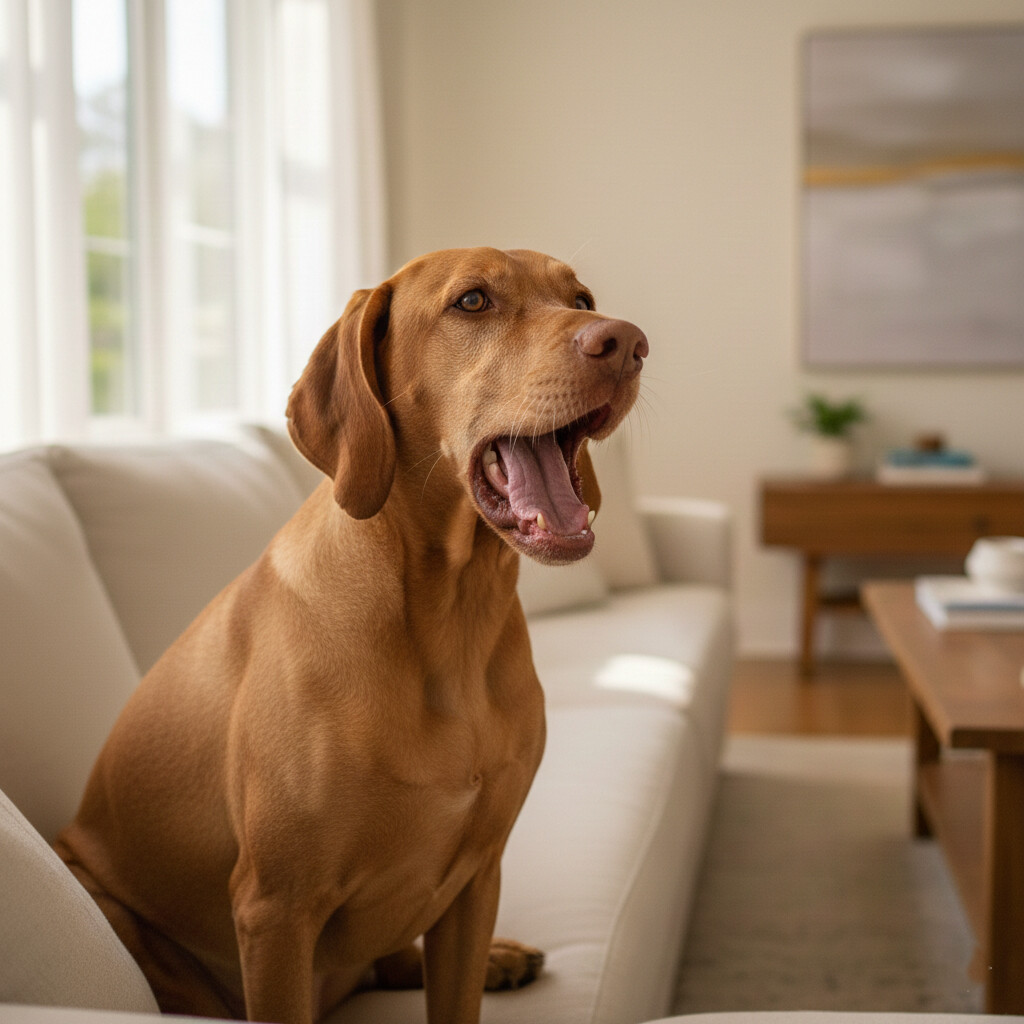
Dogs often yawn when they are not tired to communicate how they are feeling. This behavior is primarily a “calming signal” used to release stress, lower anxiety, or defuse a tense situation. It can also indicate excitement, anticipation (like waiting for a walk), or empathy toward their owner. Context is key: if your dog yawns while being hugged or scolded, they are likely uncomfortable, not sleepy.
Summary Table
| Type of Yawn | Common Context | Underlying Meaning | Recommended Owner Action |
| The Stress Yawn | Vet visits, scolding, loud noises | “I am anxious and trying to calm down.” | Remove the stressor; give the dog space. |
| The Anticipation Yawn | Before a walk, while food is being prepared | “I am excited and trying to control my energy.” | Continue with the activity (walk/feed). |
| The Appeasement Yawn | When approached by an aggressive dog or human | “I come in peace; please don’t hurt me.” | Monitor the interaction closely; intervene if necessary. |
| The Empathy Yawn | When the owner yawns | “I feel connected to you.” | Take it as a sign of bonding. |
| The Confusion Yawn | During difficult training sessions | “I don’t understand what you want.” | Lower the criteria or take a break. |
Why Do Dogs Yawn When Not Tired?
If you are a dog owner, you have probably seen this scenario before: You are training your dog to “sit” or “stay.” You have repeated the command a few times, perhaps with a slightly frustrated tone. Suddenly, your dog lets out a massive, exaggerated yawn.
Your immediate reaction might be annoyance. Is the dog bored? Are they disrespecting you? Are they tired of listening?
The answer is almost certainly no.
While humans mostly yawn when we are sleepy or bored, dogs use yawning as a complex tool for communication. It is a vital part of their body language.
Understanding why your dog yawns when they are wide awake will change how you interact with them and help you build a stronger, more trusting relationship.
Read Also: What Does It Mean When a Dog Whines?
1. Yawning as a Calming Signal
The most common reason a dog yawns when not tired is to manage stress. In the world of dog psychology, this is known as a Calming Signal. This term was popularized by Norwegian dog trainer Turid Rugaas. She identified that dogs use specific movements to calm themselves down and to signal peaceful intentions to others.
When a dog feels internal pressure, anxiety, or unease, the physical act of yawning helps them “shake off” that stress. It is a displacement behavior, something the dog does to displace the energy of their anxiety into a physical action.
Common scenarios for stress yawning:
- The Vet’s Office: Watch your dog in the waiting room. You will likely see them yawn repeatedly.
- Hugs and Cuddles: Many humans love to hug dogs, but most dogs find being restrained stressful. If you hug a dog and they yawn, they are politely asking to be let go.
- Arguments: If a dog hears a couple arguing or shouting, they may yawn to try to diffuse the tension in the room.
2. Dealing with Social Conflict (Appeasement)
Dogs are conflict-avoidant animals by nature. In the wild, fighting is expensive; it costs energy and risks injury. Therefore, canines developed a sophisticated language to prevent fights before they start.
If a dominant or aggressive dog approaches a more submissive dog, the submissive dog might yawn. This is an appeasement gesture. It translates to: “I see you are big and strong. I am not a threat. Please do not attack me.”
This also applies to interactions with humans. If you catch your dog doing something naughty, like chewing a shoe, and you march over to them with a stern face and loud voice, they might yawn. They are not ignoring your scolding; they are actually acknowledging your anger and trying to get you to calm down.
Key takeaway: If you scold your dog and they yawn, stop scolding. They have already received the message and are feeling threatened.
3. The Yawn of Anticipation and Excitement
Not all non-tired yawns are negative. Sometimes, a yawn is simply a way for a dog to transition from one energy state to another. This happens frequently during moments of high anticipation.
Think of an athlete stretching before a big race. They aren’t tired; they are preparing their body for action. Similarly, when a dog realizes you are putting on your shoes for a walk, or when they hear the rattle of the food bowl, they might let out a loud yawn.
This yawn serves two purposes:
- Oxygen Intake: It draws a large amount of oxygen into the lungs and brain, increasing alertness.
- Energy Regulation: It helps the dog control their overwhelming excitement so they don’t explode with energy before the door opens.
Prompt for Visual: A split-screen image. On the left, a dog is looking eagerly at a leash. On the right, the same dog is yawning widely, tail wagging, showing excitement rather than fatigue.
Read Also: Why Do Dogs Sleep at Your Feet?
4. Confusion and Mental Pressure
Mental effort can be just as tiring as physical exercise. When you are teaching your dog a new trick, you are asking them to use their brain in a new way. If the training session goes on too long, or if the dog simply doesn’t understand what you want, they will likely yawn.
In this context, the yawn means: “I am trying, but this is hard, and I am confused.”
If you see this during training, it is a sign that you are moving too fast. The dog is feeling the pressure of your expectations.
How to handle the Confusion Yawn:
- Stop the current exercise.
- Ask the dog to do something they know very well (like a simple “sit”).
- Reward them heavily to rebuild their confidence.
- Take a break or end the session.
5. Contagious Yawning (Empathy)
You know how, when you see a friend yawn, you almost immediately have to yawn yourself? This is called contagious yawning, and it is linked to empathy. Research suggests that dogs are one of the few species (along with humans and chimpanzees) that experience this.
Studies have shown that dogs are more likely to catch a yawn from their owners than from strangers. This suggests that when your dog yawns after you do, they are syncing their emotional state with yours. It is a sign of a close bond. They are paying attention to you and mirroring your physiology.
Prompt for Visual: A photo-realistic image of a person sitting on a couch, yawning, with their dog sitting next to them, looking at the person and yawning at the same time.
Read Also: What Causes Sudden Fear in Dogs?
How to Read the Context
Since a yawn can mean “I’m sleepy,” “I’m stressed,” or “I’m excited,” how do you know which one it is? You must look at the entire dog, not just the mouth. You have to read the cluster of signals.
Signs it is a Stress Yawn
- Whale Eye: You can see the whites of the dog’s eyes (sclera).
- Lip Licking: The dog quickly flicks their tongue over their nose.
- Tucked Ears: The ears are pinned back against the head.
- Tense Body: The muscles look stiff, not relaxed.
- Avoidance: The dog is turning their head away from you or the trigger.
Signs it is an Excitement Yawn
- Wagging Tail: The tail is moving loosely or in a wide arc.
- Pricked Ears: The ears are forward and alert.
- Dancing: The dog might be tapping their front feet or spinning.
- Vocalization: The yawn might be accompanied by a high-pitched whine or squeak.
Signs it is a Tired Yawn
- Environment: It is late at night, or the dog just woke up.
- Stretching: A long, slow stretch of the legs and back.
- Heavy Eyelids: The eyes are drooping or closing.
Medical Causes (When to Worry)
While behavioral reasons are the most common, consistent and excessive yawning can sometimes indicate a medical issue. It serves as a way for the dog to relieve physical discomfort.
- Ear Infections: The motion of yawning opens the Eustachian tubes. If a dog has an ear infection or pressure build-up, they may yawn to try to “pop” their ears.
- Nausea: Similar to humans, dogs may yawn when they feel nauseous or are about to vomit.
- Dental Pain: Jaw pain or toothaches can sometimes trigger a yawning reflex as the dog tries to adjust their jaw.
If your dog is yawning constantly, for example, every few minutes for an hour, and there is no obvious stressor or excitement, you should check for other symptoms like head shaking, rubbing their face on the floor, or drooling. This warrants a trip to the veterinarian.
What Should You Do When Your Dog Yawns?
Now that you understand the “Why,” here is the “How” for owners.
If the dog is stressed:
Stop what you are doing. If you are hugging them, let go. If you are training, take a break. If you are in a loud environment, move them to a quiet corner. Acknowledge that your dog is uncomfortable and advocate for them.
If the dog is excited:
Wait for a moment of calm. If they are yawning at the door because they want to walk, wait for them to have four paws on the floor before you open the door. This teaches them that calm behavior gets them what they want.
If the dog is engaging in conflict:
If your dog yawns at another dog, do not force them to “say hi.” They have clearly signaled they want no trouble. Guide your dog away to prevent the situation from escalating into a growl or a bite.
Conclusion
A dog’s yawn is rarely just a yawn. It is a sentence in a silent language. It is a request for space, a release of tension, or a shout of excitement. By paying attention to these subtle signals, you move from being just a pet owner to being a true partner to your dog. You build trust because the dog realizes, “Finally, my human understands what I am saying.”
Next time your dog yawns when they aren’t tired, take a quick scan of the environment. Ask yourself: What is happening right now? How is my dog feeling? The answer is right there in the yawn.