
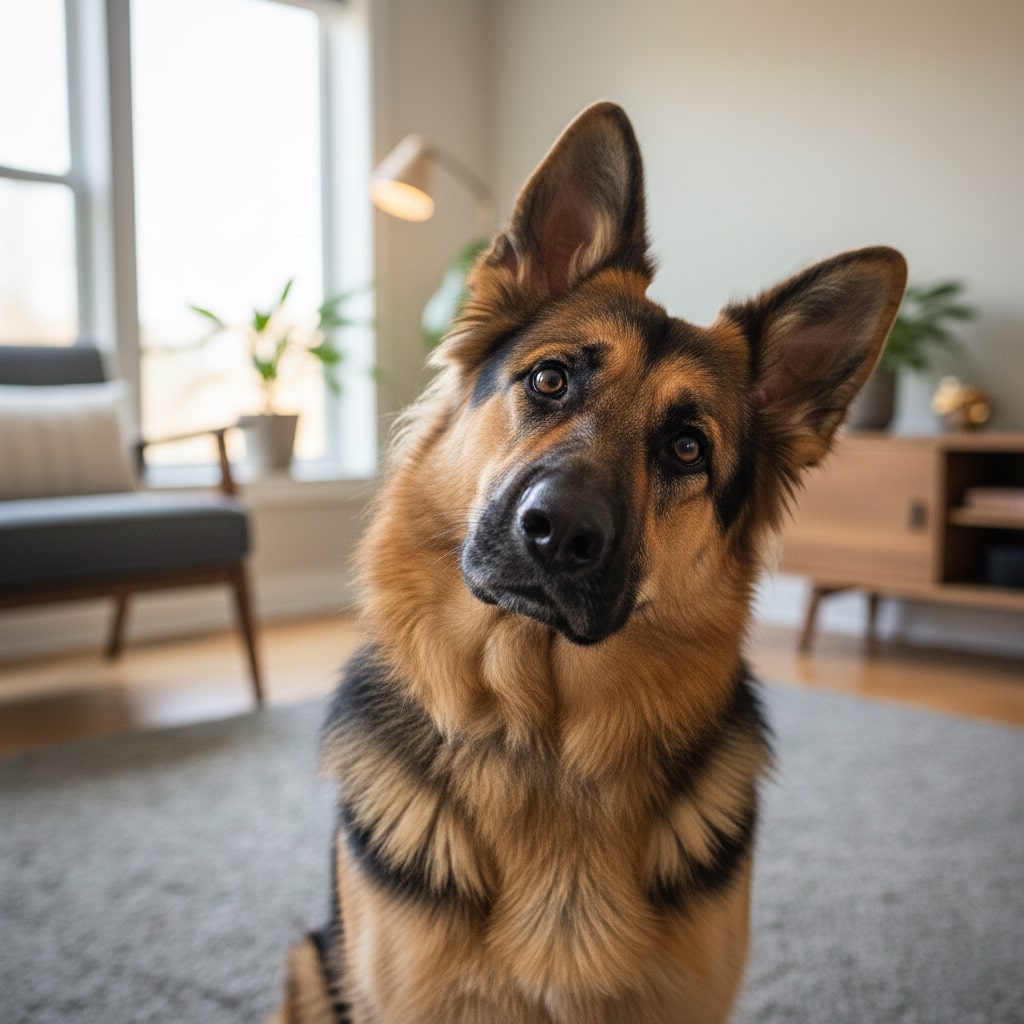
Dogs primarily tilt their heads to adjust their pinnae (outer ears) to better pinpoint the location and distance of a sound. This motion also helps them see your face more clearly by moving their muzzle out of their line of sight, allowing them to read your facial expressions. Additionally, head tilting can be a sign of empathy or a learned behavior reinforced by owner praise.
Summary Table: Head Tilting in Dogs
| Reason | Explanation | Common Context |
| Better Hearing | Adjusting outer ears to locate sound sources. | When you make strange noises or ask a question. |
| Better Vision | Moving the muzzle to see the speaker’s mouth. | When you are speaking directly to them. |
| Empathy | Showing engagement and emotional intelligence. | When you are sad or speaking in a high-pitched tone. |
| Learned Behavior | Repeating an action that gets treats/praise. | When they want attention or a reward. |
| Medical Issue | Vestibular disease or ear infection. | Constant tilting, loss of balance, or distress. |
The Iconic Head Tilt: More Than Just a Cute Pose
Every dog owner knows the move. You make a funny sound, ask “Do you want to go for a walk?” or simply talk to your pup in a high-pitched voice. Suddenly, their head snaps to the side, perhaps cocking to the left, then the right. It is arguably one of the most adorable behaviors in the canine world.
While it is easy to assume dogs do this just to be cute, researchers and animal behaviorists have found that there are functional, evolutionary, and psychological reasons for this action. It is a complex mix of sensory adjustment and emotional communication.
This guide explores the science behind the tilt, covering auditory mechanics, visual perspective, and when a head tilt might actually signal a medical emergency.
Read Also: Can Dogs Be Racist?
1. Adjusting the Ears for Better Hearing
The primary reason dogs tilt their heads lies in their anatomy. Unlike humans, who have flat ears against the side of the head, dogs have movable ear flaps called pinnae. These are essential for capturing sound and funneling it into the ear canal.
Locating the Source of Sound
Dogs have hearing that is significantly more sensitive than humans, especially at high frequencies. However, locating the exact source of a sound (sound localization) requires precision.
When a dog tilts its head, it is physically adjusting the position of its ears relative to the sound source.
This allows the dog to distinctively hear the time difference between the sound reaching one ear versus the other. By tipping their head, they can better judge:
- The distance of the sound.
- The elevation of the sound (whether it is coming from above or below).
- The precise direction.
Filtering Specific Words
Dogs are excellent at recognizing specific vocabulary words like “treat,” “walk,” “car,” or their names. When you speak to your dog, they are listening for these familiar sound patterns.
If your sentence is complex or your tone is ambiguous, they may tilt their head to open up the ear canal and filter out background noise, focusing entirely on your voice to pick out those keywords.
2. The Visual Perspective: Seeing Past the Muzzle
One of the most fascinating theories regarding head tilting comes from Dr. Stanley Coren, a professor of psychology and canine researcher. His research suggests that a dog’s muzzle (nose) actually interferes with its vision, particularly when looking at things straight ahead, like a human face.
The Muzzle Obstruction Theory
To understand this, hold your fist against your nose and try to look at a person speaking to you. You will notice that your fist blocks the lower part of their face, specifically their mouth.
For dogs with long snouts (dolichocephalic breeds) like Greyhounds, German Shepherds, or Collies, the muzzle creates a significant blind spot in the lower center of their visual field.
By tilting their heads to the side, they move their snout out of the way. This gives them a clearer view of your mouth and lower face.
Why Seeing the Mouth Matters
Dogs are visual communicators. While they listen to your tone, they also rely heavily on reading your facial expressions to understand your intent. They look for:
- Whether you are smiling or frowning.
- Movement of the lips.
- Eye shape and openness.If they cannot see your mouth because their nose is in the way, they miss half the conversation. The head tilt grants them an unobstructed view of your facial expressions.
Evidence in Breeds
Studies have shown that dogs with flatter faces (brachycephalic breeds) like Pugs, Bulldogs, and Boston Terriers tend to tilt their heads less frequently than dogs with long snouts.
Because their faces are flat, their vision is less obstructed, so they have less need to adjust their head angle to see you.
Read Also: Can Dogs Eat Mayonnaise?
3. Empathy and Emotional Intelligence
Dogs are the only species that has evolved specifically to live alongside humans and understand us. They are masters of empathy. The head tilt is often a physical manifestation of this emotional connection.
Reading Emotional Cues
When you are upset, crying, or speaking enthusiastically, your dog picks up on the shift in your energy and tone. The head tilt signals that they are engaged and paying close attention to your emotional state. It is a gesture of curiosity and concern.
Behaviorists call this “social intelligence.” By tilting their head, the dog is effectively saying, “I am listening, I am focused on you, and I am trying to understand what you are feeling.”
The Bond Connection
This behavior strengthens the human-animal bond. When a dog tilts its head, humans almost universally respond with affection. We perceive it as listening and understanding. This creates a feedback loop where the dog feels connected to the owner, and the owner feels understood by the dog.
4. Positive Reinforcement and Learned Behavior
Never underestimate the power of a treat or a “Good boy!” Dogs are opportunistic learners. If an action results in a reward, they will repeat it.
The “Cute” Trap
Because the head tilt is so endearing, most owners react immediately when their dog does it.
- We smile.
- We say “Aww, look at you!” in a happy voice.
- We offer physical affection (scratches behind the ears).
- We give them a treat.
Operant Conditioning
In psychology, this is known as operant conditioning. The dog learns that the specific muscle movement of tilting the head results in positive attention.
Over time, the dog may start tilting its head not because it needs to hear or see better, but simply because it knows this is the “button” to press to get your attention.
If your dog tilts its head every time you look at them, even when there is no sound, it is likely a learned trick to get you to engage with them.
Read Also: How To Make a Homemade Dog Bite Sleeve?
5. Medical Warning Signs: When the Tilt Isn’t Cute
While the reasons listed above are behavioral and benign, there are instances where a head tilt indicates a serious medical problem. Dog owners must distinguish between a communicative tilt and a pathological one.
Vestibular Disease
The vestibular system, located in the inner ear and brain, controls balance. When something goes wrong here, it can cause a condition often called “Old Dog Vestibular Syndrome” (though it can happen to dogs of any age).
Symptoms include:
- A persistent head tilt (the head does not return to a neutral position).
- Loss of balance, stumbling, or falling over.
- Walking in circles.
- Nystagmus (eyes darting back and forth rapidly).
- Nausea or vomiting.
Ear Infections (Otitis)
A deep inner ear infection is painful and can affect equilibrium. A dog may hold its head to one side to relieve pressure or drain fluid.
Signs of infection include:
- Scratching at the ear.
- Redness or swelling in the ear canal.
- A foul odor coming from the ears.
- Shaking the head vigorously.
6. Neurological Issues
In rare cases, a persistent head tilt can signal a brain tumor, stroke, or head trauma. If the tilt is sudden, constant, and accompanied by lethargy or confusion, it is a medical emergency.
When to See a Vet
If your dog tilts its head only when you talk to them, it is normal. However, you should visit a veterinarian immediately if:
- The head tilt is constant and never straightens out.
- The dog seems dizzy or cannot stand up.
- The dog is refusing to eat or seems in pain.
- You see discharge coming from the ear.
Read Also: Can a Dog Get a Cat Pregnant?
Breed-Specific Tendencies
While all dogs can tilt their heads, the frequency varies by breed and ear shape.
Cocked Ears vs. Floppy Ears
Dogs with prick ears (upright), such as German Shepherds, Huskies, and French Bulldogs, often display very distinct head tilts. Their ears act like radar dishes, and the tilt is very effective for them.
Dogs with heavy, floppy ears (pendulous pinnae), like Cocker Spaniels or Basset Hounds, may also tilt their heads, but they sometimes have to tilt further to move the heavy ear flap out of the way of the ear canal to hear clearly.
Working Breeds
Working breeds that were trained to listen to commands from a distance (like Border Collies) tend to be more reactive to sounds and may tilt their heads more frequently as they attempt to process complex instructions.
Frequently Asked Questions
Do puppies tilt their heads more than adult dogs?
Yes, often. Puppies are experiencing many sounds for the first time. Their brains are working hard to categorize new noises. Is that a threat? Is it food? Is it a toy? This intense processing often results in frequent, exaggerated head tilts.
Can I train my dog to tilt its head on command?
Yes. Because this is often a learned behavior, you can capture it. When your dog tilts their head naturally, use a clicker or a marker word (“Yes!”) and reward them immediately. Eventually, you can add a cue word like “Listen?” or “What?” to trigger the behavior.
Does a head tilt mean my dog is smart?
It is often linked to social intelligence. A dog that tilts its head is actively engaging with you, processing information, and trying to communicate. This level of engagement is a sign of a socially aware and cognitive dog.
Conclusion
The dog head tilt is a perfect example of form meeting function. It serves a biological purpose, helping your dog hear and see you better, while simultaneously serving a social purpose by deepening the bond between pet and owner. Whether they are trying to look past their nose to read your smile, or adjusting their ears to catch the word “park,” they are showing you that you are the center of their world.
So, the next time your dog cocks their head to the side, enjoy the moment. It is their way of saying, “I’m all ears, and I’m with you.”