
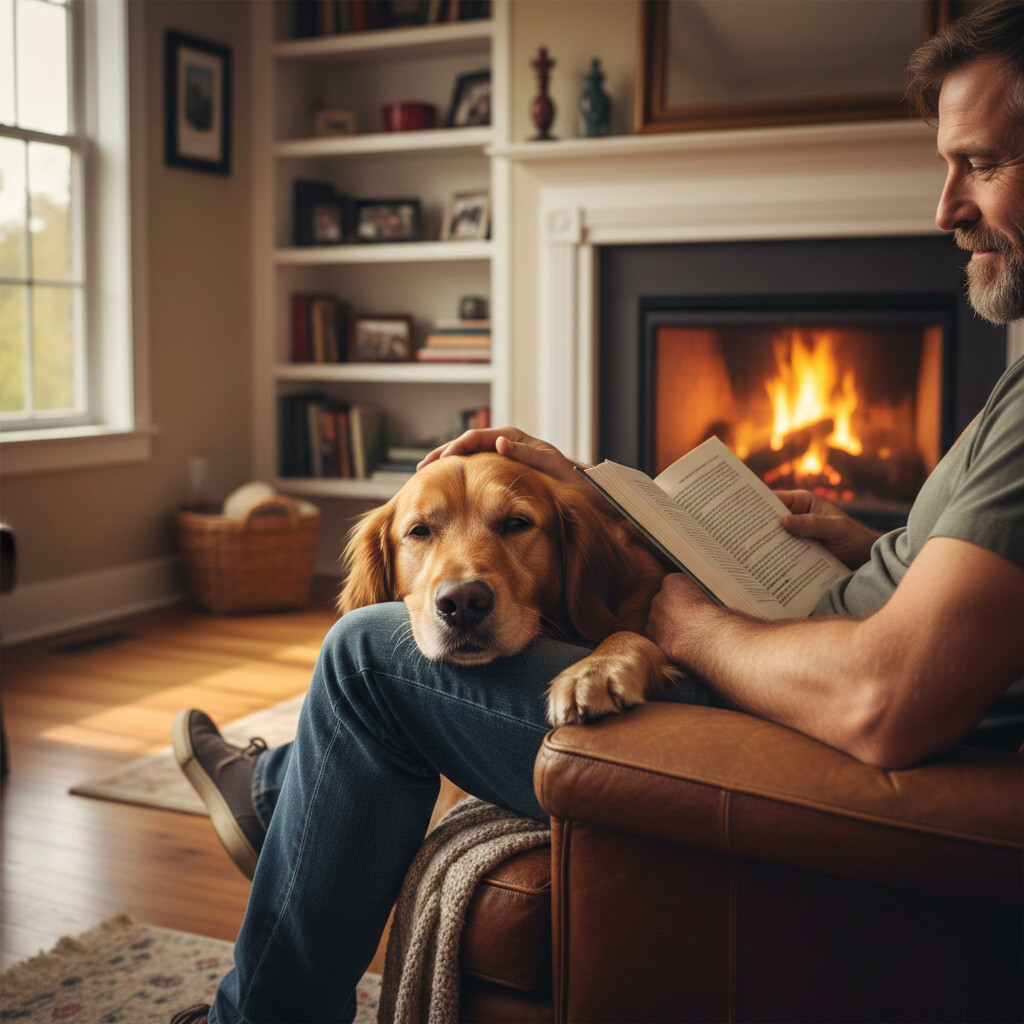
Dogs lean on people primarily to express affection, seek comfort, or feel secure. Because dogs are pack animals, physical contact helps them bond and feel safe. While often compared to a human hug, leaning can also indicate anxiety, a desire for attention, or physical need, such as seeking warmth or support due to age or injury.
Summary Table: Why Is My Dog Leaning on Me
| Reason | Meaning | Context | Suggested Action |
| Affection | “I love you.” | Relaxed posture, soft eyes. | Pet or praise them. |
| Security | “I feel safe here.” | Leaning while standing still, usually in new places. | Offer calm reassurance. |
| Anxiety | “I am scared.” | Panting, trembling, tail tucked. | Identify the trigger and comfort them. |
| Attention | “Notice me!” | Nudging hand, looking at you. | Ignore if unwanted, or engage in play. |
| Warmth | “I’m cold.” | Shivering, seeking body heat. | Provide a blanket or warm spot. |
| Support | “I’m in pain.” | Difficulty standing, old age. | Consult a veterinarian immediately. |
Why Do Dogs Lean on People?
If you are a dog owner, you have likely experienced the “lean.” You might be standing in the kitchen cooking, or sitting on the couch, when suddenly you feel a distinct weight pressing against your legs. Your dog has parked themselves right against you, putting their full body weight onto your side.
To humans, this can sometimes feel intrusive or clumsy, especially if you have a large breed dog. However, in the canine world, physical proximity is a love language.
Dogs cannot speak, so they rely heavily on body language and tactile cues to communicate their feelings. Understanding why your dog leans on you is key to strengthening your bond and recognizing if your pet needs help.
This guide explores the psychology, biology, and behavioral reasons behind this common canine habit.
Read Also: Why Do Dogs Shake After Play or Baths?
1. Affection: The Canine Hug
The most common reason a dog leans on you is simple: they love you. In animal behavior psychology, this is often viewed as a sign of trust.
When a dog leans against you, their brain releases oxytocin. This is often called the “love hormone” or “cuddle chemical.” It is the same hormone that bonds human mothers and babies.
By pressing their body against yours, your dog is getting a chemical boost of happiness and reassurance.
Think of the lean as a dog’s version of holding hands or a hug. If your dog leans on you while you are petting them, and their body is loose and relaxed, they are expressing contentment. They are essentially saying, “I am happy to be with you.”
2. A Sense of Security and Safety
Dogs are pack animals by nature. In the wild, pack members sleep close together and stay in physical contact to protect one another from predators. Even though your domestic dog does not need to worry about wolves or bears, that ancestral instinct remains.
When a dog leans on you, they may be treating you as their “safe base.” This often happens in new or overwhelming environments.
For example, if you take your dog to a crowded park or the vet’s office, they might press against your calf. They are not necessarily scared, but they are checking in to make sure you are still there. It gives them the confidence to face the situation because they know their leader (you) is right there supporting them.
3. Fear and Anxiety
While security leaning is healthy, anxiety leaning is a distress signal. It is important to distinguish between a dog who wants to feel safe and a dog who is terrified.
If your dog is leaning on you because of fear, you will see other stress signals, including:
- Panting heavily when it isn’t hot.
- Tail tucked between the legs.
- Ears pinned back against the head.
- Trembling or shivering.
- Lip licking or yawning repeatedly.
Common triggers for this type of leaning include thunderstorms, fireworks, loud construction noises, or separation anxiety. In these moments, your dog is literally clinging to you for protection.
If the leaning is accompanied by these signs, your dog is asking you to make the scary thing go away.
4. Attention Seeking
Dogs are incredibly smart. They learn quickly which behaviors get them what they want. If your dog leans on you and you immediately look down, talk to them, or scratch behind their ears, they have learned a valuable lesson: Leaning equals attention.
This is a learned behavior. If you are engrossed in your phone or watching TV and ignoring your dog, they might walk over and lean hard against your knees. It is their way of saying, “Hey, remember me? I’m still here.”
If you enjoy this interaction, feel free to pet them. However, if the behavior becomes annoying, you have to be careful not to reward it.
Pushing them away can sometimes be interpreted as play, which reinforces the behavior. The best way to stop attention-seeking leaning is to simply step away or ignore them until they sit quietly.
Read Also: What It Means When a Dog Sighs?
5. The Dominance Myth
For many years, old-school dog training theories suggested that a dog leaning on you was trying to assert dominance. The theory was that the dog was physically invading your space to show they were the “alpha.”
Modern animal science has largely debunked this idea. Veterinary behaviorists now agree that leaning is rarely, if ever, an act of dominance. A dominant dog does not need to lean on you; they assert control through stiffness, staring, and guarding resources.
A dog that leans on you is making themselves vulnerable. They are putting themselves in a position where they cannot easily move or defend themselves. This vulnerability proves that the behavior is rooted in trust, not power.
6. Seeking Warmth
Sometimes the explanation is purely physical. Dogs have a higher body temperature than humans (typically around 101 to 102.5 degrees Fahrenheit), but they can still get cold.
If you have a short-haired breed like a Greyhound, Boxer, or Pit Bull, they may lean on you simply to steal your body heat. You act as a giant radiator for them.
This is especially common in winter months or in houses with tile or hardwood floors that stay cool. If your dog leans on you and then curls up in a tight ball right next to your feet, they are likely just trying to stay warm.
7. Breed Tendencies
While any dog can lean, certain breeds are famous for it. Large breeds, in particular, are notorious “leaners.” This might be because their height makes it easier for them to lean against a human’s thigh or hip.
Common Leaning Breeds
- Great Danes: Often called “Velcro dogs,” they seem unaware of their massive size and will lean their full weight on owners.
- Greyhounds: This breed is very affectionate and tactile.
- Boxers: Known for having no concept of personal space.
- Mastiffs: Their sheer weight makes their lean impossible to ignore.
- Dobermans: Often referred to as “Velcro Dobermans” because they stick to their owners’ sides.
Small dogs lean too, but it is often less noticeable because they lean against your ankle or foot rather than your thigh.
Read Also: Why Do Dogs Stare at Their Owners?
8. Medical Issues and Old Age
In some cases, leaning isn’t emotional; it’s functional. If an older dog suddenly starts leaning on you, they might be experiencing pain or weakness.
Arthritis and Hip Dysplasia
As dogs age, their joints deteriorate. Standing for long periods can become painful. Leaning against you takes the weight off their hips or hind legs. If you notice your dog leans mostly on their back end or seems to struggle to get up, they may be using you as a crutch.
Vestibular Disease
This is a condition affecting a dog’s balance, similar to vertigo in humans. It is common in older dogs. If your dog is leaning because they are dizzy, you might also see:
- A head tilt.
- Stumbling or falling over.
- Rapid eye movement (nystagmus).
- Vomiting.
If the leaning is sudden, constant, or accompanied by signs of pain or unsteadiness, schedule a visit with your veterinarian immediately.
Should You Stop the Behavior?
For most owners, the “lean” is a sweet bonding moment. There is no harm in letting your dog lean on you if it is done out of affection. It strengthens the human-animal bond and makes your dog feel loved.
However, you might want to discourage the behavior if:
- The dog is too heavy: A 150-pound Mastiff leaning on a child or an elderly person can be a safety hazard.
- It is caused by separation anxiety: If the dog cannot function without touching you, you need to work on confidence-building training.
- Dirty paws: If you are dressed for work, a leaning dog can leave hair or mud on your clothes.
How to Train a Dog to Stop Leaning
- Ignore it: When they lean, step away so they lose the support. Do not make eye contact or speak.
- Redirect: Ask the dog to “Sit” or go to their “Place” (a bed or mat).
- Reward independence: When they lay down on their own bed or stand calmly without leaning, give them a treat and praise.
Conclusion
So, why do dogs lean on people? In the vast majority of cases, it is a compliment. Your dog sees you as a source of comfort, safety, and love. Whether they are looking for a hug, a bit of warmth, or reassurance during a storm, the lean is a sign that you are their person.
Unless the leaning is accompanied by signs of pain or extreme anxiety, you should embrace it. It is one of the many silent ways our dogs tell us that we are the most important thing in their world.