
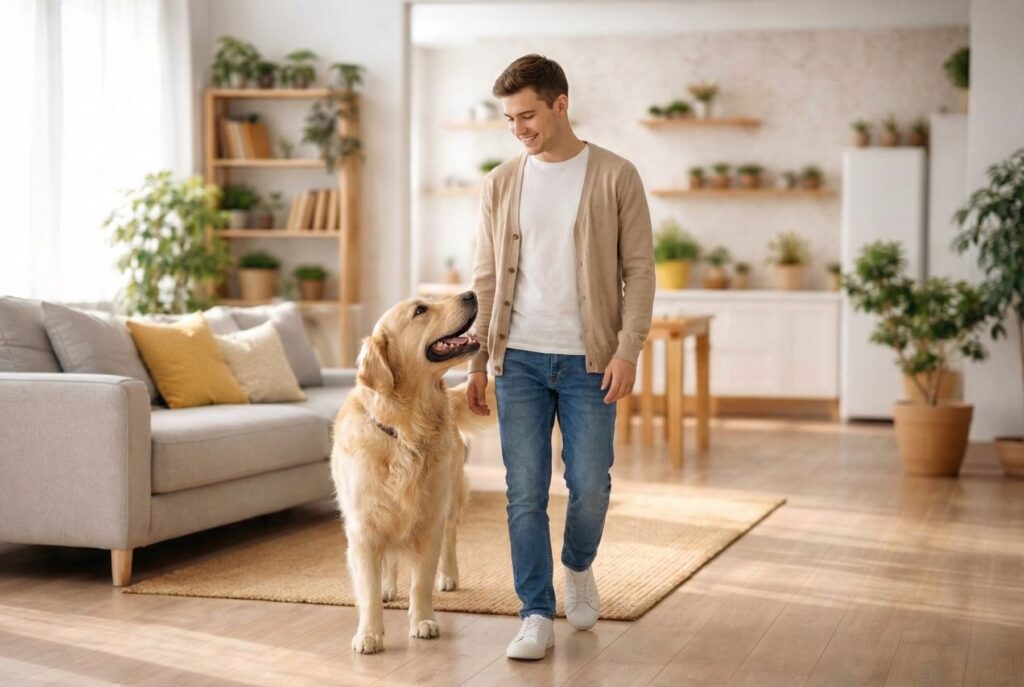
Dogs follow their owners everywhere primarily due to their pack instinct, which drives them to seek safety and companionship with their group leader. This behavior, often called being a “Velcro dog,” is reinforced by the release of bonding hormones like oxytocin, positive reinforcement (receiving treats or affection), and simple curiosity about what you are doing. While usually a sign of love, excessive following can sometimes indicate separation anxiety.
Summary Table: Why Do Dogs Follow You Everywhere
| Reason | Description | Is it Healthy? |
| Pack Mentality | Instinctual need to stay close to the family unit for safety. | Yes, completely natural. |
| Positive Reinforcement | They learned that following you equals treats or pets. | Yes, it is a learned behavior. |
| Companionship | They genuinely enjoy your company and bond with you. | Yes, a sign of affection. |
| Breed Traits | Working or herding breeds are wired to watch over their humans. | Yes, genetic predisposition. |
| Separation Anxiety | Inability to settle when you leave the room; panic. | No, requires training/vet help. |
| Curiosity | They simply want to know what you are doing (FOMO). | Yes, dogs are nosy! |
Why Do Dogs Follow Their Owners Everywhere? A Deep Dive
If you own a dog, you likely know the feeling of never being truly alone. You walk to the kitchen, and four paws trot behind you. You sit on the couch, and they are at your feet. You go to the bathroom, and they scratch at the door. This phenomenon is often jokingly referred to as having a “Velcro dog.”
While it can be adorable, it can also be overwhelming. Why is your canine companion so obsessed with your every move? The answer is a fascinating mix of evolution, psychology, and the unique bond you share.
Read Also: Why Do Cats Follow You Everywhere?
1. The Evolutionary Link: Pack Mentality
To understand your dog, you have to look at their ancestors. Domestic dogs (Canis lupus familiaris) are descendants of wolves. In the wild, survival depended on the pack. A solitary wolf was a vulnerable wolf.
Safety in Numbers
For early canines, staying close to the pack leaders meant protection from predators and access to resources like food and shelter.
Even though your Goldendoodle doesn’t need to worry about predators in your living room, that genetic coding remains deep within their DNA. You and your family are their pack. By following you, they are maintaining the integrity of the group.
Resource Guarding and Patrol
In a pack, members often patrol their territory together. When you move from the bedroom to the kitchen, your dog may view this as a joint patrol. They are helping you secure the perimeter and ensuring everything is safe.
2. The Chemical Connection: Bonding and Hormones
Science tells us that the bond between a human and a dog is chemically very similar to the bond between a parent and a child.
The Oxytocin Effect
When you look into your dog’s eyes or pet them, both your brain and your dog’s brain release oxytocin. This is widely known as the “love hormone.” It creates feelings of trust, relaxation, and attachment.
Because being near you makes your dog feel good physically and chemically, they seek out that feeling repeatedly. Following you is their way of getting another “dose” of that comforting hormone. It is a self-soothing mechanism that reinforces their love for you.
3. Learned Behavior: Positive Reinforcement
Dogs are incredibly smart, and they are masters of cause and effect. Often, we train our dogs to follow us without even realizing it.
The Cookie Jar Effect
Think about your daily routine. When you walk to the kitchen, do you sometimes give your dog a treat? When you sit on the sofa, do you give them a belly rub?
If the answer is yes, your dog has learned a simple equation:
Proximity to Human = Good Things Happen.
Even if you don’t give a treat every time, the possibility of a reward is enough to keep them interested. In psychology, this is called “variable reinforcement,” and it is actually the most powerful way to establish a habit. They follow you because you are the source of all good things: food, walks, play, and scratches.
Read Also: Signs Your Dog Is Stressed
4. Breed Traits: Born to Work
Not all dogs are Velcro dogs to the same degree. Genetics play a massive role in how independent or clingy a dog is. Humans have bred dogs for specific jobs for thousands of years, and these jobs influence their current behavior.
Herding Dogs (Border Collies, Shepherds, Corgis)
These dogs were bred to work closely with humans to move livestock. They take direction from a handler and need to keep their eyes on the flock. In a home environment, you are the flock. They follow you to ensure you are going where you are supposed to go.
Working Dogs (Dobermans, Boxers)
Breeds developed for guarding or protection naturally want to keep their charges in sight. If they can’t see you, they can’t protect you.
Companion Dogs (Pugs, Chihuahuas, Cavalier King Charles Spaniels)
These breeds were literally designed to be lap warmers. Their historical “job” was simply to be with their owners. Following you isn’t just a habit for them; it is their entire purpose.
5. Curiosity and FOMO (Fear Of Missing Out)
Dogs are naturally inquisitive creatures. They rely on exploring their environment to keep their minds active. Humans are the most interesting thing in a dog’s world. We open doors, we move objects, we make food, and we make strange noises.
When you get up to leave a room, your dog instantly wonders, “Where are we going? Is there a squirrel? Are we getting a snack? Is something exciting about to happen?”
They follow you because they don’t want to miss out on any potential action. This “Fear Of Missing Out” is particularly strong in young puppies who are still learning how the world works.
Read Also: Can Dogs Eat Salt?
6. Helplessness in Puppies
If you have a young puppy, the following behavior is even more intense. Puppies constitute a developmental stage where they are entirely dependent on a caregiver. From the moment they are born, they follow their mother for warmth and milk.
When you adopt a puppy, you become the surrogate mother. Following you is a survival instinct. They are literally imprinted on you. As they age and gain confidence, this intense shadowing might decrease, but for the first few months, it is a critical part of their safety system.
Separation Anxiety vs. Healthy Attachment
This is the most critical distinction dog owners need to make. Is your dog following you because they love you, or because they are terrified of being alone?
Healthy Velcro Dog signs:
- They follow you, but if you close a door, they wait patiently or walk away.
- They are relaxed when they are with you (lying down, sleeping).
- They can be left alone in the house without destroying furniture or barking for hours.
Separation Anxiety signs:
- They panic if you close a door between you (whining, scratching, barking).
- They cannot settle down, even when you are in the room; they pace constantly.
- They engage in destructive behavior when you leave.
- They have accidents in the house despite being potty trained.
If your dog shows signs of anxiety, the following behavior is a symptom of distress, not just affection. This requires a different approach, often involving desensitization training or professional help.
Read Also: Why Do Dogs Tilt Their Heads?
The Bathroom Phenomenon
One of the most common questions owners ask is: “Why does my dog watch me in the bathroom?”
It seems awkward to us, but to a dog, the bathroom is just another room. However, there are a few specific reasons for this quirk:
- Vulnerability: In the wild, going to the bathroom is a vulnerable moment. Your dog might be “watching your back” while you are indisposed, just as they might look at you while they poop to ensure you are watching out for them.
- Captive Audience: When you are on the toilet, you aren’t moving. You aren’t typing on a laptop or washing dishes. To your dog, this looks like the perfect time to get your undivided attention and some head scratches.
How to Manage a “Velcro Dog”
If the shadowing is becoming too much, or if you simply need a little personal space, you can take steps to build your dog’s independence.
Teach the “Place” Command
This is one of the most valuable commands for a clingy dog. Train your dog to go to a specific mat or bed and stay there. Start with short durations and reward them heavily. This teaches them that they can be in the same room as you without being physically touching you.
Desensitization to Movement
If your dog jumps up every time you stand up, practice standing up and sitting back down immediately without going anywhere. Do this repeatedly. Eventually, the dog learns that your movement doesn’t always mean something exciting is happening, and they will stop reacting to every twitch.
Enrichment Toys
Give your dog something better to do than follow you. A stuffed Kong, a puzzle toy, or a long-lasting chew can keep them occupied in one spot while you move around the house. This helps them learn that being alone can be rewarding.
Read Also: Can Dogs Eat Sugar?
Does Age Matter?
Geriatric Dogs
As dogs get older, their vision and hearing may decline. This can make the world feel scary and confusing. An older dog may begin following you more closely because you are their seeing-eye human.
They rely on your presence to navigate the world and feel safe. If an older dog suddenly becomes clingy, a vet visit is in order to check for sensory loss or cognitive dysfunction (doggie dementia).
Adolescent Dogs
Teenage dogs might go through a rebellious phase where they seem less interested in following you. This is natural as they explore their independence. However, consistent training is needed to ensure they maintain their bond with you.
Conclusion
So, why does your dog follow you everywhere? It is a compliment. It is a mix of their ancient wolf heritage, their specific breed purpose, and their genuine love for you. You are their world, their provider, and their best friend.
While it can be a bit much when you just want five minutes of privacy, try to view it as a sign of a healthy, strong bond. As long as the behavior doesn’t stem from anxiety, having a little shadow is just one of the many joys and slight inconveniences of sharing your life with a dog.
Next Step for You:
If you suspect your dog’s following behavior is due to anxiety rather than love, try the “door test.” Close a door between you and your dog for 10 seconds. If they whine instantly, start working on “stay” commands today. If they wait silently, give them a treat and enjoy the companionship!