
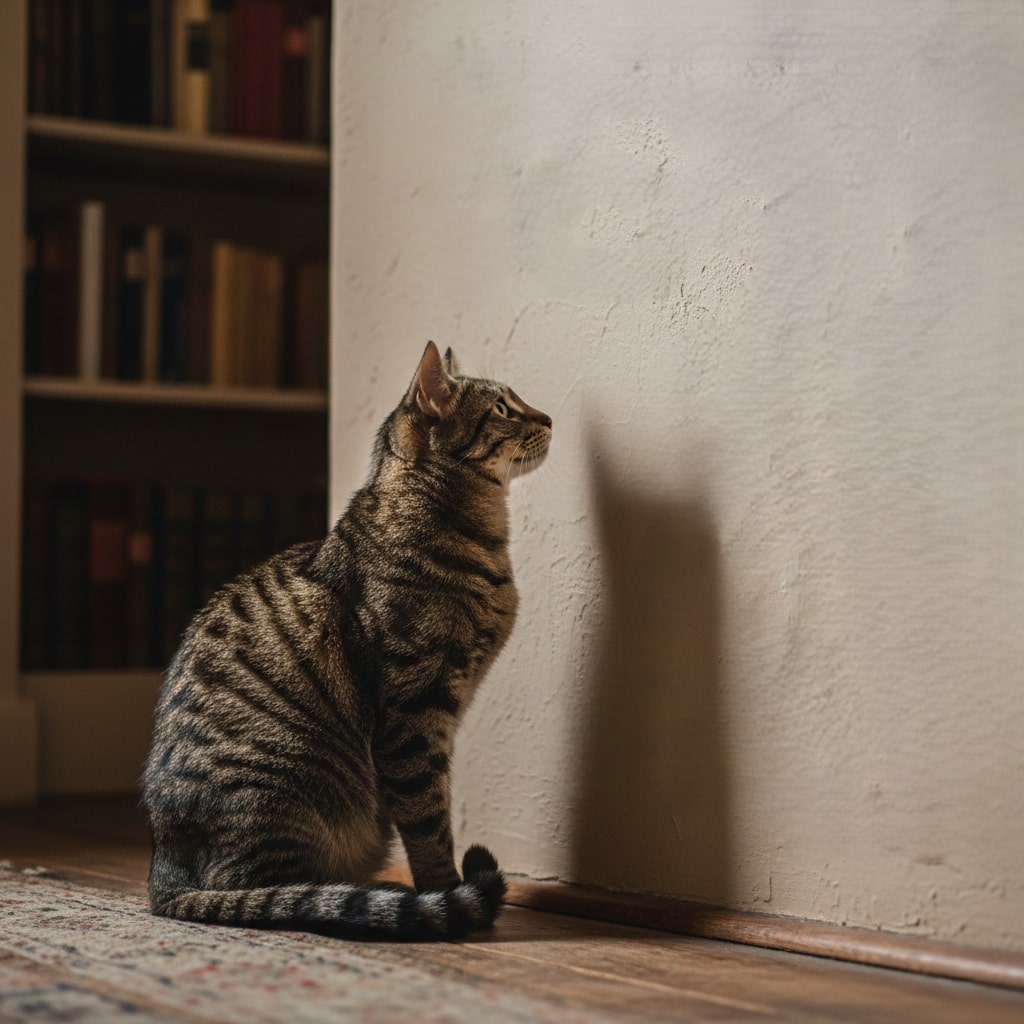
Cats usually stare at walls because their superior senses detect things humans cannot perceive. They may see tiny insects, dust motes, or shifting shadows, or hear high-pitched sounds like pipes settling or critters inside the wall. While often harmless curiosity, prolonged staring can sometimes indicate medical issues like cognitive dysfunction or seizures.
Summary Table: Common Reasons Cats Stare at Walls
| Potential Cause | What It Means | Action Required |
| Super Senses | Your cat sees or hears something you can’t (bugs, shadows, mice). | None. Let them investigate. |
| Predatory Drift | They are focused on potential prey (insects, light reflections). | None, unless the bug is harmful. |
| Cognitive Dysfunction | Senility or dementia, common in older cats. | Consult a veterinarian. |
| Feline Hyperesthesia | “Rolling skin syndrome,” causing over-sensitivity. | Consult a veterinarian. |
| Head Pressing | Pressing the head firmly against a wall (emergency). | Emergency: Go to the vet immediately. |
Why Do Cats Stare at Walls: 5 Reasons
Every cat owner has experienced this eerie moment. You are sitting quietly in your living room when you notice your cat freezes. Their eyes lock intensely on a blank spot on the wall. They might sit there for minutes, unblinking, ears swiveled forward. You look at the wall and see absolutely nothing. It is easy to joke that your cat is seeing a ghost, but the reality is usually grounded in biology rather than the paranormal.
Cats possess sensory abilities that are vastly superior to ours. Their world is filled with sights and sounds that are completely invisible to humans. Understanding why your cat stares at “nothing” helps you distinguish between normal hunting behavior and potential medical emergencies.
Read Also: Why Do Cats Suddenly Get the Zoomies?
1. The Power of Feline Senses
The primary reason cats stare at walls is that they are gathering information. To a cat, a blank wall is rarely blank.
1. Superior Vision
Your cat’s eyes are designed differently than yours. They are crepuscular hunters, meaning they are most active during dawn and dusk. Evolution has optimized their eyes to detect movement and see in low light.
- Rod Cells: Cats have a high concentration of rod cells in their retinas. These cells are responsible for peripheral vision and seeing in dim light. This allows them to spot a tiny gnat or a shifting shadow that your eyes completely miss.
- Tapetum Lucidum: This is a reflective layer of tissue behind the retina. It reflects light back through the eye, giving the retina a second chance to register an image. This is what makes cat eyes glow in photos, and it allows them to see clearly with roughly one-sixth of the light humans need.
- Ultraviolet Light: Recent studies suggest cats may be able to see parts of the UV spectrum. This means they might see patterns on paint or wallpaper that are invisible to the human eye.
2. Ultrasonic Hearing
While your cat’s vision is impressive, their hearing is even more powerful. A cat’s ears can rotate 180 degrees to pinpoint the exact location of a sound.
- Frequency Range: Humans can hear sounds up to about 20,000 Hertz. Cats can hear frequencies up to 64,000 Hertz. This allows them to hear the ultrasonic calls of rodents and insects.
- Internal Sounds: If your cat is staring at a wall, they might be listening to what is inside the wall. This could be water running through pipes, the house settling, electrical buzzing, or—more concerningly—termites, mice, or squirrels scratching behind the drywall.
2. Predatory Instincts and “Greebles”
Cat owners often use the internet slang “greebles” to describe the invisible monsters cats seem to be hunting. In reality, this behavior is just their prey drive in action.
Even well-fed house cats retain the instincts of wild predators. Movement triggers this instinct.
- Dust Motes: Floating dust particles catching the sunlight look like flying insects to a cat.
- Light Reflections: A reflection from a watch, phone screen, or passing car can dance across a wall.
- Micro-Movements: Small insects like silverfish or spiders often blend into paint colors. Your cat sees the slight disruption in the texture of the wall.
When a cat stares intently, they are entering “stalking mode.” They are calculating distance and waiting for the target to move again.
3. Behavioral Reasons for Staring
Sometimes the behavior isn’t about senses, but about the cat’s mental state.
Curiosity and Boredom
Indoor cats can get bored. If a cat spends all day inside with limited stimulation, they may hyper-focus on minor changes in their environment. A new crack in the paint or a stray cobweb becomes the most interesting thing in the room. This is their version of watching television.
Attention Seeking
Cats are smart. If you laugh, talk to them, or pet them every time they stare at a specific corner, they learn that “staring at the wall = attention from my human.” They may repeat the behavior simply to get you to interact with them.
Read Also: Why Do Cats “Make Biscuits”?
4. Medical Causes: When to Worry
While 90% of wall-staring is harmless, there are specific medical conditions where this behavior is a symptom. You need to observe how they are staring.
1. Feline Cognitive Dysfunction Syndrome (FCDS)
This is essentially dementia for cats. It typically affects cats who are 10 years or older. As a cat ages, their brain function declines.
Symptoms of FCDS include:
- Staring blankly at walls or into space for long periods.
- Getting “lost” in corners or behind furniture.
- Loud vocalizing (yowling), especially at night.
- Changes in sleep cycles (awake all night, sleeping all day).
- Forgetting litter box training.
If your senior cat suddenly starts staring at walls and seems confused, you should schedule a vet visit. While FCDS cannot be cured, diet changes and medication can slow its progression.
2. Feline Hyperesthesia Syndrome
This is a rare condition often called “rolling skin syndrome.” It is a neurological disorder that causes extreme sensitivity in the skin and muscles.
Signs to look for:
- The cat stares at a wall or their own tail, then suddenly attacks it.
- The skin on their back ripples or twitches visibly.
- Sudden bouts of aggressive grooming or biting at the tail.
- Frantic running or “zoomies” followed by freezing and staring.
3. Seizures
Not all seizures involve violent shaking. “Focal seizures” or “absence seizures” can look like the cat is simply zoning out. During a focal seizure, a cat might freeze, stare at a wall, and be unresponsive to you calling their name. They might also smack their lips or chew at the air.
5. The Danger Zone: Head Pressing
There is a massive difference between staring at a wall and pressing against it.
Head pressing is characterized by the cat physically pushing their forehead against a wall, floor, or corner. They will stand rigid with their head down, pressing firmly.
This is a medical emergency. It indicates severe damage to the nervous system. Causes include:
- Brain tumors.
- Head trauma.
- Liver failure (Hepatic Encephalopathy).
- Toxic poisoning (lead, antifreeze).
- Stroke.
If you see your cat pressing their head against the wall, take them to an emergency vet immediately. Do not wait.
Read Also: 10 Best Ways to Remove Pet Hair from Your Car
How to Test Your Cat
If you are unsure if your cat is just hunting a dust bunny or if something is wrong, try to distract them.
- Call their name: Does their ear twitch back toward you?
- Make a noise: Clap your hands or shake a treat bag.
- Use a laser pointer or toy: wave a feather wand near them.
The Result:
- Normal Cat: Will look at you, look back at the wall, and eventually break focus to investigate the noise or toy. They are alert and responsive.
- Medical Issue: If the cat does not react to loud noises, does not move their eyes, or seems “locked in,” it could be a seizure or cognitive issue.
Conclusion
In the vast majority of cases, a cat staring at a wall is simply being a cat. Their evolutionary biology has gifted them with eyes that see in the dark and ears that hear electricity. They are likely watching a microscopic bug or listening to a mouse three rooms away. It is a quirky, harmless behavior that showcases their status as natural-born hunters.
However, as a responsible pet owner, you should always monitor for changes. If the staring is accompanied by confusion, behavioral changes, or physical head pressing, it is time to consult a professional.