
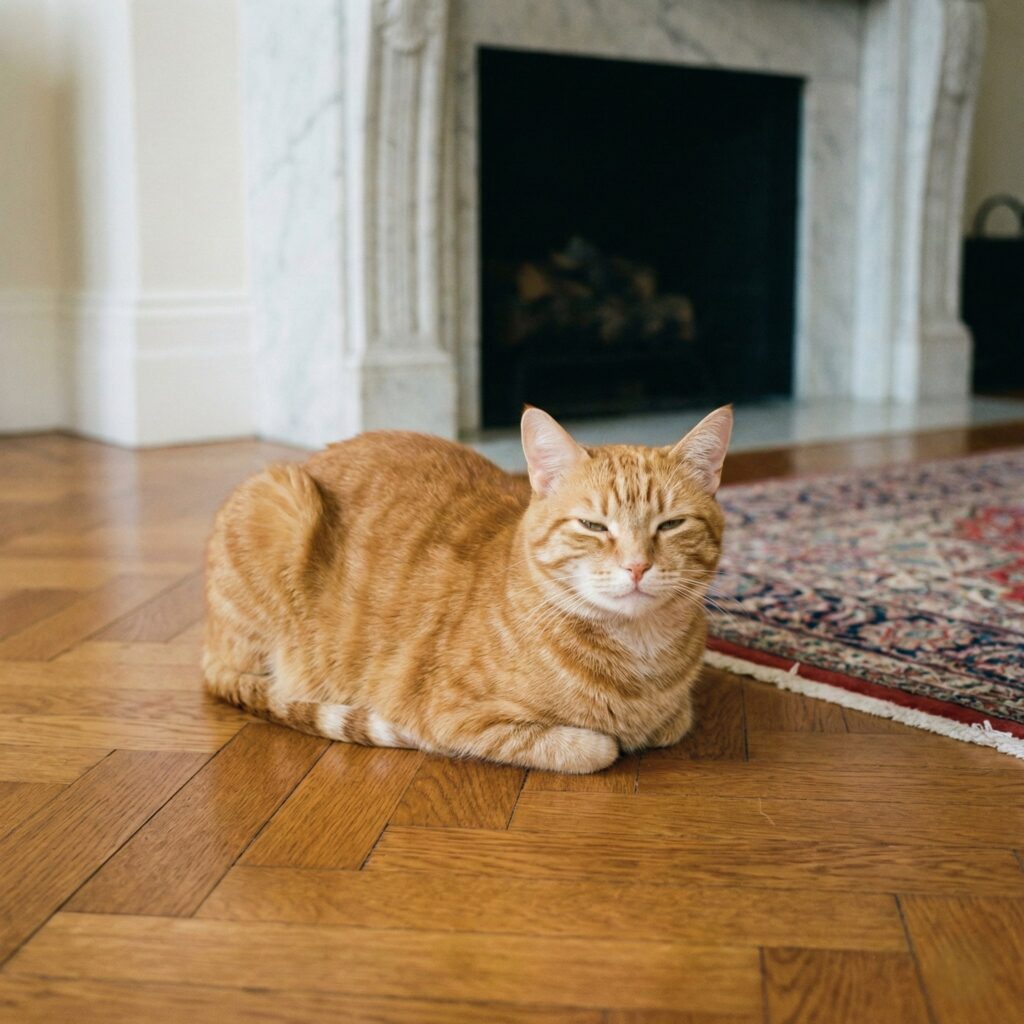
Cats sit in a “loaf” position, tucking their paws and tail underneath their bodies, primarily to conserve body heat and maintain a comfortable body temperature. This position also indicates that the cat feels safe and relaxed, as they do not feel the need to be ready to defend themselves instantly. However, in some cases, a hunched or tense loaf position can signal pain or illness.
Summary Table: The Cat Loaf Explained
| Reason for Loafing | Explanation | Key Indicator |
| Heat Conservation | Cats tuck extremities to minimize heat loss. | Common in cooler rooms; paws are fully hidden. |
| Relaxation & Safety | The cat trusts its environment and doesn’t need to run. | Soft eyes, slow blinking, relaxed ears. |
| Comfort | It relieves pressure on paws and joints. | Cat settles in quickly and stays still. |
| Pain or Illness | A “hunched” loaf can hide abdominal pain or injury. | Furrowed brow, lowered head, hiding, lack of appetite. |
Why Do Cats Sit in Loaves?
The “cat loaf,” often referred to by veterinarians and behaviorists simply as “loafing,” is a specific body posture where a cat sits with all four paws tucked neatly underneath its belly. The tail is usually wrapped tightly around the side or tucked under the body as well. The result is a compact, rectangular shape that resembles a loaf of bread.
While it looks incredibly cute, this posture serves several functional purposes related to a cat’s biology and psychology. Understanding why your cat assumes this shape can give you valuable insight into their mood and health.
Read Also: Why Do Cats Headbutt People?
Reason 1: Thermoregulation (Keeping Warm)
The most common biological reason for loafing is thermoregulation. A cat’s normal body temperature is higher than a human’s, typically ranging between 100.5°F and 102.5°F (38°C – 39°C).
Because they run hotter than we do, they have a higher thermoneutral zone, the temperature range where they don’t have to expend energy to cool down or warm up.
- Protecting Extremities: A cat’s paw pads and nose are the few areas on their body not covered in thick fur. These areas lose heat faster than the rest of the body.
- Creating a Heat Shield: By tucking their paws underneath their chest and wrapping their tail around their body, they reduce the surface area exposed to the cool air. This effectively seals in their body heat.
You will often notice your cat loafing more frequently during winter months or if they are sitting on a cold surface, like a tile floor or a granite countertop.
It is the feline equivalent of a human crossing their arms and hunching their shoulders when they feel a draft.
Reason 2: A Sign of Safety and Trust
Believe it or not, the loaf position puts a cat at a slight disadvantage if they need to move quickly. Because their paws are tucked beneath them, they cannot instantly spring into a sprint or lash out with their claws to defend themselves. They would first have to untuck their limbs, which takes a split second.
Therefore, if your cat is loafing near you, it is a huge compliment. It signals:
- Low Anxiety: They do not perceive any immediate threats in their environment.
- Trust: They feel comfortable enough in your presence to disable their primary defenses.
- Contentment: They are likely in a positive mood, often accompanied by purring or slow blinking.
If a cat is on high alert, they will usually keep their paws flat on the ground (the “Sphinx” pose) so they are ready to launch into action at a moment’s notice.
Read Also: Why Does My Cat Sleep Face Down?
Reason 3: Comfortable Relaxation
Cats sleep anywhere from 12 to 16 hours a day. However, they don’t spend all those hours in a deep sleep cycle. Much of their downtime is spent simply resting or dozing lightly. The loaf is the perfect position for this type of rest.
- Joint Relief: The position takes weight off their paws.
- Spine Alignment: For many cats, the rounded curvature of the spine in a loaf is physically comfortable.
- Not Deep Sleep: You rarely see a cat in a deep REM sleep while loafing. Usually, if they want to sleep deeply, they will sprawl out on their side or curl into a tight “donut” shape. The loaf is for “power naps” or simply watching the world go by.
Reason 4: They Wants to Be Left Alone (Politely)
Sometimes, body language is about setting boundaries. While a cat exposing their belly is often an invitation for play (or a trap!), the loaf is a neutral, self-contained pose.
When a cat loafs, they are making themselves smaller and removing their limbs from the equation. This can sometimes indicate that they are content but not necessarily looking for interaction.
They are in a state of “do not disturb, but I am happy to be near you.” It is a passive way of existing in a shared space without demanding attention.
Read Also: How Cats Choose Their Favorite Sleeping Spots
The Different Types of Loaves
Not all loaves look exactly the same. Cat owners often spot variations in this posture, and each can mean something slightly different.
1. The Full Loaf
This is the classic bread shape. All four paws are tucked, the tail is hidden, and the head is upright. This is the ultimate sign of thermal conservation and relaxation.
2. The Partial Loaf (The Sphinx)
In this version, the back paws are tucked, but the front paws are extended flat on the ground.
- Meaning: This is a semi-alert state. The cat is resting but wants to keep their front claws ready just in case a toy (or a mouse) runs by.
3. The Face Plant Loaf
The cat assumes the loaf position but buries their face into the blanket or floor.
- Meaning: This often means the cat is very cold and trying to keep their nose warm. However, if your cat is pressing their head hard against a wall or surface while awake, this can be a medical emergency called “head pressing” and requires a vet visit. If they are just sleeping face-down on a soft pillow, it’s usually just a quirk.
4. The Elbow Loaf
The cat tucks their paws, but their elbows stick out slightly, creating a nub on either side of the chest.
- Meaning: This is just a variation of anatomy. Some cats have longer limbs and can’t tuck as tightly as others.
When to Worry: The “Pain Loaf”
While loafing is generally normal, it can sometimes be a sign that a cat is unwell. Cats are masters at hiding pain. In the wild, showing weakness made them targets for predators, so they evolved to mask illness.
A cat in pain may assume a position that looks like a loaf but has distinct differences. You should look for the following signs of the “Pain Loaf”:
- Hunched Back: Instead of a relaxed, flat back, the spine is arched or hunched up.
- Lowered Head: The head hangs low, often below the level of the shoulders, rather than being held upright and alert.
- Squinting or Furrowed Brow: The eyes are not soft and blinking; they are squinted in a grimace. The whiskers may be pulled back tightly against the cheeks.
- Inability to Settle: The cat seems restless, constantly shifting weight while in the loaf position, or they stay in the loaf for hours without moving at all, refusing to eat or drink.
- Location: A sick cat will often loaf in a hiding spot—under a bed, in a closet, or facing a corner—rather than in their favorite sunny spot or on the sofa.
This posture is often associated with abdominal pain, kidney disease (CKD), or pancreatitis. The hunched position guards their belly and relieves tension on internal organs.
Read Also: Why Cats Love Boxes
Anatomy of the Loaf: How Do They Do It?
Have you ever tried to tuck your arms and legs under your torso? It’s not easy for humans. Cats have a unique skeletal structure that makes this effortless.
- The Clavicle (Collarbone): Unlike humans, whose collarbones connect the shoulder to the breastbone, cats have free-floating collarbones. This allows them to squeeze through tight spaces and tuck their front limbs inward comfortably.
- Flexible Spine: A cat’s spine has more vertebrae than a human’s, and the cushioning discs between them allow for extreme flexibility. This lets them curve their body into a compact shape without strain.
- Wrist Rotation: Cats can rotate their wrists (carpals) to tuck their paws inward, folding them against their chest without overextending the joint.
Does Breed Matter?
While all domestic cats can loaf, some do it more than others due to body type and fur length.
- Shorthair Cats: Breeds like the American Shorthair, Siamese, and Abyssinians are frequent loafers. Because they have shorter fur, they feel the cold faster and use the loaf position to conserve heat.
- Longhair Cats: Breeds like Maine Coons or Persians naturally have more insulation. You might see them loafing less often, or they might prefer the “Sphinx” pose with paws out because they don’t need to trap as much heat. They may even sleep sprawled out on their backs to cool down.
- Hairless Cats: Sphynx cats are professional loafers. Without any fur to keep them warm, they rely heavily on body posture (and sweaters) to regulate their temperature.
Frequently Asked Questions
Why does my cat stare at me while loafing?
This is usually a sign of affection and curiosity. They are relaxed and simply observing you, their favorite human. If they slow blink while staring, return the blink to show them you love them too.
Do big cats (lions/tigers) loaf?
Yes! Even big cats like lions, tigers, and leopards have been photographed in the loaf position. The mechanics of the feline skeleton are similar across species, although big cats do it less frequently than house cats.
Why does my cat bite me when I touch their tucked paws?
The tucked paws are sensitive and currently serving a purpose (warmth). When you poke them, you are disrupting their temperature regulation and their sense of security. It is best to admire the loaf from a distance or pet their head instead.
Conclusion
When you see your cat turn into a loaf of bread, it is almost always a good sign. It means they are feeling chilly, comfortable, and safe enough to tuck away their defenses. It is one of the most classic and endearing behaviors in the feline world.
However, as a responsible pet owner, always pay attention to the context. A relaxed loaf on a sunny windowsill is perfect. A hunched, tense loaf in a dark closet may be a cry for help.
By learning to read the subtle differences in your cat’s posture, you can ensure they are not just looking cute, but feeling great too.