
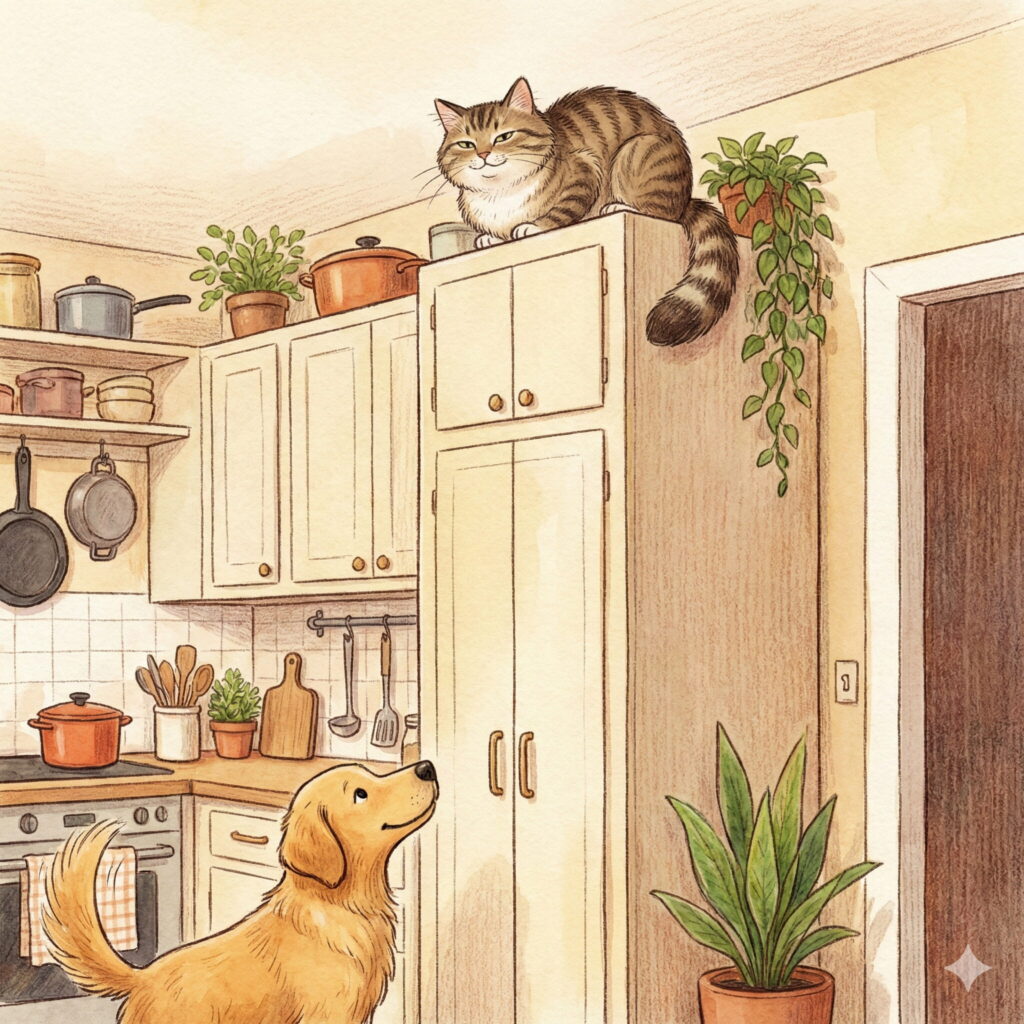
Cats prefer high places primarily due to their evolutionary instincts. Being high up gives them a strategic vantage point to spot prey and avoid larger predators. Additionally, vertical spaces offer a sense of security, help establish social hierarchy in multi-cat households, provide warmth as heat rises, and serve as a private retreat from household chaos.
Summary Table: Reasons Cats Seek Heights
| Reason | Description | Benefit to Cat |
| Survival Instinct | Rooted in wild ancestry (arboreal heritage). | Safety from predators; spotting prey. |
| Territory & Status | Height often equals status in the feline world. | Displays dominance; surveys territory. |
| Temperature Control | Warm air rises to the ceiling. | Conserves body heat; stays comfortable. |
| Stress Relief | Escape from kids, dogs, or vacuums. | Lowers anxiety; provides “me time.” |
| Observation | A clear view of the room and windows. | Mental stimulation; monitoring activity. |
5 Reasons Cats Prefer High Places?
If you share your home with a cat, you have likely found them perched on top of the refrigerator, balancing on a bookshelf, or napping on the highest tier of a cat tree. It is a universal feline behavior.
While it might seem like they just enjoy looking down on their humans (both literally and figuratively), there is actually a complex set of biological and psychological reasons for this behavior.
Understanding why your cat seeks out vertical space is crucial for being a good pet owner. It allows you to create an environment that satisfies their natural needs, reduces behavioral issues, and keeps them happy.
Read Also: Why Do Cats Hide in Small, Dark Spaces?
This guide explores the evolutionary history, social dynamics, and physical benefits behind your cat’s love for heights.
1. Evolutionary Instincts and Arboreal Heritage
To understand the modern house cat (Felis catus), we must look at their ancestors. Domestic cats are descendants of wildcats that were both predators and prey. In the wild, survival depended on being able to climb.
Safety From Predators
In nature, danger usually comes from the ground. Larger predators like coyotes, wolves, or hyenas hunt at ground level. By climbing trees, wildcats could escape these threats.
This survival mechanism is deeply hardwired into your cat’s DNA. Even in a safe living room, your cat’s instinct tells them that being high up means being safe.
When they are on a high shelf, they are out of reach of “predators”, which, in a modern home, might be an overenthusiastic toddler or a vacuum cleaner.
The Hunter’s Vantage Point
Cats are solitary hunters. Climbing high gave their ancestors a significant advantage. From a high branch, a wildcat could scan the forest floor for movement without being seen.
They could spot rodents or birds and plan a surprise attack. This is known as the “vantage point.”
When your cat sits on a tall cat tree staring at a toy on the floor, they are mimicking this hunting behavior. They are assessing the situation, calculating the distance, and waiting for the perfect moment to pounce.
2. Social Hierarchy and Territory
In the world of cats, vertical space is not just about safety; it is about status. Height plays a significant role in the social hierarchy, especially in households with multiple cats.
The “Top Cat”
There is a literal meaning to the phrase “top cat.” The cat with the highest ranking in the social group often claims the highest resting spot.
By physically positioning themselves above others, they are asserting their dominance without needing to fight. It is a passive way to display authority.
If you have two cats, you might notice they take turns on the top shelf, or one might control the top spot while the other stays lower. This negotiation of vertical space helps maintain peace. It allows cats to share a territory without constant confrontation.
Surveying the Kingdom
Cats are territorial animals. They need to know what is happening in their domain at all times. A high perch acts as a watchtower.
It allows them to see the entry points of a room, monitor the movement of humans and other pets, and ensure their territory is secure. This visual control gives them a sense of confidence and ownership over their environment.
Read Also: Why Do Cats Suddenly Bite During Petting?
3. Stress Reduction and Anxiety Management
The modern home can be a chaotic place. Loud noises, unfamiliar guests, crying babies, or other pets can be overwhelming for a cat. Cats are sensitive to environmental changes, and they cope with stress by retreating.
The Safe Retreat
High places serve as a panic room. When a cat feels threatened or annoyed, their first instinct is often to go up. Being high up creates physical distance between them and the stressor. It essentially makes them invisible. If they cannot be reached, they cannot be bothered.
For shy or anxious cats, having access to vertical space is essential for their mental health. It gives them a way to control their interaction with the world.
If you force a cat to stay on the ground when they are scared, they may react with aggression because they feel cornered. Allowing them to climb helps them self-soothe.
Conflict Avoidance
Cats generally prefer to avoid physical fights. Fighting risks injury, which is dangerous for a solitary predator. Vertical territory provides an escape route. If a cat is being chased by another cat or a dog, jumping onto a table or shelf ends the interaction immediately. It creates a “time-out” zone where the pursuer cannot follow.
4. Temperature Regulation
Cats love warmth. Their thermoneutral zone (the temperature range where they do not need to expend energy to cool down or warm up) is much higher than that of humans, roughly 86 to 97 degrees Fahrenheit.
Heat Rises
It is a basic law of physics that hot air rises while cool air sinks. Consequently, the air near your ceiling is warmer than the air near the floor. In the winter months, the top of a bookshelf or a high window perch is often the warmest spot in the house.
By sleeping in high places, cats are essentially conserving body energy. They find a pocket of warm air and curl up to maintain their body temperature without having to shiver or move around.
This is why you will often find your cat sleeping on top of kitchen cabinets, where the heat from the refrigerator motor and the rising room heat combine to create a cozy sauna.
Read Also: Why Do Cats Flick Their Tails While Lying Down?
5. Curiosity and Environmental Enrichment
Cats are naturally curious creatures. They have a high need for mental stimulation to prevent boredom. A life on the floor is limited in perspective, but vertical spaces open up a new world of observation.
Window Watching
Many high places in a home, such as the back of a sofa or a windowsill, offer a view of the outdoors. This is “Cat TV.” From a high window, a cat can watch birds, squirrels, insects, and passing cars. This visual stimulation is vital for an indoor cat’s cognitive health. It keeps their predator brain engaged even if they aren’t hunting.
New Perspectives
Changing elevation changes perspective. A cat might get bored with the living room layout from the floor, but from the top of a curtain rod, the room looks completely different.
It provides a new landscape to explore. This variety helps prevent behavioral issues that stem from boredom, such as destructive scratching or over-grooming.
How to Provide Vertical Space
Now that we understand why cats need height, it is the owner’s responsibility to provide it. You do not need to rebuild your house, but you should incorporate “cat-friendly” design elements. This is often called “catification.”
Cat Trees and Towers
The standard solution is a cat tree.
- Stability: Ensure it has a wide, heavy base so it does not wobble.
- Height: Taller is usually better. Aim for at least 5 or 6 feet.
- Perches: Look for trees with curved perches or “condos” for sleeping.
- Placement: Place it near a window or in a corner where the cat can see the whole room. Do not hide it in a basement; cats want to be where the social action is, just from a safe distance.
Cat Shelves and Walkways
If you have limited floor space, use your walls. Floating shelves specifically designed for cats are very popular.
- Staggered Steps: Create a staircase effect so the cat can easily jump from one to the next.
- Traction: Add non-slip mats or carpet to the tops of shelves so the cat doesn’t slide off.
- Route: Create a continuous path that allows the cat to enter and exit without getting stuck.
Window Perches
Window perches are platforms that suction-cup to the glass or attach to the sill. These are excellent for bird watching. Ensure they are rated for your cat’s weight.
Utilizing Existing Furniture
You don’t always need to buy new products. You can clear off the top of a bookshelf, armoire, or refrigerator. Just ensure there is a safe way for the cat to get up and down, perhaps by placing a sturdy chair or stool nearby to act as a step.
Read Also: Why Do Cats Roll on Their Backs but Hate Belly Rubs?
7. Safety Concerns: The Risk of Falling
While cats are excellent climbers, they are not immune to gravity. There are specific risks associated with high places that owners must address.
High-Rise Syndrome
This is a term used by veterinarians to describe injuries sustained by cats falling from windows or balconies, typically from the second story or higher.
- The Myth: People think cats always land on their feet and survive.
- The Reality: While they have a “righting reflex,” falls from great heights can cause shattered jaws, broken legs, and internal trauma.
- Prevention: Always ensure window screens are secure. If you have a balcony, enclose it with netting or mesh (a “catio”) to prevent accidental falls.
Unstable Furniture
Cats jump with force. If they leap onto a tall, lightweight lamp or an unsecured bookshelf, it could tip over. This can injure the cat and destroy your property.
- Anchor Furniture: Use wall anchors to secure tall bookcases and dressers to the wall.
- Check Stability: Regularly tighten the screws on cat trees, as the vibration from jumping can loosen them over time.
Senior and Arthritic Cats
As cats age, their agility declines. A 15-year-old cat still has the instinct to be high up, but they may lack the muscle power to jump.
- Accessibility: Add ramps or pet stairs.
- Lower Options: Provide mid-level perches that are easier to reach.
- Softer Landings: Place rugs or cushions around the base of climbing areas to protect their joints if they stumble.
Conclusion
The preference for high places is not a quirk; it is a fundamental part of being a cat. It is tied to their survival, their social structure, and their emotional well-being.
By understanding the biology behind this behavior, you can stop seeing your cat on the counter as a nuisance and start seeing it as a natural expression of their instincts.
Providing vertical space, whether through expensive cat trees or simply clearing off a shelf, is one of the best ways to enrich your cat’s life. It gives them security, warmth, and entertainment.
When your cat looks down at you from their high perch, they aren’t judging you (well, maybe a little); they are simply feeling safe, secure, and at home in their territory.