
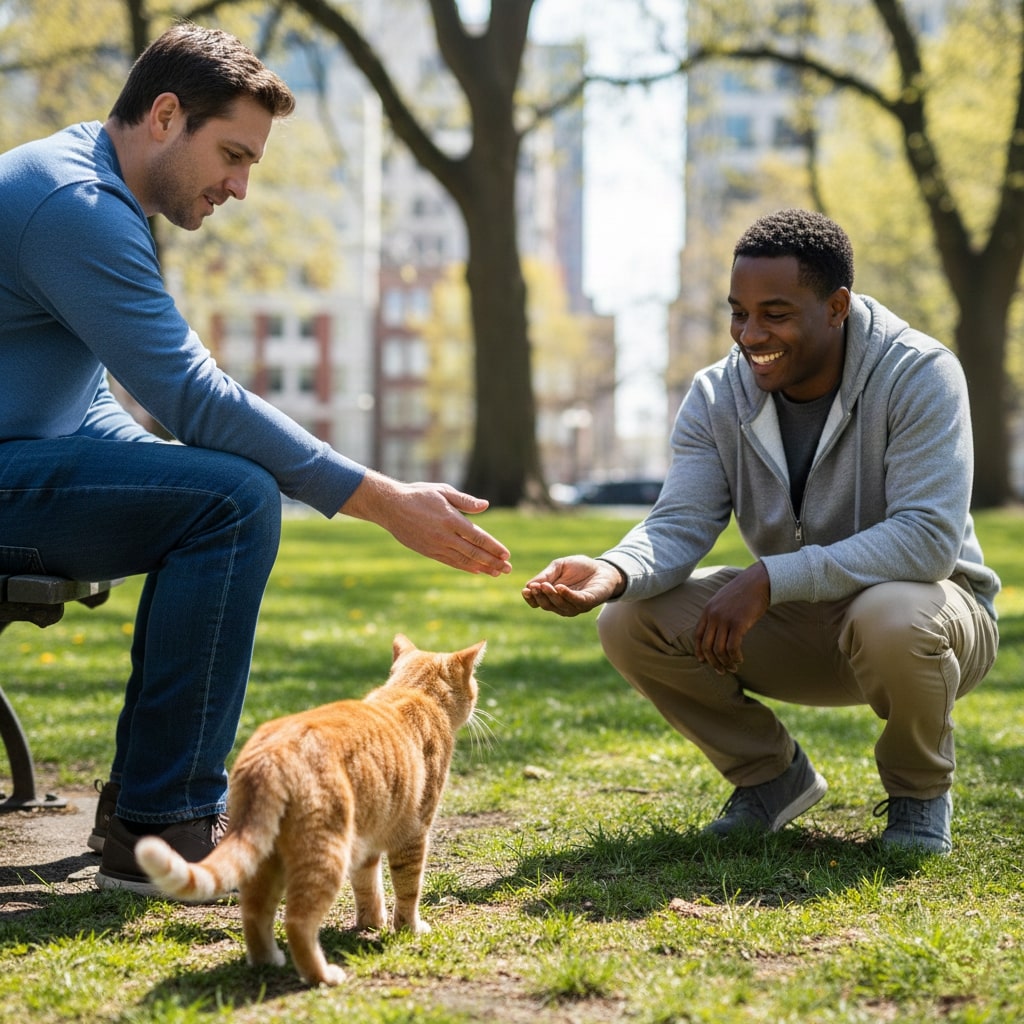
Cats often choose a favorite person based on communication style, predictability, and resource provision. They gravitate toward individuals who respect their boundaries, use subtle body language (like slow blinks), and provide positive experiences such as food or gentle play. Often, the person who tries the least, avoiding direct eye contact and aggressive petting, is the one a cat feels safest around.
Summary Table: Key Factors in Feline Bonding
| Factor | Description | Why It Matters |
| Communication | Slow blinks, soft voice, indirect gaze | Signals safety and non-aggression to the cat. |
| Respect for Space | Letting the cat approach first | Builds trust and reduces anxiety. |
| Scent Association | Familiar and comforting smells | Cats use scent to mark “safe” people and territory. |
| Resource Provision | Feeding, treats, and play | Creates a positive association with that person. |
| Personality Match | Energy levels aligning (e.g., calm vs. active) | Ensures the cat feels understood and comfortable. |
| Early Socialization | Interactions during kittenhood (2–9 weeks) | Shapes future preferences for human interaction. |
Why Do Cats Prefer Certain People for Bonding: 10 Reasons
Cats have a reputation for being aloof, mysterious, and independent. Unlike dogs, who often wear their hearts on their furry sleeves, cats can be harder to read. One of the most common questions cat owners ask is, “Why does my cat like my husband/wife/roommate more than me?” or “Why does the cat sit on the lap of the one person in the room who is allergic?”
The answer lies in a complex mix of feline psychology, sensory perception, and behavior. Cats are not random in their affections; they are highly observant creatures who choose their companions based on who makes them feel safe, understood, and comfortable.
This guide explores the scientific and behavioral reasons behind feline favoritism.
Read Also: Why Do Cats Stare at Walls?
1. The “Less Is More” Approach
One of the biggest ironies in the cat world is that cats often gravitate toward the person who ignores them. If you are a “cat person,” you likely try to engage a cat immediately by staring, reaching out, or talking loudly. To a human, this is friendly. To a cat, this can feel aggressive or overwhelming.
Why Ignoring Works:
- Eye Contact: In the animal kingdom, prolonged direct eye contact is often a threat. People who dislike cats or are allergic often avoid looking at them. The cat interprets this lack of eye contact as a non-threatening signal.
- Physical Space: Someone who doesn’t want the cat near them sits still and doesn’t reach out. This allows the cat to approach at their own pace, which gives the cat a sense of control.
- Noise Level: “Cat people” might use high-pitched, excited voices. A reluctant human usually stays quiet. Cats have sensitive hearing and generally prefer a calm, quiet demeanor.
If you want a cat to like you, try ignoring them. Let them come to you, sniff you, and decide you are safe before you try to pet them.
Read Also: Why Does My Cat Hate Me But Love Everyone Else?
2. Understanding Feline Communication
Cats have a specific language that relies heavily on body signals and scent. People who naturally (or accidentally) speak this language will win a cat’s favor.
The Slow Blink
The “slow blink” is a universal sign of trust among cats. If a cat looks at you and slowly closes and opens their eyes, they are telling you they feel safe. People who instinctively slow blink back, rather than staring wide-eyed, build a quicker rapport.
Respecting Boundaries
Cats are consent-oriented animals. They prefer interactions where they initiate contact. A person who picks a cat up constantly, hugs them tight, or touches their belly without permission is often labeled “annoying” or “unsafe” by the cat. The favorite person is usually the one who stops petting when the cat’s tail starts twitching or when their ears turn back.
Signs a Cat Wants Space:
- Tail twitching or lashing
- Ears flattened or turned sideways
- Dilated pupils
- Skin rippling on the back
- Growling or hissing
3. The Power of Scent
Cats live in a world of smell. Their sense of smell is roughly 14 times stronger than a human’s. They use scent to communicate, mark territory, and identify friends.
Scent Mixing
When a cat rubs their cheek against your leg or bumps their head on you (a behavior called “bunting”), they are depositing pheromones from scent glands on their face. They are marking you as “theirs.” If you accept this behavior without washing it off or pushing them away, you become a familiar, safe part of their territory.
Familiar Smells
Cats may prefer a person whose scent is familiar or comforting. This could be due to the person’s natural body chemistry, or even the laundry detergent they use. Conversely, strong perfumes, colognes, or the smell of other animals (especially strange dogs or cats) can be a turn-off.
Read Also: Why Does My Cat Keep Sniffing Me?
4. Resource Association
At their core, cats are pragmatic. They know who feeds them. While food isn’t the only reason a cat loves you, it is a massive foundation for bonding.
The “Food Giver” Advantage
The person who fills the food bowl represents survival and reward. However, it is not just about the act of feeding; it is about the routine. Cats love routine. The person who feeds them at the same time every morning becomes a predictable, positive force in their life.
Beyond the Bowl
Resources aren’t just kibble. They include:
- Treats: High-value rewards for good behavior.
- Play: The person who uses the feather wand or laser pointer is providing an outlet for the cat’s hunting instinct.
- Warmth: A person with a warm lap or a cozy blanket is a valuable resource for a heat-seeking cat.
5. Personality Compatibility
Just like humans, cats have distinct personalities. Some are bold and energetic, while others are shy and retiring. A cat will usually bond best with a human whose energy matches their own.
- The Shy Cat: A timid cat will almost always prefer a quiet, calm human who moves slowly and speaks softly. A loud, boisterous person will be terrifying to them.
- The Active Cat: A high-energy Bengal or Siamese might prefer a person who is active, playful, and willing to engage in rough-and-tumble games or training sessions.
- The Lap Cat: An older or affectionate cat will choose the person who spends the most time sitting on the couch, providing a stable surface for napping.
Read Also: Why does my cat hate me?
6. Early Socialization and History
A cat’s preference for certain types of people is often rooted in their kittenhood. The critical socialization period for kittens is between 2 and 9 weeks of age.
Positive Associations
If a kitten was handled gently by women during this period but never saw a man, they might grow up to be fearful of men. If they were raised in a noisy house with kids, they might be comfortable with children. If they were a feral rescue who had limited human contact, they might always be wary of strangers and bond only with one specific caretaker who earned their trust over months.
Trauma and Memory
Cats have excellent long-term memories regarding emotional experiences. If a person with a beard once stepped on a cat’s tail or yelled at them, that cat might develop a lifelong aversion to men with beards. Conversely, if a person with glasses always gave them treats, they might generalize that people with glasses are “good.”
7. Predictability and Routine
An often-overlooked factor is predictability. Cats are control freaks. They get stressed by chaos and unpredictability.
The favorite person in the household is often the one with the most stable routine. If you wake up, feed the cat, go to work, come home, and sit in the same chair at the same time every day, the cat knows exactly what to expect from you. You are a safe harbor in a chaotic world.
Why Erratic Behavior Fails
A person who is moody, sometimes hugging the cat, sometimes yelling at the cat to get off the counter, is confusing. The cat cannot predict if an interaction will be positive or negative, so they will likely avoid that person to be safe.
Read Also: Why Does My Cat Hit Me with Her Tail?
8. The Breed Factor
While individual personality reigns supreme, breed tendencies can influence who a cat prefers.
- One-Person Breeds: Some breeds, like the Russian Blue, Siamese, or Ragdoll, are notorious for bonding intensely with one specific person. They may tolerate others, but they have a clear “human.”
- Social Breeds: Breeds like the Maine Coon or Abyssinian are often more dog-like and social, willing to greet everyone at the door.
Understanding your cat’s breed heritage can help explain why they might be velcroed to your side or why they act like a social butterfly.
How to Become Your Cat’s Favorite
If you are reading this and realizing you are not the favorite, don’t worry. You can change your status. Relationships with cats are fluid and can be improved with patience and strategy.
Steps to Improve Your Bond with a Cat
- Stop Trying So Hard: Ignore the cat. Let them come to you. When they do, offer a single finger for them to sniff. If they rub against it, give them a gentle scratch under the chin. Then stop.
- Become the Source of Good Things: Take over feeding duties. Keep a bag of high-value treats in your pocket. Whenever the cat looks at you, toss a treat.
- Play Every Day: Spend 10-15 minutes a day playing with the cat. Use an interactive toy like a wand. Let them catch the “prey” at the end to boost their confidence.
- Learn Their Language: Practice the slow blink. Watch their tail. If the tail thumps, back off immediately.
- Create Rituals: Establish a routine that involves just you and the cat. Maybe it’s morning brushing or evening snuggles while watching TV.
The Role of Safety and Security
Ultimately, affection in the animal world is rooted in survival. A cat loves you because you provide safety.
When a cat sleeps on you, they are at their most vulnerable. By choosing your lap, they are saying, “I trust you to protect me while I am unconscious.” This is the highest compliment a predator can give.
The person who makes the cat feel the most secure, through consistent behavior, gentle handling, and respect for personal space, will always win the contest for affection. It is not about who buys the most expensive toys; it is about who listens to what the cat is saying.
Common Myths About Cat Favoritism
Myth: Cats only like people who feed them.
- Fact: While food helps, many cats ignore the person who feeds them in favor of the person who plays with them or lets them sleep in peace.
Myth: Cats hate men.
- Fact: Cats are not sexist. However, men tend to have deeper voices and larger physical frames, which can be more intimidating. Men who are gentle and soft-spoken are often huge favorites among cats.
Myth: You can’t change a cat’s mind.
- Fact: You absolutely can. It takes time, sometimes months, but consistent positive reinforcement can turn a wary cat into a lap cat.
Conclusion
Cats prefer certain people not by accident, but by a careful calculation of safety, comfort, and compatibility. They choose the human who speaks their language of subtle gestures and boundaries. They choose the provider of food and fun. They choose the person whose energy balances their own.
If you are the chosen one, cherish it. It is a bond earned through trust. If you aren’t, observe the person who is. Watch how they sit, how they move, and when they choose to interact. Mimic their calm, respectful approach, and you might find a furry friend curling up in your lap sooner than you think.