
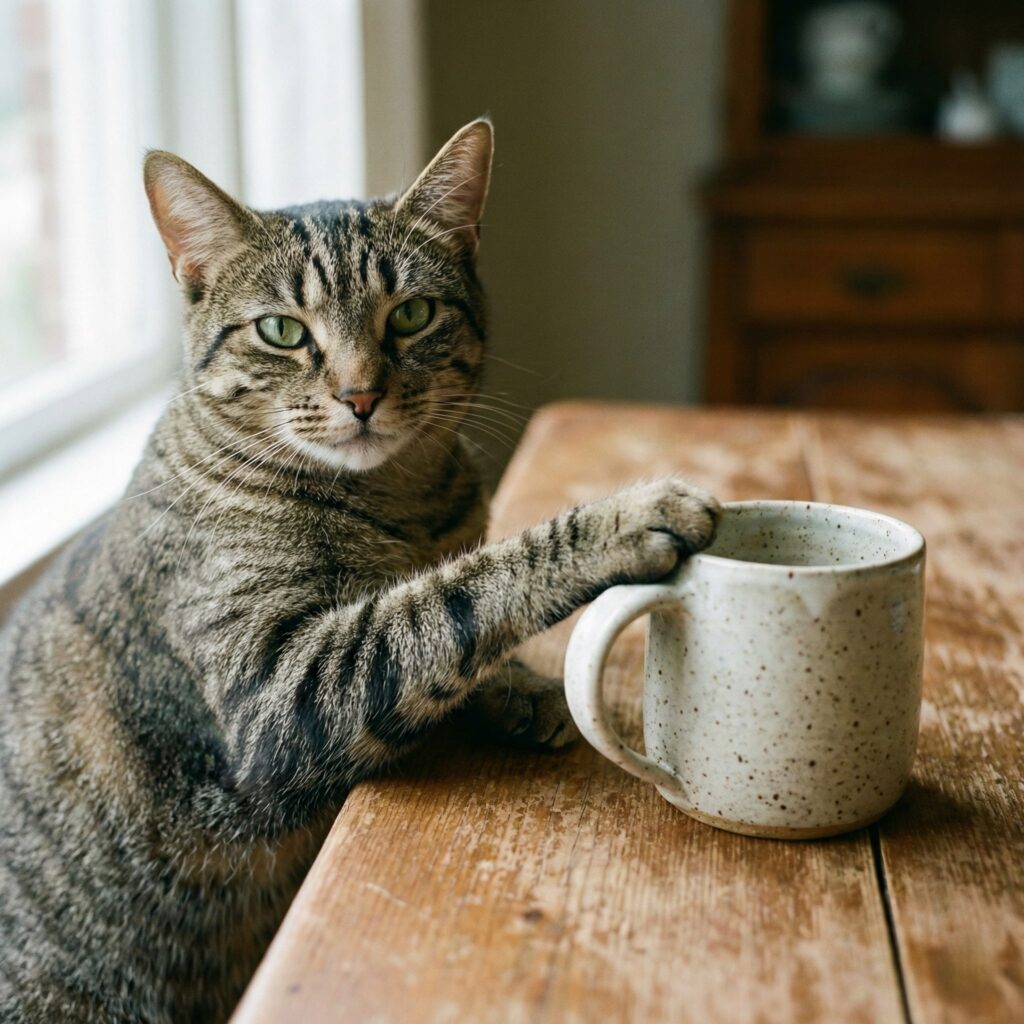
Cats knock things over primarily due to hunting instincts, boredom, or attention-seeking behavior. In the wild, cats use their paws to test if prey is alive or dangerous. Indoors, this translates to swatting objects to see how they move. Additionally, if you react when they push a glass off a table, they learn it is a quick way to get your attention.
Quick Summary: Why Cats Push Items Off Tables
| Cause | Description | Best Solution |
| Predatory Instinct | Testing objects to see if they are potential prey or alive. | Provide “prey-like” toys (mice, feathers) for them to swat. |
| Attention Seeking | They want you to look at them, feed them, or play. | Ignore the bad behavior; reward them when they are calm. |
| Boredom | They are under-stimulated and making their own fun. | Increase playtime and use food puzzles. |
| Exploration | Testing textures, weight, and sound of objects. | Rotate toys to keep their environment interesting. |
Why Do Cats Knock Things Over? The Science Behind the Swat
It is a sound every cat owner knows. You are sitting on the couch, maybe reading or watching TV, when you hear a slow scratching sound against the coffee table. You look up to see your cat staring you dead in the eyes. They extend one paw, tap your glass of water, and watch it crash to the floor.
Why do they do this? Is it spite? Is it an accident?
While it might feel personal, animal behaviorists assure us it is not. Cats are driven by biology, instinct, and a desire to communicate with us. Understanding why your cat knocks things over is the first step to saving your favorite mugs and maintaining your sanity.
Read Also: Indoor vs Outdoor Cats
1. The Hunter’s Instinct: Testing for Life
The primary reason cats knock things over lies in their DNA. Your fluffy house cat shares a significant amount of genetic programming with lions, tigers, and leopards. In the wild, a cat’s survival depends on its ability to hunt.
When a predator encounters something unfamiliar in the grass or under a bush, it doesn’t immediately bite it. That could be dangerous. Instead, cats use their sensitive paws to “test” the object. They swat, poke, and prod to see if the object moves, runs away, or fights back.
How this applies to your house:
- Static objects are boring: A pen sitting on a desk looks dead. To a cat, this is uninteresting.
- The “Life” Check: By swatting the pen, the cat forces it to move. If it rolls, skitters, or falls, it mimics the movement of a mouse or lizard.
- The Chase: The movement triggers their prey drive. The crash to the floor is the “kill.”
This is why small, light objects like lighters, lip balms, and coins are frequent victims. They move easily when batted, satisfying that urge to hunt.
2. They Want Your Attention (And They Know How to Get It)
Cats are incredibly smart observers. They watch humans constantly and learn cause and effect very quickly.
Think about what happens when your cat sits quietly on the cat tree. You might ignore them. But what happens when they jump on the counter and start nudging a glass vase toward the edge?
- You gasp.
- You rush over.
- You say, “No, Fluffy, stop!”
- You pick them up or move the object.
To a human, this is discipline. To a cat, this is success.
The Loop of Attention:
Cats do not always distinguish between “good” attention (cuddles) and “bad” attention (being scolded). If a cat is bored or hungry, any reaction from you is better than no reaction. They learn that the sound of an object hitting the floor makes their human come running immediately.
This is often why cats knock things over specifically when you are busy, such as when you are working on a laptop, sleeping, or cooking. They have figured out the “button” to press to make you interact with them.
Read Also: Why Cats Scratch Furniture
3. “Cat Physics” and Boredom
Sometimes, the answer is simple: your cat is bored. An under-stimulated cat will create their own games.
Indoor cats do not have the same environmental challenges as outdoor cats. They don’t have to hunt for food, avoid predators, or navigate rough terrain. If you do not provide enough mental and physical enrichment, they will turn your home into a playground.
Why gravity is fun for cats:
- Visual Stimulation: Seeing an object fall from a high place to a low place is visually interesting.
- Sound: The clatter of an object hitting the floor provides auditory feedback.
- Texture: They enjoy the feeling of different surfaces, like smooth glass or rough wood, against their paw pads.
If a cat discovers that swatting a remote control makes a cool noise and slides across the table, they will do it again just for the entertainment value.
4. They Are Navigating Their Territory
While less common than the other reasons, sometimes a knocked-over item is just an accident. Cats are generally graceful, but they prioritize their own path over your belongings.
If a shelf is cluttered with knick-knacks, a cat will not politely walk around them. They will walk through them. In the wild, a cat pushes through tall grass or leaves.
In your home, they push through picture frames and collectibles. They view high surfaces like mantles and bookshelves as their territory for patrolling. If your stuff is in the way of their patrol route, it is getting pushed off.
Read Also: How to Tell If Your Cat Is in Pain
Common Items Cats Target (And Why)
You may notice your cat targets specific types of items. This is rarely random.
- Glasses of Water: These are a triple threat. They have interesting reflections (visual), the water moves when touched (prey mimicry), and they make a mess when they fall (environmental change).
- Small Plastic Items: Bottle caps, pens, and hair ties slide easily across surfaces, mimicking the scurrying of insects.
- Paper: Cats love the crinkle sound of paper. Knocking a stack of mail off a table creates a satisfying chaotic fluttering motion.
- Electronics: Phones and remotes are often touched because they smell like you (the owner) and are usually in your hands, making the cat jealous of the object.
How to Stop Your Cat From Knocking Things Over
Now that we understand the why, we can look at the how. You cannot completely delete a cat’s instincts, but you can redirect them.
1. Increase Environmental Enrichment
If your cat is knocking things over out of boredom, you need to give them something better to do. A bored cat is a destructive cat.
- Puzzle Feeders: meaningful play often involves food. Instead of putting kibble in a bowl, use a puzzle feeder or a treat ball. This forces the cat to use their paws to “hunt” for their food appropriately, rather than hunting your car keys.
- Rotate Toys: Cats get bored with the same old mouse toy. Put some toys away in a closet and bring them out a few weeks later. The novelty makes them exciting again.
- Vertical Space: Ensure your cat has cat trees or window perches. If they have high places that belong to them, they might spend less time on the high places that belong to you (like your mantle).
Read Also: Why Cats Groom So Much
2. The “Ignore It” Technique
This is the hardest strategy for humans to master, but it is essential for stopping attention-seeking behavior.
If your cat looks at you and then knocks a pen off the table, do not react.
- Do not look at them.
- Do not say “No.”
- Do not pick up the pen immediately.
Wait until the cat has lost interest and walked away. Then pick up the pen. If you react immediately, you have reinforced the behavior. You must break the link between “Knocking Item” and “Human Attention.”
Conversely, give your cat plenty of attention when they are being “good.” If they are sitting quietly near a breakable object without touching it, praise them or give them a treat.
3. Manage Your Environment (Cat-Proofing)
Sometimes, the best offense is a good defense. If you have a cat that loves gravity, you need to adjust your home decor.
- Museum Wax: This is a clear, sticky putty used by museums to keep artifacts from falling during earthquakes. A small dab under your vases or collectibles will hold them firm against even the most persistent cat paw.
- Velcro Strips: For items like remotes or lightweight electronics, you can use removable velcro strips to keep them anchored.
- Keep Surfaces Clear: The most effective method is simply not leaving breakable items on the edge of tables. Get into the habit of pushing glasses to the center of the table or using heavy coasters.
4. Scheduled Playtime
Cats operate on a cycle: Hunt, Catch, Kill, Eat, Sleep.
If your cat is knocking things over at night or in the evening, it means they have excess energy they haven’t burned off. Schedule 15 minutes of intense play with a wand toy or laser pointer right before their dinner.
- Make them run and jump.
- Let them “catch” the toy at the end.
- Feed them immediately after playing.
This mimics a natural hunting cycle. After a big hunt and a big meal, a cat’s biology tells them it is time to sleep and groom, not time to knock your phone off the nightstand.
Read Also: How Spaying or Neutering Affects Cat Behavior
When to Worry: Is It Medical?
In rare cases, a sudden change in behavior can indicate a medical issue. If your cat has never knocked things over before and suddenly starts doing it aggressively, or if they seem clumsy and are knocking things over by bumping into them (rather than swatting), it could be a sign of:
- Vision Loss: They may not see the object clearly.
- Neurological Issues: Issues affecting balance or coordination.
- Cognitive Dysfunction: Similar to dementia in humans, older cats may become confused or change their habits.
If the behavior is accompanied by other changes like weight loss, hiding, or changes in litter box habits, take your cat to the veterinarian for a check-up.
Conclusion
While it can be frustrating to clean up shattered glass or search for your lip balm under the sofa, try to remember that your cat isn’t trying to be a villain. They are simply being a cat. They are exercising their predatory skills, asking for your love, or simply trying to alleviate boredom.
By removing the temptation, ignoring the bad behavior, and providing fun alternatives, you can protect your belongings and build a happier relationship with your feline friend.
What to do next: Look around your living room right now. Identify three small items sitting near the edge of a table that would be tempting for your cat. Move them to a drawer or the center of the table immediately, and then spend 10 minutes playing with your cat to burn off their hunting energy.