
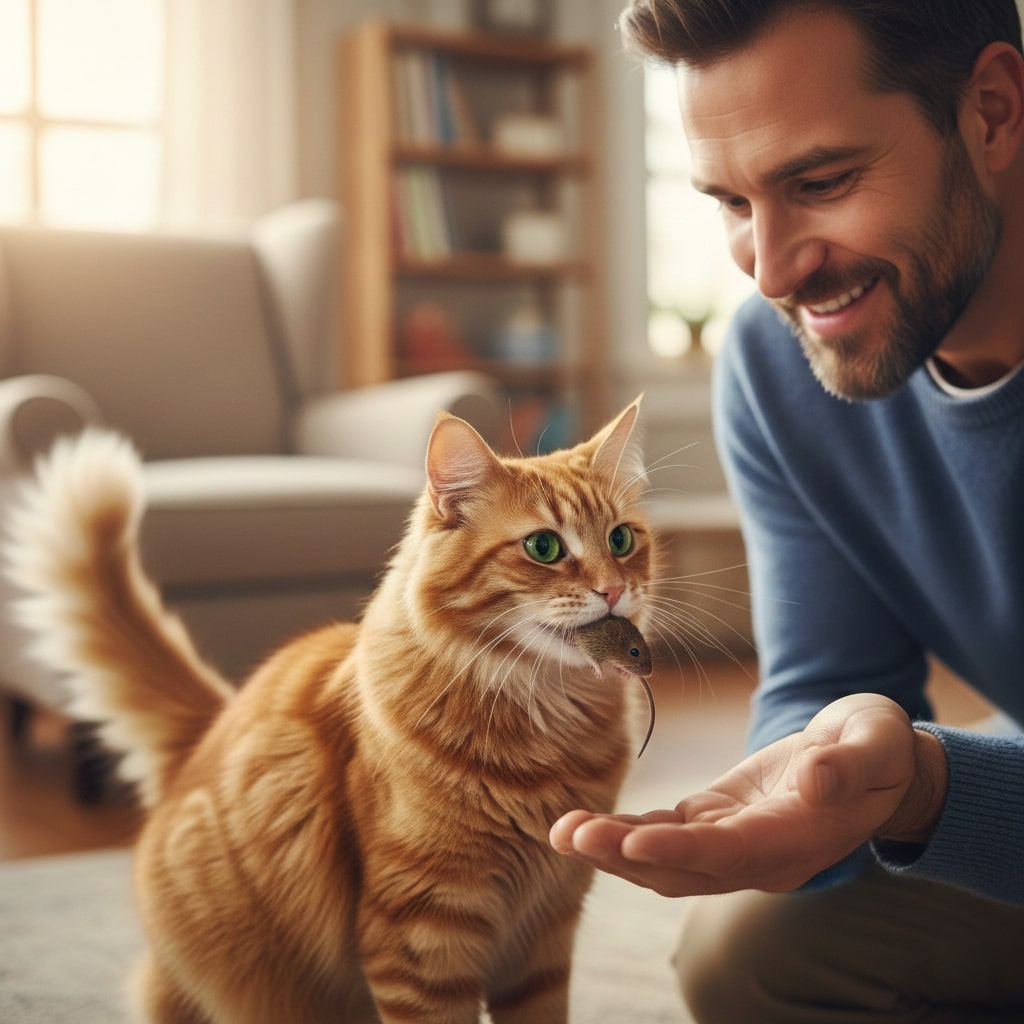
Cats bring you “gifts” primarily due to their natural hunting instincts. In the wild, mother cats bring dead or injured prey to their kittens to teach them how to eat and hunt. When your cat brings you a mouse, bird, or toy, they likely view you as a member of their family who needs to be fed or taught. It is also a sign that your cat feels safe in your home and wants to share their “success” with you.
Summary Table: Why Do Cats Bring You “Gifts”?
| Reason | Explanation | What It Means for You |
| Hunting Instinct | Cats are hardwired predators; the drive to hunt exists even if they aren’t hungry. | Your cat is just being a cat. |
| Parental Instinct | Mother cats bring prey to teach kittens. | Your cat might think you are a terrible hunter who needs help. |
| Safety & Security | Cats bring food to the place where they feel safest to eat or store it. | Your home is their sanctuary. |
| Bonding | Sharing a catch is a major sign of trust and affiliation. | Your cat considers you part of their core group. |
| Play | Sometimes, a toy “gift” is just an invitation to play. | Your cat is bored and wants interaction. |
Why Do Cats Bring You “Gifts”?: The Gross but Sweet Gesture
Every cat owner knows the feeling. You walk into the kitchen for your morning coffee, only to step on something squishy. Or perhaps you wake up to a strange meow, only to find your feline friend dropping a half-dead mouse on your pillow.
It is one of the most confusing behaviors in the pet world. On one hand, it is disgusting. On the other, your cat looks incredibly proud of themselves.
Why do they do this? Are they paying rent? Are they threatening you? Or is it actually, as strange as it sounds, an act of love?
To understand this behavior, we have to stop looking at them as small humans and start looking at them as small predators. This guide will break down exactly why your cat brings you gifts, what it means, and how you should react.
Read Also: What Does It Mean When a Cat Slow Blinks?
1. The Biological Drive: Born to Hunt
The most straightforward reason your cat brings you dead animals is that they are biologically programmed to do so. Even the fluffiest, most pampered house cat is a predator at heart.
Domestic cats (Felis catus) share 95.6% of their DNA with tigers. While we have bred them to be docile companions, we haven’t bred the hunter out of them.
The Prey Drive
In the wild, hunting is necessary for survival. A wild cat must hunt multiple times a day to eat. This instinct is triggered by movement. If something small scuttles across the floor, your cat’s brain sends a signal: Chase it.
Interestingly, the urge to hunt and the urge to eat are controlled by different parts of a cat’s brain.
- Hunger tells them they need calories.
- Prey Drive tells them to catch moving objects.
This explains why a well-fed cat will still kill a bird or a mouse. They aren’t doing it because they are starving; they are doing it because the biological chemicals in their brain reward them for the catch. When they bring that catch home, they are simply returning to their “den” after a successful patrol.
2. The “Teacher” Theory: You Are a Bad Hunter
One of the most popular scientific theories regarding gift-giving comes from the way mother cats raise their kittens.
In the wild, kittens are born blind and helpless. They don’t know how to hunt. The mother cat (the queen) has to teach them. She does this in gradual steps:
- Step 1: She brings dead prey to the kittens so they can eat it.
- Step 2: She brings live but injured prey to the kittens so they can practice the “killing bite.”
- Step 3: She brings live prey for them to chase.
Spayed Females and the Mothering Instinct
Even if your female cat is spayed and has never had kittens, her instincts remain. When she looks at you, she sees a very large, clumsy cat who never seems to catch any mice.
In her eyes, you are unable to fend for yourself. You open cans, but you never hunt. By bringing you a dead mouse, she might be trying to “teach” you how to eat, or simply providing for a member of her pack who she thinks is incapable of hunting alone.
Read Also: Why Does Mama Cat Move Kittens?
3. The “Safe Place” Theory
Cats are vulnerable when they are eating. In the wild, a cat that is busy chewing on a mouse is distracted, which makes them a target for larger predators like coyotes or owls.
Because of this, cats prefer to bring their food back to a location where they feel secure before they consume it.
If your cat catches a moth or a mouse in the yard, they may not want to eat it out in the open. They carry it through the cat flap and into the living room because the living room is their territory. It is safe, warm, and smells like you.
When they drop the item at your feet, they aren’t necessarily giving it to you. They might just be dropping it in the safest place they know, right next to their protector.
4. Emotional Bonding: Gifts as Love
While scientists focus heavily on instinct, we cannot ignore the social aspect of cats. Cats are not pack animals like dogs, but they do form social colonies. In these colonies, sharing resources is a sign of affiliation.
If a cat brings you a toy or a catch, they are including you in their resource circle. They are effectively saying, “I have excess resources, and I am willing to share them with you.”
This is a high honor. In the feline world, food is survival. To share food is to prioritize the bond over their own immediate hunger. If your cat chirps or meows while dropping a toy at your feet, they are seeking your attention and approval. They want you to acknowledge their success.
5. Types of Gifts and What They Mean
Not all gifts are created equal. The type of item your cat brings can tell you a lot about their mindset.
Dead Animals (Mice, Birds, Insects)
- Meaning: High prey drive. They have completed the “hunt, catch, kill” cycle.
- Context: They likely view the house as their den and you as family to be fed or taught.
Live Animals
- Meaning: This is often the “teaching” behavior. They want you to finish the job.
- Context: Be careful, this often results in a chase around the living room as the mouse escapes.
Toys (Balls, Stuffies, Socks)
- Meaning: This is a mix of hunting instinct and play.
- Context: Indoor cats often treat toys as “prey.” If they bring you a toy and drop it, they might want you to throw it (fetch), or they are showing you their “kill” because there are no real mice to catch.
Leaves or Trash
- Meaning: Opportunity hunting.
- Context: Some cats are scavengers. If they see a leaf blowing in the wind, it triggers the same chase instinct as a mouse. Bringing it inside is the same victory lap.
Read Also: Why Does My Cat Slap Me?
What Should You Do When Your Cat Brings a Gift?
Reacting to a dead mouse on your carpet is difficult. Your natural reaction is probably to scream or scold the cat. However, this is the wrong approach.
Do Not Punish Your Cat
If you yell or spray water at your cat, they will be confused. To them, they have done a good job. They performed a natural behavior and returned home. Punishing them creates fear and damages your bond. They won’t understand why you are mad; they will just learn that you are unpredictable.
Do Not Praise Too Enthusiastically
On the flip side, if you give them treats and lots of petting, you are reinforcing the behavior. You are telling them, “Yes, I love dead birds! Please bring more!”
The Correct Reaction
- Stay Calm: Do not scream.
- Acknowledge: Give a neutral acknowledgement. A simple “Good kitty” in a calm voice is enough.
- Distract: Gently guide the cat away from the “gift.” Go to the kitchen or another room.
- Dispose: Once the cat is not looking, dispose of the prey. Do not let them see you throw it in the trash, or they might think you lost it and go get another one.
How to Stop (or Reduce) the Behavior
If you are tired of cleaning up feathers and critters, you can take steps to reduce your cat’s hunting success without hurting their feelings.
1. Keep Them Indoors
The only 100% effective way to stop a cat from killing wildlife is to keep them inside. Indoor cats live longer, safer lives. They are not exposed to cars, predators, or diseases.
2. Use a Bell Collar
If your cat must go outside, put a breakaway collar with a loud bell on it.
- How it works: Cats rely on stealth. A bell ruins their stealth mode.
- Effectiveness: Studies show that wearing a bell can reduce the number of birds caught by 30% to 40%.
- Tip: Make sure it is a “breakaway” collar so your cat doesn’t get snagged on a fence or branch.
3. Upgrade Their Diet
Some studies suggest that cats fed a high-protein, meat-rich diet hunt less. If a cat is getting all their nutritional needs met with high-quality food, the biological urge to seek out extra nutrients from prey might decrease slightly (though the chase instinct usually remains).
4. Play Therapy (The Best Solution)
The most effective way to stop hunting is to simulate it inside the house. Your cat has energy they need to burn. If they don’t hunt toys, they will hunt animals.
The Hunt-Catch-Kill-Eat Cycle:
You need to replicate the full predatory sequence for your cat every day.
- Hunt: Use a wand toy (like a feather on a string). Make it move like a mouse. Make it hide behind the sofa. Let your cat stalk it.
- Catch: Let them catch the toy. Don’t just wave it in the air forever. They need to feel the tactile success of grabbing it.
- Kill: Let them bite and kick the toy.
- Eat: Immediately after play, give them a meal or a high-value treat.
This satisfies the brain’s need for the cycle. They hunted, they caught, and now they have eaten. They will likely groom themselves and go to sleep, rather than going outside to kill a bird.
Environmental Impact: The Serious Side
It is worth noting that while we view these gifts as cute or gross quirks, they have a real impact on the ecosystem.
Domestic cats are an invasive species in most parts of the world. They are incredibly efficient killers. In the United States alone, outdoor cats kill billions of birds and mammals every year.
Because we feed them, they are “subsidized predators.” They don’t die off when prey is scarce like wild predators do. They keep hunting regardless of population numbers.
By managing your cat’s “gift-giving” through play and keeping them indoors, you aren’t just saving your carpet from stains; you are helping preserve local wildlife populations.
Conclusion
When your cat drops a lifeless mouse at your feet, try to suppress the urge to scream. Take a moment to see it from their perspective.
They have just completed a complex task requiring patience, skill, and energy. They have returned to the heart of their territory, your home, to share the spoils of their victory with you. It is a compliment. It is a sign that you are family.
Accept the compliment (mentally), dispose of the mouse (secretly), and grab a feather wand. If you can channel that wild energy into a game, you’ll keep your floors clean, your local wildlife safe, and your ferocious little tiger happy.