
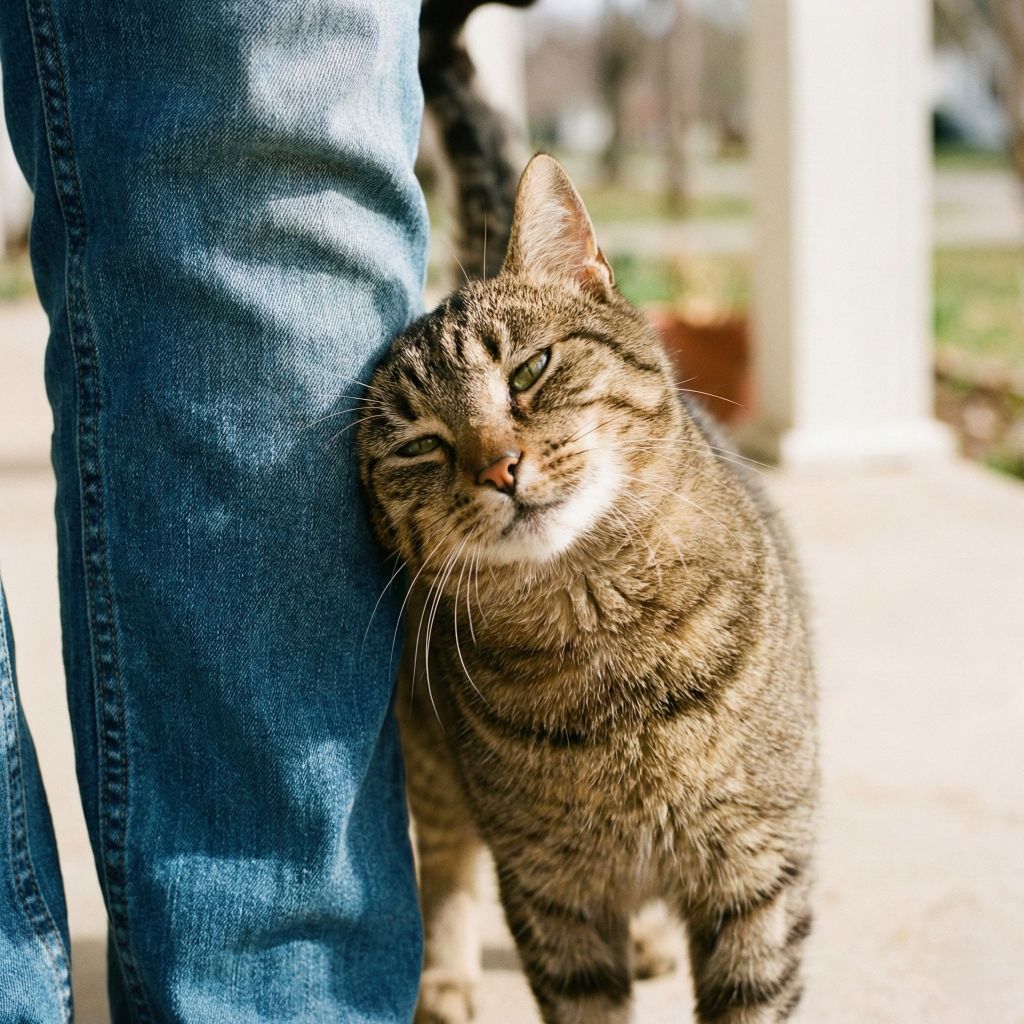
Cats rub against their owners primarily to mark their territory and show affection. This behavior, known as “bunting,” allows a cat to transfer pheromones from scent glands located on their face to you. By doing this, they are creating a communal scent that signals safety, ownership, and social bonding. It is a sign that you are accepted as part of their family group.
Summary Table: Why Cats Rub Against You
| Reason | Explanation | Key Signal |
| Scent Marking | Transferring pheromones to claim you as “theirs.” | Ownership |
| Affection | Showing love and strengthening the bond. | Trust |
| Greeting | Saying hello after being apart. | Social Recognition |
| Communication | Signaling needs like hunger or a desire for pets. | Attention Seeking |
| Information Gathering | Picking up scents you carried home from outside. | Investigation |
Why Cats Rub Against You: The Meaning Behind the Head Bumps
If you are a cat owner, you are likely familiar with the routine. You walk through the door, and your cat immediately weaves between your legs, rubbing their cheek against your shins. Sometimes, they might even stand on their hind legs to bump their head against your hand or face.
While this looks like a simple hug or a demand for food, there is a complex biological communication system happening right under your nose. This behavior is technically called bunting. It is one of the most important ways felines communicate with their families.
When a cat rubs against you, they are not just trying to trip you. They are using their sense of smell and chemical signals to organize their world, establish safety, and tell you they love you.
Read Also: Why Does My Cat Keep Sniffing Me?
Understanding Cat Scent Glands
To understand why cats rub, you first need to understand their anatomy. Cats live in a world of scents. While humans rely heavily on sight, cats rely on their noses. They possess scent glands located on various parts of their bodies. These glands release pheromones, which are chemical substances that trigger social responses in other cats.
The primary scent glands used for rubbing are located in the head area:
- Temples: Just between the eye and ear.
- Cheeks: Along the side of the face.
- Lips: Specifically the corners of the mouth.
- Chin: The underside of the jaw.
- Tail: At the very base of the tail.
When a cat rubs these specific areas against you, they deposit an oily secretion containing these pheromones. You cannot smell it, but to your cat, you now smell distinctly like them.
Reason 1: Marking You as Territory
The most biological reason for rubbing is territorial claiming. In the wild, cats rely on scent to define their boundaries. By leaving their scent on objects, trees, and other animals, they create a map of “safe” and “owned” spaces.
When your cat rubs against your legs or hands, they are essentially claiming you. They are putting a chemical label on you that says, “This human belongs to me.” This is not necessarily dominance; it is about security. A cat feels most secure when their environment smells familiar. By covering you in their scent, they ensure that the most important mobile object in their life, you, smells safe.
This is often why cats will rub against you immediately after you shower or return from work. You have washed away their scent or covered it with foreign smells. They need to re-apply their mark to restore the balance.
Read Also: Why Does My Cat Sniff My Eye?
Reason 2: Creating a “Group Scent”
In multi-cat households or wild colonies, cats engage in a behavior called allorubbing. This is when two cats rub their bodies or heads against one another. This is not just a greeting; it is a way to mix their scents together.
This creates a “colony scent.” It is a unified smell that identifies everyone in the group as a friend. If an outsider cat walked in, they would smell different and potentially be treated as a threat.
When your cat rubs against you, they are including you in this colony scent. It is a huge compliment. They are effectively treating you like a giant, non-hostile cat. They are validating that you are part of their social group. This helps maintain peace and reduces aggression within the home.
Reason 3: Seeking Information
Cats are natural investigators. When you come home from the outside world, your shoes and pants carry hundreds of fascinating smells. You might have walked past a dog, visited a friend with a cat, or stepped on grass.
When a cat rubs against your legs, they are often sniffing intently at the same time. They are reading the “news” off your clothes.
- Where have you been?
- Did you interact with other animals?
- Did you bring food?
This information gathering is vital for a cat’s mental stimulation. It helps them understand what is happening outside their territory without ever leaving the house.
Reason 4: Asking for Needs and Attention
Cats are masters of operant conditioning. This means they learn very quickly which behaviors get them what they want.
If your cat rubs against your legs and you immediately reach down to pet them, they learn: Rubbing = Affection.
If they rub against you in the kitchen and you feed them, they learn: Rubbing = Food.
Over time, the rubbing behavior transforms from a purely instinctual scent-marking habit into a learned communication tool. They might head-butt your hand specifically to get you to scratch that itchy spot behind their ears. They might weave through your legs while you are opening a can of food to urge you to hurry up.
Common “Needs” Signals:
- Vigorous rubbing near food bowls: Usually hunger or anticipation of a treat.
- Head-butting your hand: A request for scratching or petting.
- Rubbing against the door: A request to be let out (or in).
Reason 5: Greeting and Acknowledgement
Have you ever noticed your cat head-bunts you when you first wake up? This is the feline equivalent of a handshake or a hug.
In feral cat colonies, cats that return to the group after hunting will often rub against the others to reconnect. It is a peace signal. By rubbing against you after a period of separation (even if you were just asleep for 8 hours), they are re-establishing the bond. They are saying, “I see you, I acknowledge you, and we are still good friends.”
Read Also: How Cats Recognize Their Owners
Different Types of Rubbing and What They Mean
Not all rubs are the same. The part of the body the cat uses can change the meaning slightly.
1. The Head Bunt (Bunting)
When a cat cracks their forehead against you, this is the most affectionate gesture. It usually indicates high comfort and trust. They are exposing their eyes (a vulnerable area) to you while depositing scent from their temporal glands.
2. The Cheek Rub
This is the most common form of scent marking. They will often start at the corner of their mouth and slide their entire face along your hand or leg. This is heavy pheromone deposition and indicates a desire for ownership and familiarity.
3. The Full Body Weave
This involves the cat starting with their head and rubbing their entire side and tail against you, often winding between your legs. This is usually a greeting combined with a request for attention or food. It maximizes the surface area for scent transfer.
4. The Tail Wrap
Sometimes, after rubbing, a cat will wrap their tail around your leg. This is similar to humans putting an arm around someone’s shoulder. It is a sign of friendship and intimacy.
Read Also: When Is a Cat Considered a Senior?
Why Does My Cat Rub Against Objects?
You will often see your cat rubbing their face on the corner of walls, the legs of tables, or the side of the sofa. This follows the same logic as rubbing against you. They are building a sensory map of their home.
By marking the corners of their territory, they create a sense of familiarity. When a cat walks through a room and smells their own pheromones on the furniture, they feel confident and relaxed. This is why you should never punish a cat for rubbing on furniture; it is essential for their mental well-being.
When Rubbing Becomes a Medical Issue
While rubbing is generally normal, sudden changes in behavior can indicate a problem.
1. Itchy Skin or Allergies
If your cat is rubbing their face obsessively or aggressively against rough surfaces (like the carpet or brick), they might be itchy. This could be due to fleas, food allergies, or ear mites. Watch for hair loss or redness in the areas they are rubbing.
2. Dental Pain
Sometimes, cats with toothaches will rub their mouth against things to soothe the pain, although more often they will stop rubbing entirely because it hurts. If the rubbing seems frantic or is accompanied by drooling, check their teeth.
3. Overstimulation
If a cat rubs against you but then immediately bites or scratches, they may be overstimulated. They want to interact, but the physical sensation becomes too intense too quickly. This is often called “petting-induced aggression.”
Read Also: Can Cats Be Trained?
How to Respond When Your Cat Rubs You
If you want to strengthen your bond with your cat, responding correctly to their rubbing is key.
- Offer a Hand: When a cat approaches you to rub, hold out a relaxed hand or a single finger. This gives them a target to bunt against.
- Pet Them Gently: Stroke the areas they are presenting, usually the head and neck.
- Blink Slowly: Combine the physical contact with a slow blink, which is another sign of trust in cat language.
- Do Not Force It: If a cat walks away after one rub, let them go. They have said hello and marked you; they may not want a full cuddle session.
Frequently Asked Questions
Why does my cat rub against my face specifically?
The face contains many scent glands and is the primary source of your personal pheromones. By rubbing your face, they are mixing their scent with your unique identity scent. It is a very intimate act of bonding.
Why does my cat rub against strangers?
This can be confusing. Is the cat claiming the stranger? Sometimes, yes. A confident cat might want to mark a new object (the guest) to make them smell familiar and safe. Other times, the cat is simply investigating the new smells the stranger brought in.
Do big cats (lions and tigers) rub?
Yes! Lions are the most social of the big cats and engage in frequent head rubbing to maintain pride cohesion. It is a fundamental feline behavior, from the smallest house tabby to the king of the jungle.
Conclusion
When your cat rubs against you, it is far more than just a request for dinner. It is a multi-layered communication signal that combines territory, chemistry, and emotion. They are claiming you as their own, verifying that you are safe, and reinforcing the social bond that holds your little “pride” together.
So the next time your cat nearly trips you with a figure-eight weave or bumps their head against your shin, take it as a compliment. You have been officially marked as a trusted member of the family.