
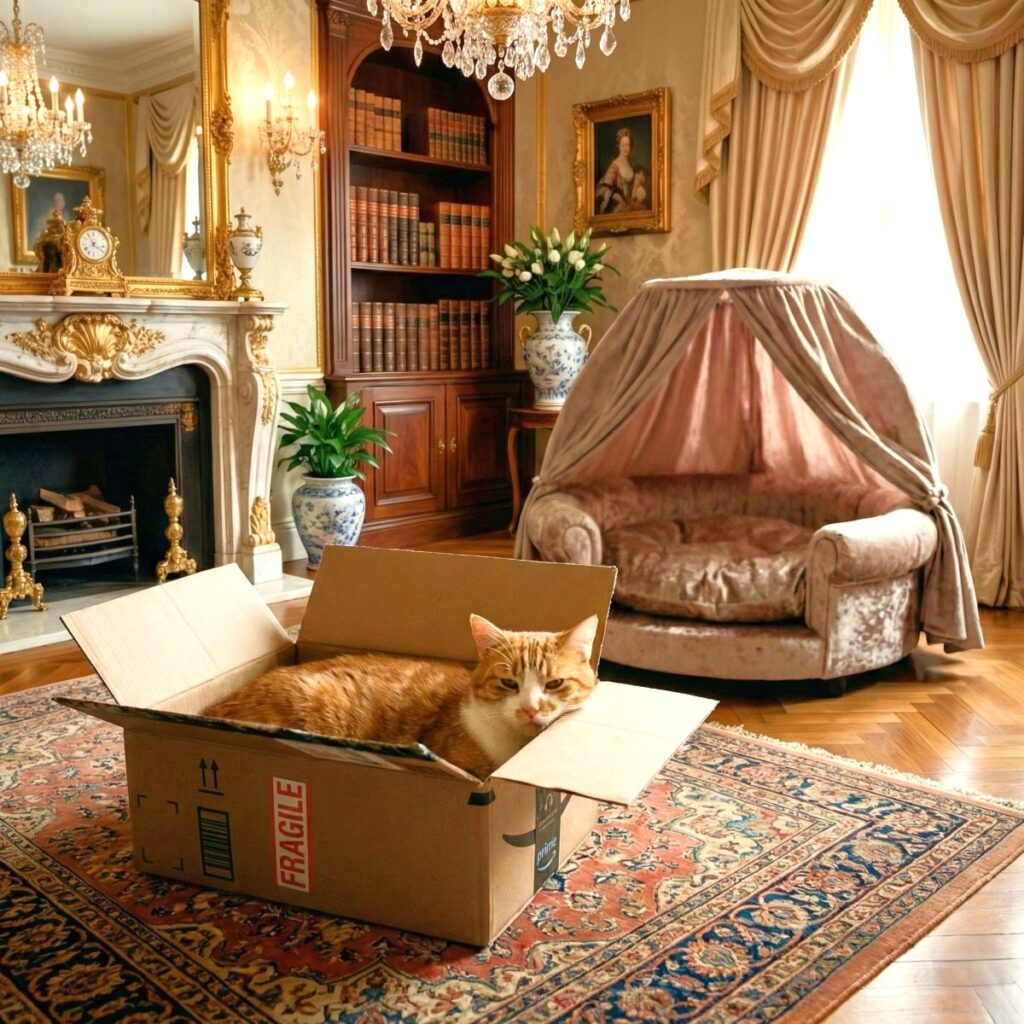
Cats love boxes because they provide a safe, enclosed space that reduces stress and offers protection. The confined area mimics a den, allowing cats to hide from predators while stalking prey. Additionally, cardboard is an excellent insulator, helping cats maintain their high body temperature, which is essential for their comfort and health.
Summary Table: The Science of Cats and Boxes
| Key Reason | Benefit to the Cat |
| Safety & Security | Protects them from being sneaked up on; offers a safe vantage point. |
| Stress Reduction | Hiding is a primary coping mechanism for anxiety in felines. |
| Warmth | Cardboard insulates heat, helping cats stay at their ideal 100°F (38°C). |
| Predatory Instinct | Acts as the perfect hiding spot to launch an ambush on toys or ankles. |
| Texture & Scent | Cardboard is fun to scratch, chew, and mark with scent glands. |
Why Cats Love Boxes?
Every cat owner knows the struggle. You spend money on an expensive, plush cat bed. You bring it home, excited to see your pet curl up in luxury. Instead, your cat ignores the bed completely and jumps straight into the shipping box it came in.
This behavior can seem confusing, but it is not random. It is deeply rooted in your cat’s biology and history. Whether you have a tiny kitten or a senior cat, the urge to squeeze into a box, even one that looks too small, is universal.
Scientists and animal behaviorists have studied this quirk for years. They have found that enclosed spaces are vital for a cat’s mental and physical health. A simple cardboard box offers a unique mix of safety, warmth, and entertainment that modern cat furniture often fails to replicate.
Read Also: How to Make Your Home Cat-Safe
1. The Instinct for Safety and Security
To understand why your cat loves boxes, you have to look at their ancestors. Domestic cats are small predators. In the wild, being out in the open makes an animal vulnerable. Larger predators can attack from any direction.
A box eliminates this danger. When a cat backs into a box, they know nothing can attack them from behind or the sides. They only have to watch the opening in front of them. This gives them a massive sense of security.
The “Denning” Instinct
Cats are den animals. They seek out small, confined spaces to rest.
- Protection: In the wild, this would be a hollow log or a cave. In your home, it is a shoe box.
- Deep Sleep: Because they feel safe, they can enter deeper stages of sleep without worrying about threats.
- Observation: A box allows them to watch the world without being seen. This is crucial for a solitary hunter.
When your cat is in a box, they are not just hiding. They are controlling their environment. They decide who sees them and when they want to engage.
2. Stress Reduction and Coping Mechanisms
Cats are sensitive creatures. They do not deal with change very well. Loud noises, new guests, or moving to a new house can cause significant anxiety.
A study conducted by ethologists (scientists who study animal behavior) at a Dutch animal shelter proved the power of the box. They divided newly arrived shelter cats into two groups. One group was given boxes; the other was not.
The Results:
- Faster Recovery: The cats with boxes adapted to their new environment much faster.
- Lower Stress Levels: Their stress hormones (cortisol) dropped significantly quicker than the cats without boxes.
- Better Interaction: Because they felt safe, they were more willing to interact with humans sooner.
Hiding is a behavioral strategy. It is a coping mechanism. When a cat gets overwhelmed, they do not usually fight; they retreat. If they do not have a safe space to retreat to, their anxiety increases. A box provides an instant “safe zone” where the cat can reset and calm down.
Read Also: Why Is My Male Cat Peeing On My Bed?
3. The Ambush Predator
Your house cat shares DNA with tigers and lions. Even though they are fed regular meals, the hunting instinct is still active. Cats are “ambush predators.” They do not chase prey for miles like wolves; they wait for the perfect moment to strike.
A box is the ultimate hunting blind. It conceals the cat from its prey.
- Concealment: The prey (or your foot) cannot see the cat hiding inside.
- Focus: The walls of the box block out distractions, allowing the cat to focus entirely on the target.
- The Pounce: The explosion of energy when they jump out is a practiced survival skill.
You will often see this during play. If you drag a feather toy past a box, your cat will likely wiggle their hindquarters and launch an attack. This is serious practice for them, even if it looks like a game to us.
4. Thermal Regulation: The Need for Heat
Cats run hotter than humans. A human’s normal body temperature is around 98.6°F (37°C). A cat’s normal temperature is between 100.5°F and 102.5°F (38°C – 39°C).
This means cats feel cold more easily than we do. Their “thermoneutral zone”, the temperature range where they don’t have to use extra energy to stay warm or cool, is 86 to 97 degrees Fahrenheit. Most people keep their homes around 70 to 75 degrees, which is actually chilly for a cat.
Why Cardboard Works:
- Insulation: Corrugated cardboard creates air pockets between the layers of paper. These air pockets are excellent insulators.
- Reflection: The small space traps the cat’s body heat and reflects it back to them.
- Draft Protection: The high sides of a box block cold drafts from air conditioners or windows.
By curling up into a tight ball inside a small box, a cat can conserve body heat very efficiently. This is why you will often see a large cat squeezing into a tiny box. The tighter the fit, the warmer they are.
Read Also: Why Cats Rub Against You
5. Texture and Scratching Needs
Cats experience the world through touch and scent. Cardboard offers a unique sensory experience that most cats find irresistible.
Texture
The texture of cardboard is perfect for biting and scratching. It is firm enough to provide resistance but soft enough that their claws can sink in. This mimics the sensation of tearing into prey or scratching tree bark.
Scent Marking
Cats have scent glands in their paw pads. When they scratch the sides or bottom of a box, they are depositing pheromones.
- Ownership: This marks the box as “theirs.”
- Comfort: The scent of their own pheromones is soothing to them.
- Visual Mark: The physical shredding of the box leaves a visual mark of their territory.
Sound
The rustling sound of paper or cardboard stimulates a cat’s curiosity. It sounds like small prey (like a mouse) moving through dry leaves. This can trigger a playful mood even in older, more sedentary cats.
6. The “If I Fits, I Sits” Phenomenon
You have likely seen internet memes of cats sitting in squares of tape on the floor or squeezing into glass bowls. This is related to their love of boxes.
This behavior suggests that cats are attracted to defined boundaries. A box provides a physical boundary, but even a 2D square on the floor suggests a “territory” to a cat. It creates a distinction between “inside” and “outside.”
However, the physical pressure of a box’s walls is key. This is similar to why humans like weighted blankets. The sensation of touch against their sides (swaddling) releases endorphins and helps them relax.
Types of Cats That Love Boxes
It is not just the domestic house cat (Felis catus) that enjoys a good box. This behavior is seen across the entire Felidae family.
Zoos and sanctuaries often give large cardboard boxes to big cats as enrichment.
- Lions: They will crush the box, sit in it, and roll over it.
- Tigers: They often carry boxes around and shred them.
- Leopards: They use them for ambush practice.
- Lynx and Bobcats: They exhibit the exact same “sit and hide” behavior as house cats.
This proves that the attraction to enclosed spaces is an ancient, evolutionary trait, not just a quirk of domestication.
Read Also: Why Does My Cat Hit Me with Her Tail?
Safety Tips for Box Play
While boxes are generally safe, there are a few things you need to check before giving one to your pet. Shipping boxes are designed for transport, not for animals, so a quick inspection is necessary.
Checklist for Box Safety:
- Remove Staples: Large industrial staples can cause serious puncture wounds to paws or mouths. Remove them with pliers.
- Remove Tape: Some cats like to eat plastic tape. This can cause intestinal blockages which are life-threatening. Remove all packing tape.
- Check for Chemicals: Ensure the box did not contain toxic chemicals, harsh cleaning agents, or essential oils that could have spilled.
- Watch for Ingestion: Most cats just shred cardboard, which is fine. However, if your cat actively eats and swallows large pieces of cardboard, it can cause a blockage. Monitor them.
DIY Enrichment: Making the Ultimate Box Fort
You do not need to spend money to give your cat a great experience. You can create a stimulating environment using old delivery boxes. This is often called “environmental enrichment.”
The Tunnel System
Take two or three boxes and cut holes in the sides. Line them up so the holes connect. Tape them together (using safe paper tape or glue). This creates a tunnel system for your cat to explore.
The Treat Puzzle
Take a small box and cut several holes in the lid, just slightly larger than your cat’s paw. Put their favorite treats or a toy inside and close the box. Your cat will have to fish the treats out through the holes. This engages their brain and mimics hunting behavior.
The Tower
Stack boxes vertically. Cut holes in the “floors” between them so the cat can climb up from the inside. Ensure the base is wide and weighted down so it does not tip over. This gives them vertical territory, which increases their confidence.
Read Also: How Cats Use Scent to Communicate
Why You Should Rotate Boxes
Novelty is important for cats. If a box sits in the same spot for months, it becomes just another piece of furniture. It loses its scent and its excitement.
To keep your cat mentally stimulated:
- Rotate Locations: Move the box to a different room or place it near a window.
- New Boxes: When you get a new delivery, swap out the old box for the new one. The new smells from the warehouse or delivery truck are exciting for your cat to investigate.
- Change Orientation: Turn a box on its side one week, and flip it upside down with a door cut out the next week.
Conclusion
The relationship between cats and boxes is a perfect example of how wild instincts survive in our modern pets. A box is never just a box to a cat. It is a fortress, a warm bed, a hunting ground, and a stress reliever all in one.
Understanding this behavior helps you be a better cat owner. Instead of getting frustrated that they ignore the expensive bed, you can embrace their natural needs. By providing safe, clean boxes, you are giving your cat exactly what their biology demands: safety, warmth, and a place to hide.
So, the next time a package arrives, don’t throw the box in the recycling bin right away. Remove the tape, take out the staples, and put it on the floor. It is the cheapest and most effective gift you can give your feline friend.