
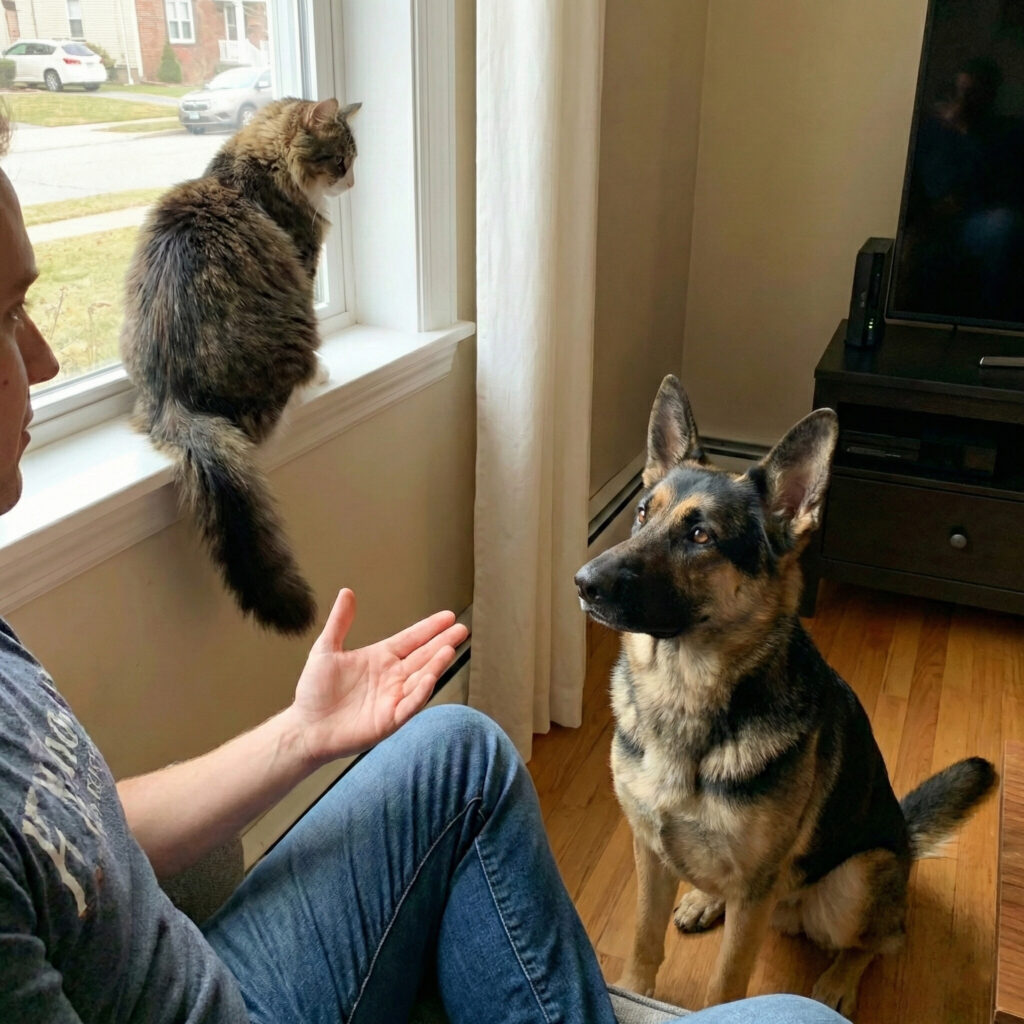
Cats ignore commands because they were not bred to work alongside humans like dogs were. Dogs have a “pack mentality” and a long history of selective breeding for cooperation, making them eager to please. Cats are solitary predators who “self-domesticated” to hunt mice; they are independent thinkers motivated by hunting instincts rather than social praise.
Summary Table
| Feature | Dogs (Canis lupus familiaris) | Cats (Felis catus) |
| Domestication Style | Active selection for work and obedience | Passive “self-domestication” for pest control |
| Social Structure | Pack animals (Hierarchical) | Solitary hunters (Territorial) |
| Primary Motivation | Social praise, food, play | Hunting instincts, high-value food, security |
| Response to Humans | Look to humans for direction | Look to humans for resources |
| Intelligence Type | Social & Working Intelligence | Independent Problem Solving |
Why Cats Ignore Commands but Dogs Follow Them?
If you share your home with both a dog and a cat, you have likely witnessed a familiar scene. You call your dog’s name, and they come running, tail wagging, eyes locked on you, waiting for instruction. You call your cat’s name, and you are lucky if an ear twitches. Maybe they look at you, yawn, and go back to sleep.
It is easy to label dogs as “loyal” and cats as “stubborn” or “dumb,” but those labels are scientifically inaccurate. The reason your cat ignores you isn’t an attitude problem; it is a matter of biology, evolution, and psychology.
To understand why our pets react so differently to us, we have to look back thousands of years to how they became our companions in the first place.
Read Also: Cats vs Dogs: Who Is More Independent?
The History of Domestication
The main reason for the difference in obedience lies in the “job description” humans gave these animals thousands of years ago.
Dogs: The Employee of the Month
Dogs were the very first animals domesticated by humans, likely between 20,000 and 40,000 years ago. They didn’t just hang around; they worked. Early humans and wolves (the ancestors of dogs) formed a cooperative partnership. We selectively bred dogs to perform very specific tasks that required intense focus and communication with humans.
- Herding: Dogs like Border Collies had to listen to whistles and shouts to move sheep.
- Hunting: Retrievers had to wait for a command before running to get a bird.
- Guarding: Mastiffs had to know who was a friend and who was a foe based on their owner’s reaction.
Over thousands of generations, we rewired the dog’s brain. We created an animal that feels anxiety when it doesn’t know what you want and feels a rush of “feel-good” chemicals (like oxytocin) when they make you happy.
Cats: The Freelance Contractor
Cats entered human society much later, around 10,000 years ago, coinciding with the rise of agriculture. When humans started storing grain, we attracted mice and rats. Wild African wildcats saw an abundance of prey and moved in.
Unlike dogs, humans did not selectively breed cats to perform complex tasks. We didn’t need them to herd cattle or fetch arrows. We just needed them to be themselves: efficient killers of vermin.
- No Training Required: A cat didn’t need a human to tell it how to catch a mouse. In fact, human interference would make them worse at it.
- Solitary Work: Cats hunt alone. They didn’t need to coordinate with a pack or a human leader.
Because of this, cats effectively “domesticated themselves.” They stayed because the food was good, not because they needed a leader. Evolution never put pressure on cats to listen to human commands.
Social Structure: The Pack vs. The Lone Ranger
The way animals view the world is shaped by how they interact with their own species. This social structure dictates how they view you.
The Canine Pack Mentality
Dogs are obligate social animals. In the wild, a lone wolf is a dead wolf. They survive by working together, following a hierarchy, and maintaining social harmony.
When a dog lives in your house, you are part of their pack. In their mind, maintaining a connection with you is a survival need. If they ignore a command, they risk being ostracized from the group, which causes them genuine distress. This makes them highly motivated to figure out what you are saying.
The Feline Solitary Nature
Cats are solitary hunters. While feral cats can form loose colonies around food sources, they do not hunt in packs. They do not have a hierarchy where an “Alpha” tells the others what to do.
In a cat’s world, there is no boss. When you shout “Sit!” or “Come!”, your cat isn’t being rebellious. They are genuinely confused by the concept. To a cat, you are not a pack leader; you are a large, clumsy roommate who provides food and warm laps. They don’t have the biological hardware to understand “obedience” as a social concept.
Read Also: How to Prepare for Emergencies With Dogs
Motivation: What’s in It for Them?
This is the key to training. If you want an animal to do something, you must understand what motivates them.
Intrinsic vs. Extrinsic Motivation
- Dogs (Extrinsic): Dogs are often motivated by external rewards, specifically social approval. Many dogs will perform a trick just to hear “Good boy!” The connection with you is the reward.
- Cats (Intrinsic): Cats are driven by internal desires. They do things because they feel good or serve a purpose for survival. A cat will not sit on command just to make you smile. They will sit if they know it results in a piece of salmon.
The “What Have You Done for Me Lately?” Factor
Scientific studies have shown that cats can distinguish their owner’s voice from a stranger’s voice. They hear you calling, but they just choose not to respond. This is a decision based on value.
If a dog hears his name, he thinks, “Someone needs me!”
If a cat hears her name, she thinks, “Is there food? Is there danger? No? Then I will stay here.”
Intelligence: Obedience is Not IQ
A common mistake is assuming that because dogs follow commands, they are smarter. This is like saying a soldier is smarter than an artist because the soldier follows orders better. They are just different types of intelligence.
The Dog’s Social Intelligence
Dogs have evolved “social cognition.” They are experts at reading human gestures. If you point at a hidden treat, a dog will look where you point. They understand that you have information they need.
The Cat’s Persistence
If you point at a hidden treat for a cat, the cat will likely look at your finger. However, cats excel at independent problem-solving. If a cat wants a treat locked in a cabinet, they will work tirelessly to figure out the latch mechanism on their own. They don’t look to you for help; they try to manipulate their environment directly.
In many puzzle experiments, cats fail not because they can’t solve it, but because they lose interest if the reward isn’t high enough. A dog will keep trying to please the researcher; a cat will walk away if the “paycheck” isn’t worth the effort.
Communication Barriers
We humans, are verbal creatures. We talk a lot. Dogs have adapted to listen to our vocal tone and watch our faces. Cats communicate very differently, leading to misunderstandings.
The Language of Scents and Blinks
- Vocalizing: Adult cats rarely meow at each other. They meow almost exclusively at humans to get our attention. They are trying to communicate, but they view vocal commands as “noise” unless they have learned a specific association.
- Body Language: A dog wags its tail to show happiness. A cat flicks its tail to show irritation. When you yell a command at a cat, you might be using aggressive body language (staring, leaning forward) that signals a fight to a cat, causing them to freeze or run rather than obey.
- The Slow Blink: If you want a cat to listen, you need to lower your threat level. The “slow blink” is a cat’s way of saying, “I trust you.”
Read Also: How to Safely Socialize a Shy Kitten
Can You Actually Train a Cat?
Yes, absolutely. The myth that cats cannot be trained is false. You just cannot train them like a dog. You cannot force a cat to obey; you have to convince them it is their idea.
The Strategy: Positive Reinforcement Only
Punishment does not work on cats. If you yell at a dog, they look guilty (which is actually fear). If you yell at a cat, they just become afraid of you, not the action. They won’t stop scratching the couch; they will just do it when you aren’t looking.
To train a cat to follow a command (like “Sit” or “High Five”), you must use:
- High-Value Treats: Dry kibble won’t work. You need tuna, freeze-dried chicken, or creamy treats.
- The Clicker Method: Use a clicker to mark the exact moment the cat does the right behavior, then immediately give a treat.
- Short Sessions: Dogs can train for 30 minutes. Cats have patience for about 3 to 5 minutes.
Why You Should Respect the Difference
There is something special about the fact that a cat’s affection is earned, not given freely. When a dog follows you, it is biology. When a cat chooses to sit on your lap or come when called, it is a genuine choice. They are ignoring their solitary instincts to be with you.
Summary of Why They Ignore You
If you are frustrated that your cat won’t come when called, remember this list:
- No Biological Precedent: Their ancestors didn’t work for humans.
- No Pack Instinct: They don’t feel social pressure to obey.
- Different Motivation: They are not motivated by praise, only by resources (food/comfort).
- Communication Gap: They rely on scent and subtle body language, not loud vocal commands.
Coclusion
Comparing a dog’s obedience to a cat’s obedience is like comparing a bicycle to a boat. The bicycle goes exactly where you steer it. The boat requires you to work with the wind and the current.
Dogs are our partners in work; cats are our partners in coexistence. The fact that cats ignore commands doesn’t mean they don’t love us. It just means they maintain their independence.
They are the only animal that lives in our homes but never fully surrender their wild spirit. So the next time your cat ignores your command to “get down,” don’t take it personally. They are just being cats.