
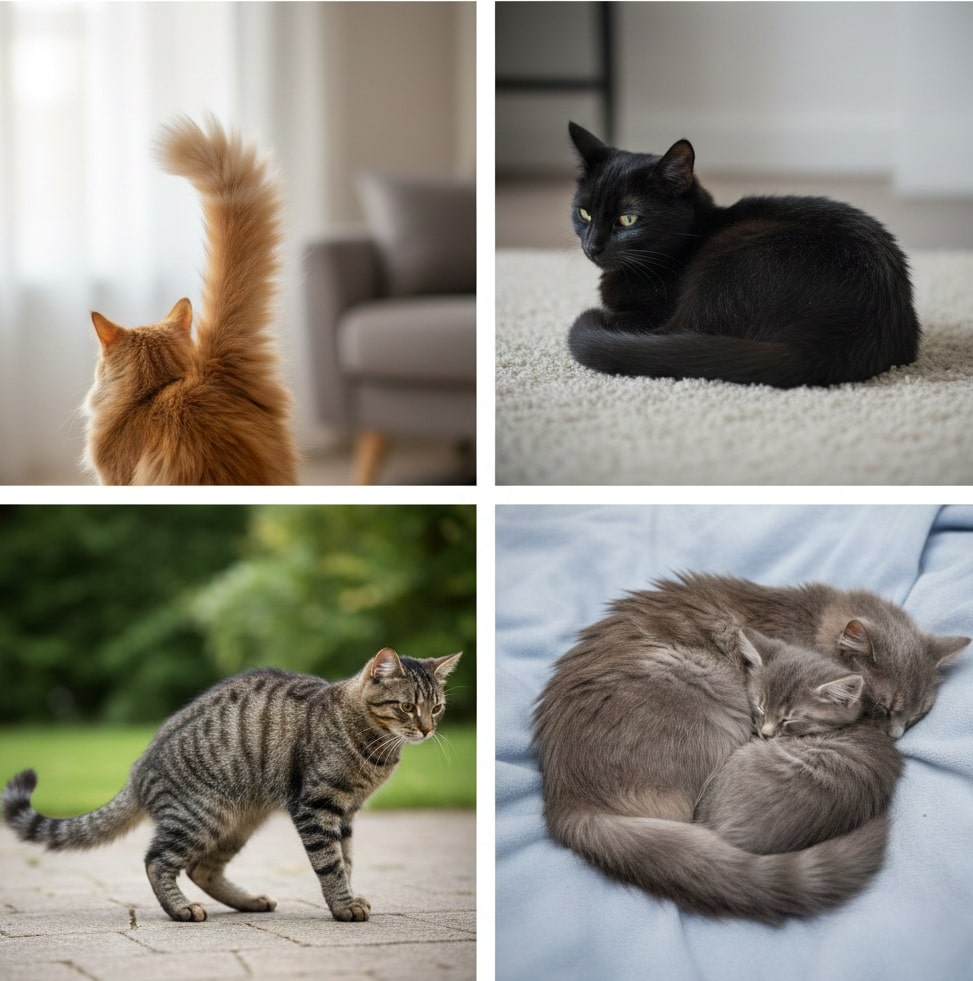
Cat tail positions are a primary form of feline body language used to communicate emotions and intentions. A high, upright tail generally signals happiness and confidence, while a tucked tail indicates fear or submission. A puffed-up “bottle brush” tail suggests aggression or severe fright, and a swishing or thumping tail is a clear warning of irritation. Understanding these signals helps owners prevent scratches and build a stronger bond with their pets.
Summary Table: Cat Tail Language
| Tail Position | Primary Emotion | What It Means | Action Required |
| Straight Up | Friendly / Confident | The cat is happy to see you. | Pet them! |
| Question Mark (?) | Playful / curious | They want to interact or play. | Engage in play. |
| Tucked Between Legs | Scared / Submissive | They feel threatened or anxious. | Give them space. |
| Puffed Up (Bottle Brush) | Terrified / Aggressive | Attempting to look larger to a threat. | Back away slowly. |
| Thumping / Whipping | Irritated / Angry | They are losing patience. | Stop petting immediately. |
| Slow Swish | Focused / Predatory | They are locking onto a toy or prey. | Watch them hunt. |
What Different Cat Tail Positions Really Mean
Cats are often described as mysterious, aloof, or hard to read. Unlike dogs, who tend to wear their hearts on their sleeves (or tails), cats communicate in subtle, nuanced ways. However, once you learn to decipher their code, you will realize your cat is constantly talking to you.
The tail is the most expressive tool in a cat’s communication toolkit. It acts as a mood barometer, swinging from happy to angry in a matter of seconds. By paying attention to the angle, movement, and shape of the tail, you can understand exactly what your feline friend is feeling. This guide covers the complete spectrum of cat tail language, helping you avoid bites, improve bonding, and ensure your pet feels safe.
The Anatomy of Communication
Before diving into specific positions, it helps to understand why the tail is so expressive. A cat’s tail is an extension of its spine, containing roughly 10% of all the bones in its body. It is packed with muscles, ligaments, and sensitive nerves. This allows for incredible precision in movement.
Because the tail is connected to the nervous system, it often reacts instinctively to emotional shifts. While a cat can control its tail, many movements, like the “puffed” tail of a scared cat, are involuntary reactions to adrenaline.
Read Also: Why Do Cats Meow More at Night?
Happy and Friendly Tail Positions
When your cat is relaxed, content, or happy to see you, their tail will reflect that confidence. These are the signals that give you the “green light” to interact.
The Straight Up (Vertical) Tail
This is the gold standard of feline friendship. When a cat walks toward you with their tail held high and straight in the air, they are announcing their presence with confidence.
- Meaning: “I am happy, confident, and glad to see you.”
- Context: You will often see this when you come home from work or when a cat is greeting a friendly human.
- Interaction: This is the best time to offer affection.
The Question Mark (Hooked) Tail
If the tail is upright but the tip curls over to look like a shepherd’s crook or a question mark, your cat is in a playful mood.
- Meaning: “I’m curious and ready to play.”
- Context: This often happens during periods of high energy, usually in the morning or evening (the “zoomies”).
- Interaction: Grab a feather wand or a laser pointer. Your cat is asking for engagement.
The Quivering Tail
Sometimes, a cat will approach you with a tail straight up, and it will vibrate or quiver rapidly.
- Meaning: Extreme excitement or joy.
- Context: This is often seen when a cat anticipates a high-value treat, or when they greet a beloved owner after a long absence.
- Note: If the cat is backed up against a wall with a quivering tail, they might be urine marking (spraying). However, if they are facing you and looking happy, it is purely a sign of affection.
The Relaxed Horizontal Tail
When a cat is walking and their tail is held out behind them, roughly level with their spine or slightly lower, they are feeling neutral.
- Meaning: “I am relaxed and nothing is bothering me.”
- Context: This is the default position for a cat patrolling their territory without any threats nearby.
Read Also: How much hair does a cat shed in a day?
Fearful and Defensive Tail Positions
Cats are both predators and prey. This duality means they are hardwired to protect themselves. When a cat feels threatened, their tail changes shape to signal submission or to try to ward off an attack.
The Tucked Tail
A tail tucked between the hind legs is the universal sign of fear in many animals, including cats and dogs.
- Meaning: “I am scared. Please don’t hurt me.”
- Context: This happens at the vet, during thunderstorms, or when a dominant cat enters the room.
- Interaction: Do not force interaction. Tucked tails mean the cat is trying to make themselves small and invisible. Reaching out to pet them now may result in a defensive scratch.
The Puffed-Up Tail (Piloerection)
This is often called the “Halloween Cat” look. The fur on the tail stands straight up, making the tail look two or three times its normal size. The back may also be arched.
- Meaning: “I am terrified, but I will fight if I have to.”
- Context: This is a biological response to a sudden scare, such as a loud noise or a strange dog.
- The Science: This is an involuntary reaction involving the arrector pili muscles. The goal is to make the cat look larger to a predator to discourage an attack.
The Low Tail
If the tail is angled downward, hovering near the ground but not fully tucked, the cat is feeling cautious or unsure.
- Meaning: “I am worried about this situation.”
- Context: This might happen if you bring a new object into the house or if there is a strange smell. The cat is alert and ready to run.
Aggressive and Irritated Tail Positions
Misreading these signals is the most common reason owners get bitten or scratched. Cats rarely attack without warning; their tails usually scream “stop” long before they use their claws.
The Thumping or Lashing Tail
Unlike dogs, who wag their tails when happy, a cat “wagging” its tail is usually angry. If the tail is thumping against the floor or whipping back and forth rapidly, the cat is agitated.
- Meaning: “I am annoyed. Back off immediately.”
- Context: This often happens during grooming sessions that have gone on too long, or when a cat is being held against their will.
- Interaction: Stop whatever you are doing. If you are petting them, stop. If you are holding them, put them down.
Read Also: How Long Can a Cat Go Without Urinating?
The Twitching Tip
Sometimes the tail is mostly still, but the very tip flicks back and forth.
- Meaning: Mild irritation or intense concentration.
- Context: You might see this if you call your cat’s name when they are trying to sleep. They hear you, but they are annoyed that you disturbed them.
The Low Swish
If the tail is held low and is swishing slowly from side to side, the cat is likely fixated on a target.
- Meaning: Predatory focus.
- Context: This is a hunting behavior. It is often seen right before a cat pounces on a toy or a mouse. While not “angry” at you, the cat is in a high-arousal state and may bite if you interrupt them.
Social and Affectionate Tail Behaviors
Tail language isn’t just about solo poses; it also involves how cats interact with others physically.
The Tail Wrap
If your cat sits next to you (or another cat) and wraps their tail around your leg or the other cat’s body, it is a gesture of friendship.
- Meaning: “We are connected.”
- Human Equivalent: This is similar to a human putting an arm around a friend’s shoulder or holding hands.
Intertwined Tails
When two cats greet each other and wrap their tails together, it is a sign of a strong social bond.
- Meaning: Mutual affection and greeting.
- Context: This is most common among littermates or cats that have lived together for a long time and trust each other deeply.
Read Also: Why Does My Cat Meow While Pooping?
Nuance: Combining Cues
To get the full picture of feline body language, you cannot look at the tail in isolation. You must read the tail in conjunction with the eyes, ears, and posture.
Scenario A: The Playful Hunter
- Tail: Swishing sideways.
- Ears: Pricked forward.
- Eyes: Dilated pupils.
- Verdict: The cat is playing or hunting. It is safe to engage with toys.
Scenario B: The Threatened Cat
- Tail: Swishing sideways.
- Ears: Flattened against the head (airplane ears).
- Eyes: Narrowed or staring hard.
- Verdict: The cat is angry and feels cornered. Do not approach.
Why Tail Language Matters for Cat Owners
Understanding these signals does more than just prevent scratches. It builds trust. When a cat realizes that you understand their request for space (signaled by a thumping tail), they feel safer around you. They learn that they don’t have to resort to biting to get their point across.
Conversely, recognizing the subtle signs of happiness, like the “slow blink” combined with an upright tail, allows you to reciprocate their affection, deepening the bond between pet and owner.
Senior Cats and Tail Movement
It is important to note that as cats age, they may suffer from arthritis or stiff joints. If an older cat stops raising their tail as high as they used to, or if they seem sensitive when you touch near the base of the tail, it may be a medical issue rather than a mood change. If you notice a sudden decrease in tail mobility, consult a veterinarian to rule out pain or injury.
Summary
Your cat’s tail is a sophisticated communication device. It signals joy, fear, aggression, and love. By observing the position, speed, and shape of the tail, you can navigate your cat’s emotional world with accuracy.
- High and loose = Happy.
- Low and tucked = Scared.
- Puffed up = Defensive.
- Whipping back and forth = Angry.
Pay attention to these signs, and you will find that your “mysterious” cat is actually telling you exactly how they feel every single day.