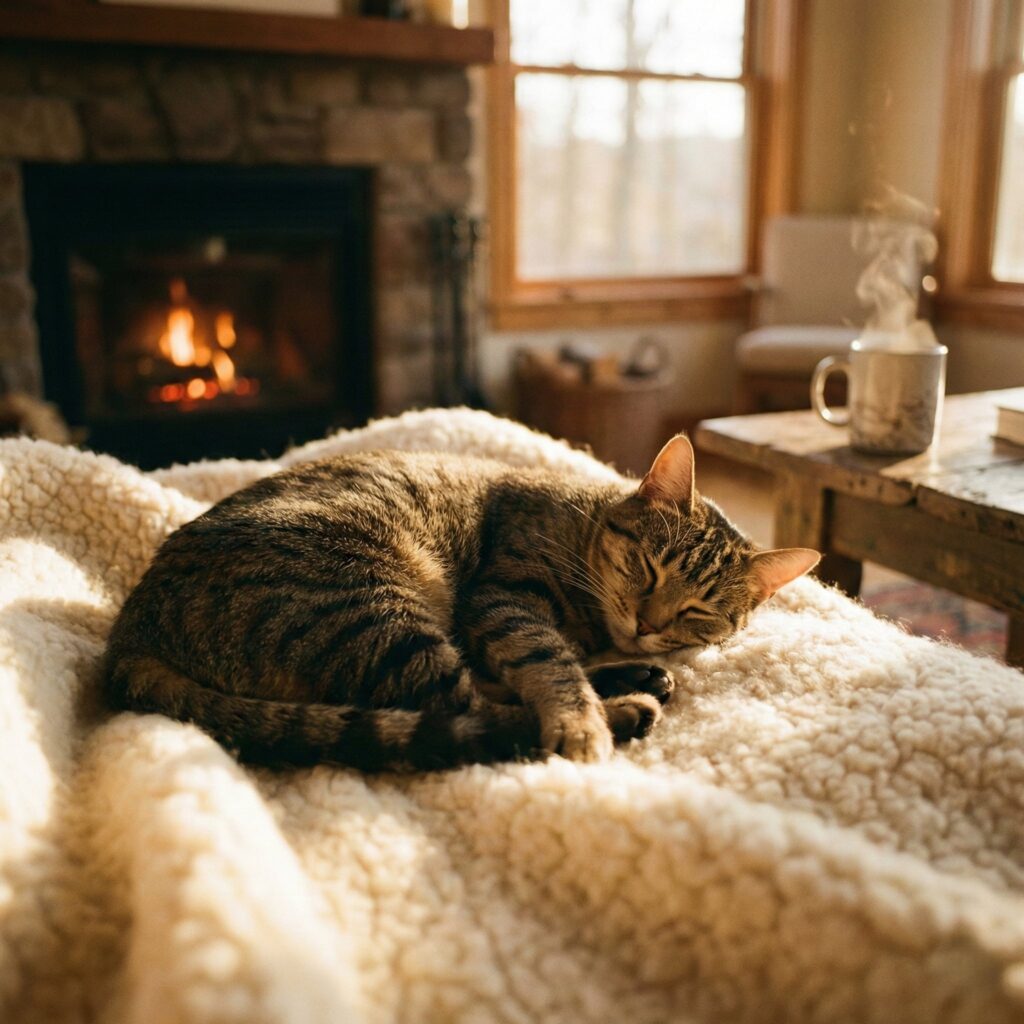
Cats purr primarily to communicate. While most people associate purring with happiness and contentment, cats also purr when they are hungry, stressed, or in pain. Research suggests that the low frequency of a cat’s purr (between 25 and 150 Hertz) acts as a self-soothing mechanism that can promote bone healing, reduce swelling, and repair tissues. Therefore, a purr is not just a smile; it is a complex tool used for bonding, healing, and survival.
Summary Table: Why Cats Purr
| Reason for Purring | Context | What It Means |
|---|---|---|
| Contentment | Lying on lap, being petted | The cat is relaxed, safe, and happy. |
| Solicitation | Near food bowl, morning time | The cat wants something, usually food or attention. |
| Self-Healing | After injury, during rest | The cat is repairing bones or tissues using sound frequencies. |
| Stress/Fear | At the vet, new environment | The cat is trying to calm itself down. |
| Mother-Kitten Bond | Nursing, grooming | Kittens signal they are okay; mother signals safety. |
What Cat Purring Really Means
For centuries, humans have listened to the rhythmic rumble of a cat and assumed it meant pure joy. It is one of the most recognizable sounds in the animal kingdom. However, science reveals that the purr is much more than just a sign of a happy pet. It is a versatile communication tool and a biological healing mechanism.
Understanding why your cat purrs requires looking at the context. Are they curled up on your lap? Are they pacing around the kitchen? Or are they hiding in a corner? This guide breaks down the science, the emotions, and the hidden meanings behind the purr.
Read Also: How Cats Use Scent to Communicate
How Do Cats Physically Purr?
Before understanding the why, it helps to understand the how. Unlike a dog’s bark or a human’s voice, purring is not produced strictly by the vocal cords.
The purr starts in the brain. A neural oscillator sends repetitive rhythmic signals to the laryngeal muscles (the voice box). These muscles twitch rapidly, at a rate of 25 to 150 times per second. This twitching separates the vocal cords during both inhalation and exhalation.
As the cat breathes in and out, air hits the vibrating muscles, producing the continuous “brrr” sound we know and love. Because it happens on both the inhale and the exhale, the sound is unbroken.
Key Anatomical Players
- Larynx: The voice box where the vibration originates.
- Diaphragm: The muscle that pushes air across the larynx.
- Hyoid Bone: A rigid bone in the throat that allows the vibrations to resonate. This rigid bone is why domestic cats can purr but cannot roar.
1. The Purr of Contentment
This is the most common and easily recognized type of purr. When a cat is relaxed, sitting in a sunbeam, or being groomed by its owner, it will emit a soft, steady purr.
In this context, the purr releases endorphins in the cat’s brain. These are natural “feel-good” chemicals that reinforce the bond between the pet and the owner. It is essentially a feedback loop: the cat feels good, so it purrs; the purring releases hormones that make it feel even better.
Signs of a Happy Purr:
- Body Language: The body is loose and relaxed.
- Eyes: Eyelids are heavy or half-closed (the “slow blink”).
- Tail: The tail is still or twitching gently at the tip.
- Paws: The cat may be “kneading” (making biscuits) on a soft surface.
2. The Solicitation Purr (The “Feed Me” Sound)
Have you ever noticed that your cat sounds different in the morning when you are near the food bowl? This is not your imagination. Studies conducted at the University of Sussex identified a specific type of vocalization called the “solicitation purr.”
This purr is distinct from the happy purr. It includes a high-frequency cry embedded within the low-frequency rumble. This cry sounds remarkably similar to a human baby’s distress cry.
Why It Works
Humans are biologically programmed to respond to the sound of a crying baby. It triggers a sense of urgency and a desire to nurture. By hiding this cry inside a purr, cats manipulate our instincts. We feel an urgent need to attend to them, which usually results in filling the food bowl.
How to Identify a Solicitation Purr:
- Urgency: It sounds more insistent and less rhythmic.
- Volume: It is often louder than a relaxation purr.
- Context: It happens when the cat wants something (food, a door opened, attention).
- Behavior: The cat is likely pacing, rubbing against your legs, or leading you toward the kitchen.
3. Purring as a Healing Mechanism
This is perhaps the most fascinating aspect of feline biology. Cats do not just purr when they are happy; they purr when they are hurt. Veterinarians often report cats purring while in severe pain, after surgery, or even when they are dying.
Why would an animal vibrate when it is in pain? The answer lies in biophysics.
The Frequency Factor
Scientists have measured the frequency of domestic cat purrs and found they fall exactly in the range of 25 Hz to 150 Hz. This specific range of vibration is used in human physical therapy and sports medicine to accelerate healing.
Benefits of Sound Frequencies in this Range:
- Bone Density: Vibrations at 25-50 Hz stimulate bone production and strengthen fractures.
- Muscle Repair: Frequencies help repair torn muscles and tendons.
- Pain Relief: The vibration acts as a natural analgesic (painkiller).
- Swelling Reduction: It helps move fluid and reduce joint swelling.
This suggests that purring is an evolutionary survival mechanism. By purring, a cat can maintain bone density even when it sleeps for 16 hours a day. It is a low-energy way to keep the body strong. If a cat breaks a bone, the purring may help it knit back together faster.
4. The Mother-Kitten Connection
Purring is one of the very first forms of communication a kitten experiences. Kittens are born blind and deaf. They cannot see their mother or hear her meow for the first week or two of life.
However, they can feel vibrations.
The mother cat purrs to act as a homing beacon. The vibrations travel through the floor or bedding, guiding the kittens toward her warmth and milk. It is a tactile signal that says, “I am here, and you are safe.”
The Kitten’s Response
Kittens begin to purr back when they are just a few days old. They often purr while nursing. This serves two purposes:
- Bonding: It tells the mother that the kitten is getting milk and is doing well.
- Milk Production: Some theories suggest the vibration helps stimulate the milk flow from the mother.
5. Purring Under Stress and Fear
If you take your cat to the vet, you might hear them purring loudly on the examination table. A vet who is not paying close attention might think the cat is friendly and happy. However, an experienced vet knows this is often “white-knuckle purring.”
Just as humans might whistle in the dark or laugh nervously when uncomfortable, cats purr to self-soothe. The release of endorphins helps calm their nervous system. It lowers their blood pressure and helps them manage the terror of a new environment.
Differentiation Checklist:
If your cat is purring but you suspect they are stressed, check for these signs:
- Ears: Are they pinned back against the head?
- Pupils: Are they dilated (large and black)?
- Posture: Is the cat crouched low or trying to make itself small?
- Hiding: Is the cat trying to retreat into a carrier or corner?
If you see these signs accompanied by a purr, do not assume the cat is enjoying the experience. They are trying to cope with fear.
Do Big Cats Purr?
The ability to purr is a major dividing line in the taxonomy of the cat family (Felidae). Generally, cats are divided into “purring cats” and “roaring cats.”
The Roaring Cats (Panthera)
- Lions
- Tigers
- Leopards
- Jaguars
These animals have a flexible ligament in their hyoid bone. This flexibility allows them to stretch their vocal cords and produce a terrifying roar. However, because the structure is not rigid, they cannot purr continuously. They can only produce a purr-like sound on the exhale, not the inhale.
The Purring Cats (Felinae)
- Domestic Cats
- Bobcats
- Cheetahs
- Cougars (Mountain Lions)
- Lynx
These animals have a completely ossified (hardened) hyoid bone. They cannot roar, but they can purr continuously and rhythmically. Interestingly, the Cheetah is the largest cat that can true-purr.
Frequently Asked Questions (FAQ)
Can humans hear the healing frequency of a cat?
Yes, humans can hear the purr, but the healing benefit comes from the vibration. You need to be in physical contact with the cat to feel the therapeutic effects of the 25-150 Hz frequency.
Why does my cat bite me while purring?
This is often called “overstimulation aggression.” The cat was enjoying the petting (hence the purr), but the sensation became too intense or repetitive. They bite to say “stop” because they transitioned from relaxed to irritated very quickly.
Do cats purr when they are dying?
Yes, many cats purr in their final moments. This is believed to be a final attempt to soothe themselves, manage pain, and perhaps release endorphins to ease their passing.
Why is my cat’s purr so loud?
Volume varies by individual anatomy. Some cats have larger resonance chambers in their chest. However, a suddenly louder-than-usual purr can sometimes indicate the “solicitation purr” where they are trying to get your attention urgently.
Conclusion
The purr is a masterpiece of evolutionary engineering. It serves as a bridge between the cat and its environment. It bonds a kitten to its mother, signals safety to a human companion, and acts as an internal medical device to heal bones and tissues.
The next time your cat jumps onto your lap and starts its engine, listen closely. Are they asking for dinner? Are they comforting themselves after a scare? Or are they simply enjoying your company? By paying attention to the context and their body language, you can decode the secret language of the purr and deepen your bond with your pet.