
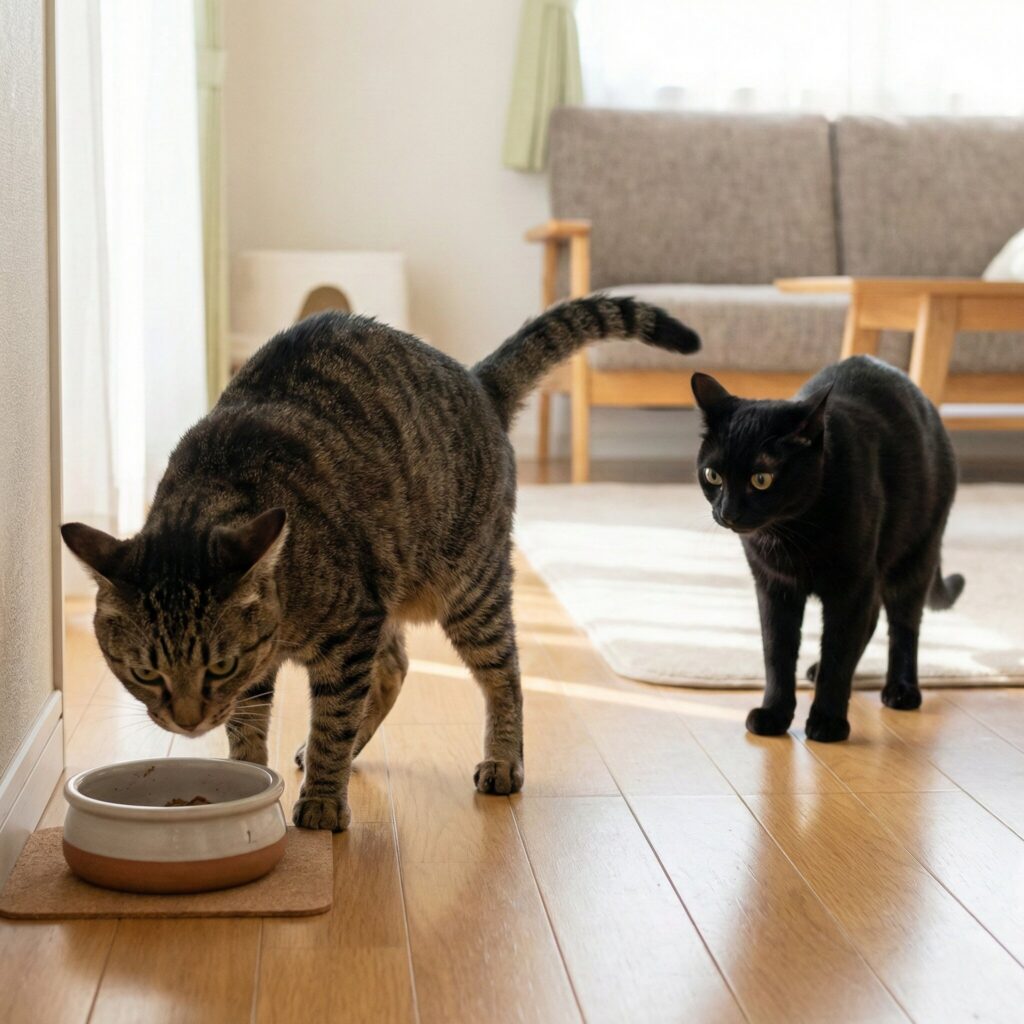
Resource guarding between cats occurs when one cat controls access to a valued item or space, preventing other cats from using it. The most common signs include stiff body posture, hard staring, blocking pathways, hissing, or chasing another cat away from food bowls, litter boxes, or sleeping spots. While often mistaken for bullying, this behavior usually stems from insecurity and a fear that there is not enough to go around.
Summary Table
| Behavior Type | Specific Signs | Common Targets | Danger Level |
| Physical | Flattened ears, stiff tail, dilated pupils, piloerection (fluffed fur) | Food bowls, Treats | High (Risk of fight) |
| Blocking | Sitting in doorways, lying in front of litter boxes | Litter box, Hallways | Medium (Chronic stress) |
| Vocal | Growling, hissing, low yowl while eating | Toys, Sleeping spots | High |
| Subtle | Staring from a distance, “claiming” a lap | Human attention, High perches | Low to Medium |
Understanding Resource Guarding in Multi-Cat Households
Resource guarding is a natural behavior rooted in survival, but in a home environment, it creates a stressful atmosphere. It is not always about a cat being “mean” or “dominant.” Instead, it is often about anxiety. The guarding cat worries that a specific resource, like food, a clean bathroom, or your affection, is scarce and must be protected.
When you have multiple cats, the dynamic shifts. Cats are territorial animals. In the wild, they control specific territories to ensure they have enough to eat. In your living room, that instinct remains. If you see one cat consistently preventing another from eating, sleeping, or using the bathroom, you are witnessing resource guarding.
Recognizing these signs early is crucial to preventing physical fights and long-term health issues caused by stress.
Read Also: How Do Cats Establish Territory?
Overt Physical Signs of Guarding
The most obvious signs of resource guarding are physical. These are the aggressive displays that are hard to miss. When a cat feels their prize is threatened, their body language changes instantly to warn off the intruder.
Ears and Eyes
Watch the ears and eyes closely. A guarding cat will often pin their ears back or rotate them sideways (often called “airplane ears”). This protects their ears in case a fight breaks out. Their eyes may become fixed on the other cat in a hard stare. Unlike a slow blink, which signals trust, a hard stare is a threat. The pupils might be dilated (large) due to adrenaline, or constricted (slits) if they are focused on an attack.
Stiff Body Posture
A relaxed cat has fluid movements. A guarding cat is stiff. You might notice them freezing in place when another cat enters the room. Their tail might lash back and forth quickly or be held rigid. If the guarding is intense, you may see piloerection, where the fur along the spine and tail puffs up to make the cat look larger and more intimidating.
Vocalizations
Sound is a clear warning. If a cat is eating and hears another cat approach, they may let out a low growl or a “yowl” without stopping their meal. Hissing is also common. These sounds mean, “Back off, this is mine.”
The “Silent” Guarding: Blocking and Staring
Not all resource guarding involves hissing or fighting. In fact, the most effective resource guarding is often silent and can go unnoticed by owners for months. This is known as passive aggression or passive blocking.
The Doorway Block
This is a classic move. A cat will sit in the middle of a doorway or hallway. To a human, it looks like the cat is just lounging. However, if that doorway leads to the only room with a litter box or food bowl, the cat is actually setting up a blockade. The victim cat knows they cannot pass without a confrontation, so they stay away.
Litter Box Ambushing
The litter box is a highly vulnerable place for a cat. Resource guarding here is dangerous because it can cause the victim cat to stop using the box entirely, leading to house soiling. Watch for a cat that lies down just a few feet away from the litter box. They may not look at the box, but they are monitoring it. If the victim cat tries to enter, the guard cat might just stand up or take a step forward, causing the victim to flee.
The Stalk and Stare
Sometimes, a guarding cat will simply stare at the other cat from across the room. If the victim cat moves toward a toy or a bed, the guard cat locks eyes with them. The victim cat will often freeze, turn around, and walk away. No sound was made, no fur was flown, but the resource was successfully guarded.
Common Resources That Trigger Guarding
To stop the behavior, you must identify what is being guarded. It is rarely everything; it is usually specific items that the cat perceives as high-value.
Food and Water
This is the most primal trigger. In the wild, food is survival. In a home, even if bowls are full, a cat may feel that access is threatened. This often happens when cats are fed side-by-side. One cat eats quickly and then pushes the other away, or simply stares until the other cat leaves their bowl.
Litter Boxes
As mentioned, the bathroom is a place of vulnerability. Guarding the litter box is a major cause of stress. If you have fewer boxes than cats, you are creating a scarcity mindset. The rule of thumb is one box per cat, plus one extra.
High Perches and Resting Spots
Cats seek high ground for safety. The top of a cat tree or a sunny windowsill is prime real estate. You might notice one cat always occupies the top spot, and if the other cat tries to jump up, they get swatted or hissed at.
Human Attention
Yes, you are a resource. If you are petting one cat and the other approaches, does the first cat hiss or swat? They are guarding your affection. They may also physically insert themselves between you and the other cat to claim you.
Toys
Interactive toys, like wand toys or laser pointers, can trigger guarding. One cat might dominate the play session, growling or swiping if the other cat tries to join in. Eventually, the second cat stops trying to play altogether and sits on the sidelines.
Read Also: How to Improve Quality of Life for Aging Cats
Differentiating Play from Resource Guarding
It can be difficult to tell if cats are playing or fighting over resources. However, there are distinct differences in the flow of the interaction.
Reciprocity
In healthy play, cats take turns. One chases, then the other chases. One is on top, then the other is on top. In resource guarding, the dynamic is one-sided. The guard cat is always the aggressor or the blocker, and the victim cat is always retreating or hesitant.
Silence vs. Noise
Play is usually quiet, aside from the thud of paws. Guarding often involves growling, hissing, or high-pitched squeals of pain or fear.
Body Language During Breaks
When playing, cats take a break; they look relaxed. They might groom each other or sit near each other. After a resource guarding incident, the victim cat will look tense, hide, or flee the room entirely. They do not return to interact with the aggressor.
The Consequences of Unchecked Guarding
Ignoring resource guarding is dangerous for the health of your cats. It is not something they will “work out on their own.”
Chronic Stress and Illness
Living in a war zone takes a toll. The victim cat lives in a state of chronic anxiety. Stress is a leading trigger for Feline Idiopathic Cystitis (FIC) and Feline Lower Urinary Tract Disease (FLUTD). A cat that is blocked from the litter box may hold their urine too long, leading to crystals or blockages, which can be fatal.
Malnutrition and Dehydration
If a cat is being guarded away from food or water, they may eat or drink less than they need. This can lead to weight loss and kidney issues over time.
Escalated Aggression
What starts as a stare can turn into a full-blown fight. Redirected aggression can also occur, where the stressed cat lashes out at you or another pet because they are on edge.
Read Also: Why Older Cats Meow More
How to Manage and Stop Resource Guarding
The solution to resource guarding is abundance and distribution. You must prove to the guarding cat that there is plenty of everything, so there is no need to fight.
The “N+1” Rule
This is the golden rule of cat ownership. You should have one of every critical resource for each cat, plus one extra.
- Two cats? You need three litter boxes, three water bowls, and multiple scratching posts.
Distribute Resources Geographically
Placing three food bowls right next to each other does not count as three resources; to a cat, that is one resource zone that is easily guarded. You must spread them out.
- Put one food bowl in the kitchen and another in the bedroom.
- Place litter boxes on different floors of the house.
- Ensure sleeping spots are available in different rooms. This prevents the guard cat from being able to control everything at once. They cannot be in two places at the same time.
Visual Barriers
Cats are visual hunters. If they cannot see the other cat, they often relax. Use cardboard boxes, furniture, or baby gates to break up lines of sight. When feeding, try feeding them on opposite sides of a closed door or an island counter so they cannot stare at each other.
Create Multiple Exit Routes
Never put a resource in a “dead end.” If a litter box is in a closet, the guard cat can easily trap the victim. Ensure every resource has two ways to escape an entrance and an exit. Move food bowls away from corners.
Scheduled Play and Attention
If the cats are guarding you, ensure you give them one-on-one time apart from each other. Play with the guard cat to burn off excess energy, which can reduce their desire to bully. Play with the timid cat to build their confidence.
Environmental Enrichment
Boredom fuels aggression. If a cat has nothing to do, controlling the household becomes their job.
Vertical Space
Add cat trees, shelves, or clear off the tops of bookshelves. Vertical space increases the square footage of the territory. If the guard cat is on the floor, the victim cat can navigate the room safely using the shelves.
Puzzle Feeders
Instead of using bowls, use puzzle feeders. This mimics the hunting instinct. If the guard cat is busy working for their food, it has less time to stare at the other cat. It also changes the association of food from “competition” to “individual activity.”
When to Seek Professional Help
Sometimes, environmental changes are not enough. If the following occurs, you need expert intervention:
- Blood is drawn: If fights result in injuries.
- Self-starvation: If the victim cat refuses to eat out of fear.
- House soiling: If the victim cat is urinating on beds or sofas because they are blocked from the box.
- Constant hiding: If one cat lives under the bed 24/7.
In these cases, consult a certified cat behaviorist or a veterinarian. Medication for anxiety may be needed for the aggressor, the victim, or both, to lower the temperature enough for training to work.
Conclusion
Resource guarding between cats is a sign of a breakdown in the social structure of your home. It stems from fear and scarcity. By recognizing the signs, whether it is the overt hiss or the subtle doorway block, you can intervene before the relationship is damaged permanently. Remember, the goal is not to punish the guard cat, but to change the environment so that guarding becomes unnecessary. Through the strategic placement of resources, increasing vertical territory, and reducing competition, you can restore peace to your multi-cat household.