
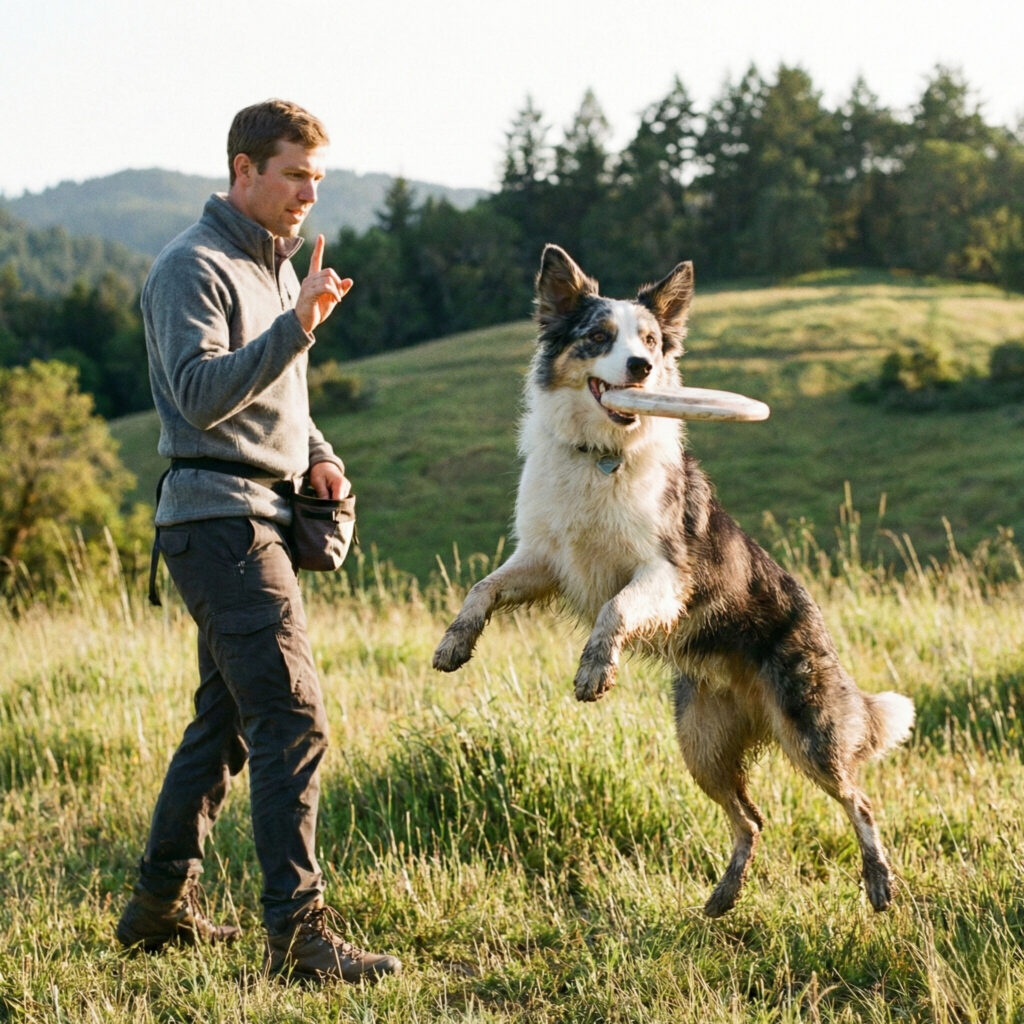
To train a high-energy dog, you must combine physical exercise with intense mental stimulation. A tired body is not enough; you need a tired brain. Focus on impulse control training, establish a strict routine, use positive reinforcement, and teach an “off switch” using techniques like the Place command or relaxation protocols. Consistency and management are key to turning chaotic energy into focus.
Summary Table: High-Energy Dog Training
| Component | Key Action Items | Expected Result |
| Physical Exercise | Flirt poles, fetch with rules, jogging | Burns excess calories |
| Mental Stimulation | Scent work, puzzle toys, trick training | Tires the brain (more effective than running) |
| Impulse Control | Baby gates, leash tethers, and removing triggers | Builds patience and focus |
| The “Off Switch” | Mat training, crate time, Capturing Calmness | Teaches the dog how to relax |
| Management | Baby gates, leash tethers, removing triggers | Prevents bad habits from forming |
How to Train a Dog With High Energy
Owning a high-energy dog often feels like living with a toddler who drank a triple espresso. Whether you have a Border Collie, a Husky, a Pointer, or a mixed-breed with endless stamina, the struggle is real. You might walk them for five miles, only to come home and find them zooming around the living room five minutes later.
Many owners make the mistake of trying to physically tire out these dogs. The problem is, high-energy breeds are athletes. If you run them for an hour every day, you are just building an endurance athlete who will eventually need two hours of running to get tired.
The solution is not just more exercise; it is the right kind of exercise combined with mental work.
This guide will walk you through a proven system to manage, train, and enjoy your high-drive dog without losing your mind.
Read Also: Why Some Dogs Ignore Commands Outside
Why Your Dog Won’t Calm Down
Before fixing the behavior, you need to understand the engine driving it. High-energy dogs were bred for jobs. They were designed to herd sheep for 12 hours, pull sleds across frozen tundras, or hunt badgers in deep burrows.
When these dogs live in a modern home without a “job,” that energy has nowhere to go. It leaks out as:
- Destructive chewing
- Excessive barking
- Digging
- Jumping on guests
- Reactive lunging on walks
Hyperactivity vs. High Energy
There is a difference between a high-energy dog and a hyperactive one. High energy is a trait; hyperactivity is often a state of mind caused by over-arousal or a lack of boundaries. Your goal is to channel the energy, not suppress it.
Phase 1: Management and Routine
You cannot train a dog that is bouncing off the walls. The first step is stopping the chaos through management. This prevents your dog from practicing bad behaviors while you work on training.
Create a Predictable Schedule
Dogs thrive on predictability. If your dog knows that a walk happens at 7:00 AM and training happens at 5:00 PM, they are less likely to pace anxiously at 3:00 PM.
- Morning: Potty, vigorous exercise, breakfast (in a puzzle toy).
- Mid-Day: Potty break, short training session, nap.
- Evening: Long walk or play session, dinner, relaxation time.
Control the Environment
If your dog runs around the house knocking things over, you are giving them too much freedom too soon.
- Use Crate Training: The crate is a place for rest, not punishment. High-energy dogs often don’t know when they are tired. Enforced naps in a crate can prevent the “toddler tantrum” behavior that comes from exhaustion.
- ** tethering:** Keep your dog on a leash attached to your belt while inside. This prevents them from wandering off to chew furniture and keeps them focused on you.
Phase 2: The Power of Mental Stimulation
This is the secret weapon. 15 minutes of mental work can be as tiring as an hour of running. High-energy dogs have busy brains. If you don’t give them a puzzle to solve, they will create their own (usually involving your drywall).
Ditch the Food Bowl
Do not feed your high-energy dog from a bowl. That is a wasted training opportunity.
- Puzzle Feeders: Use Kongs, snuffle mats, or slow feeders.
- Hand Feeding: Use their kibble as rewards for training sessions throughout the day.
- Hide and Seek: Hide piles of food around the living room and let them sniff it out.
Scent Work
A dog’s sense of smell is their primary way of seeing the world. Sniffing lowers the heart rate and burns mental energy.
- The “Find It” Game: Throw a treat in the grass and say, “Find it.”
- Box Search: Put treats in one of three empty boxes and let them identify the right one.
Trick Training
Teaching complex tricks like “roll over,” “spin,” or “weave through legs” forces the dog to think and focus on your body language.
Read Also: How Long Should a Dog Training Session Last?
Phase 3: Teaching the “Off Switch”
Many high-drive dogs do not know how to relax. They think they must be “on” 24/7. You must teach relaxation as a behavior, just like you teach “sit.”
The Place Command
This is non-negotiable for high-energy dogs. “Place” means: Go to your bed/mat and stay there until released.
- Lure: Guide the dog onto a raised cot or mat with a treat.
- Reward: Feed them continuously while they are on the mat.
- Duration: Slowly increase the time between treats.
- Distance: Slowly move away from the mat while they stay.
- Distraction: Eventually, you want them to stay on “Place” while you cook dinner or answer the door.
Capturing Calmness
This technique, popularized by dog trainers like Kikopup, involves rewarding your dog for doing nothing.
- Keep treats in your pocket.
- When your dog lies down on their own and sighs/relaxes, calmly drop a treat between their paws.
- Do not say anything. You are simply marking the behavior of relaxation.
The Relaxation Protocol
Look up Dr. Karen Overall’s Relaxation Protocol. It is a 15-day systematic program designed to teach a dog to stay calm while weird things happen (like you clapping your hands, running in place, or leaving the room).
Phase 4: Structured Physical Exercise
While mental stimulation is king, these dogs still need to move. However, you must avoid mindlessly throwing a ball for an hour, which creates an adrenaline junkie.
The Flirt Pole
A flirt pole is like a giant cat toy for dogs, a lure on a rope attached to a stick.
- Why it works: It taps into prey drive (the desire to chase) in a controlled way.
- The Rule: The dog must “sit” and “wait” before chasing the lure. They must “drop it” when caught. This combines intense cardio with intense impulse control.
Structured Fetch
Don’t just throw the ball.
- Ask for a “Sit” or “Down.”
- Throw the ball.
- Make the dog make eye contact with you.
- Release them with a command like “Go!”This forces the dog to think before it acts, preventing over-arousal.
Decompression Walks
Instead of a fast-paced power walk on a short leash, take a “sniffari.” Use a long line (15-20 feet) and let the dog sniff whatever they want (as long as it’s safe). Sniffing creates a calm, satisfied dog.
Phase 5: Impulse Control Games
Impulse control is the ability to resist the urge to do something (like chase a squirrel or eat a dropped sandwich).
The “Leave It” Command
- Put a low-value treat in your closed fist. Present it to the dog.
- They will lick and paw at it. Ignore them.
- The second they pull their head back, say “Yes” and give them a high-value treat from your other hand.
- Repeat until they stop trying to get the treat in the closed hand.
Wait at Thresholds
Never let your high-energy dog bolt out the front door or out of their crate.
- Open the door an inch. If they move toward it, shut it immediately.
- Repeat until they sit and wait while the door is fully open.
- Release them with a specific command like “Free.”
The “Look at Me” Game
Teach your dog that looking at you is more rewarding than looking at distractions.
- Hold a treat out to the side.
- The dog will look at the treat. Wait.
- When they look at your eyes, mark “Yes” and reward.
Read Also: Dog Training & Behavior Management
Advanced Outlets: Dog Sports
If your dog is still overflowing with energy, they might need a hobby. Dog sports are the ultimate way to bond and burn energy.
- Agility: navigating obstacle courses. Great for Border Collies and Aussies.
- Flyball: A relay race involving hurdles and tennis balls. Excellent for ball-obsessed dogs.
- Nosework: Professional scent detection. Great for all dogs, even older ones or those with joint issues.
- Canicross: Running cross-country with your dog attached to a waist belt.
Common Mistakes to Avoid
1. Using Laser Pointers
Never use laser pointers with high-energy dogs. It triggers their prey drive but gives them no closure (they can never “catch” the dot). This can lead to Obsessive-Compulsive Disorder (OCD) behaviors like shadow chasing.
2. Reinforcing Excitement
When you come home, do not use a high-pitched voice and ruffle their ears. This tells the dog that your arrival is a high-arousal event. Instead, ignore the dog for the first 5 minutes until they are calm, then greet them quietly.
3. Inconsistency
If you let them jump on the couch on Friday but yell at them for it on Monday, you will create anxiety. Anxiety manifests as excess energy. Be black and white with your rules.
Conclusion
Training a high-energy dog is a marathon, not a sprint. It is easy to get frustrated when your dog is pacing or whining, but remember that this energy is a gift. The same drive that makes them difficult to live with is what makes them incredible learners and partners.
By implementing a structure that balances physical exertion with mental gymnastics and teaching them the art of doing nothing, you will transform your chaotic roommate into a focused, well-behaved companion. Start small, stick to the routine, and remember: a bored dog is a “bad” dog, but a fulfilled dog is a joy.