
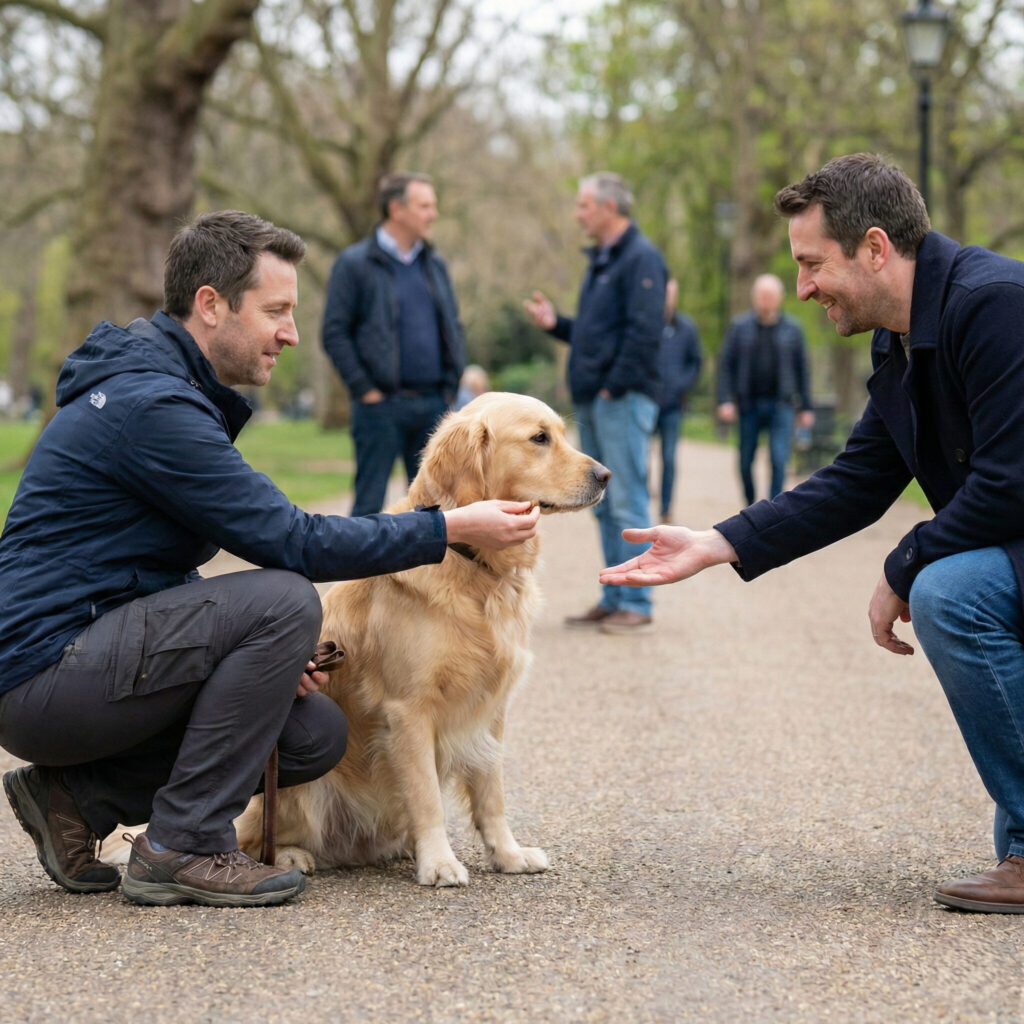
To teach a dog to be calm around strangers, use positive reinforcement to change their emotional response from fear or over-excitement to calmness. Start from a distance where the dog is comfortable, reward them with high-value treats just for noticing a stranger without reacting, and gradually decrease the distance over many sessions. Never force an interaction and always advocate for your dog’s space.
Summary Table
| Stage | Goal | Action | Key Tools |
| Preparation | Build foundational skills. | Practice “sit,” “stay,” and “watch me” at home without distractions. | High-value treats, leash, calm demeanor. |
| Phase 1: Distance | Change emotional response. | Reward the dog for looking at a stranger far away, then looking back at you. Stay far enough so the dog doesn’t react. | Really good treats (cheese, hot dogs), patience. |
| Phase 2: Approach | Shrink the comfort zone. | Slowly decrease the distance to strangers in controllable settings. Continue rewarding calm behavior. | Long leash, consistent rewards. |
| Phase 3: Greeting | Teach polite introductions. | Allow brief, controlled sniffs only if the dog is calm. Recall the dog to your side and reward. | Willing helpers who follow instructions. |
How to Teach Dogs to Be Calm Around Strangers
It is a common goal for dog owners to have a pet that is relaxed and friendly when meeting new people. A dog that jumps, barks, or cowers behind your legs when a stranger approaches can be stressful for everyone involved. The good news is that almost any dog can learn to be calmer around new faces. This process doesn’t happen overnight. It requires patience, consistency, and understanding your dog’s perspective.
This guide will walk you through practical steps using positive methods to help your dog feel safe and behave calmly around strangers.
Read Also: How to Safely Break Up a Dog Fight
Understanding Why Your Dog Reacts
Before changing behavior, it helps to know why it’s happening. Dogs rarely act out for no reason. Their reaction to strangers usually stems from one of three main things:
- Fear or Anxiety: The most common reason. The dog sees an unfamiliar person as a potential threat. Their barking or lunging is a request for distance (“Go away!”).
- Over-Excitement: Some dogs love people too much. They haven’t learned polite ways to say hello and get overwhelmed with happy energy, leading to jumping and mouthing.
- Lack of Socialization: If a dog wasn’t exposed to many different types of people as a puppy, new humans can be confusing and scary.
Regardless of the root cause, the training approach is similar: we need to change how the dog feels about strangers. We want to move their emotional dial from “scary” or “PARTY TIME!” to “neutral and good things happen.”
Foundational Skills You Need First
Don’t start training with real strangers right away. You and your dog need a few basic skills first. Practice these in your quiet home until your dog is reliable.
- The “Watch Me” Command: Teaching your dog to make eye contact with you on cue is crucial. It gives them an alternative behavior to staring at the stranger. Hold a treat near your eyes, say “watch me,” and reward when they look.
- A Solid “Sit-Stay”: This is their “parking spot.” A dog that is sitting is less likely to jump or lunge.
- Your Own Calm Energy: Dogs read our body language. If you tense up, grip the leash tight, or hold your breath when you see a stranger, your dog will think there is something to worry about. Take a deep breath, relax your shoulders, and keep a loose leash whenever possible.
The Step-by-Step Training Plan
This process uses a technique called desensitization and counter-conditioning. Basically, you expose your dog to strangers at a level they can handle and pair that presence with their favorite things (usually food).
Phase 1: Working from a Safe Distance
The goal here is not to meet anyone. The goal is for your dog to see a stranger and remain calm.
- Find the Right Spot: Go to a park or open space where you can see people, but be far away from them.
- Find the “Threshold”: This is the distance where your dog notices a person but doesn’t react (no barking, whining, or stiff body). If your dog reacts, you are too close. Move further away.
- The “Look and Treat” Game: As soon as your dog looks at the stranger, say “yes!” or click a clicker, and immediately give them a high-value treat (like small pieces of cheese or chicken).
- Repeat: Wait for them to look at the stranger again. Mark with “yes!” and treat again. You are teaching them: “Stranger appears = tasty treat appears.”
- Keep it Short: Do this for 5-10 minutes at a time. End on a good note.
Read Also: How to Read Warning Signs Before a Dog Bite
Phase 2: Gradually Decreasing Distance
Once your dog regularly looks to you for a treat when they see someone at 50 feet, you can try moving to 40 feet.
- Slowly Close the Gap: Over many sessions, gradually decrease the distance between your dog and strangers.
- Watch for Stress Signals: If your dog stops taking treats, stares intently without looking back at you, yawns excessively, or lip licks, you have moved too close too fast. Back up to the previous successful distance and practice more there.
- Add Movement: Practice walking parallel to strangers at a safe distance, rewarding your dog for staying by your side and checking in with you.
Phase 3: Controlled Introductions (The “Meet and Greet”)
Only move to this phase when your dog can calmly walk past people on the sidewalk without reacting. You will need a helper for this setup.
- Set the Stage: Have a friend or neighbor act as the “stranger.” Give them strict instructions: ignore the dog completely. No eye contact, no talking to the dog, no reaching out.
- Approach Calmly: Walk towards your helper. Stop about 6 feet away. Ask your dog to sit.
- Reward Calmness: If your dog sits calmly, feed them treats rapidly. You can talk to your helper briefly while feeding your dog.
- The 3-Second Rule: If the dog remains calm, tell the helper they can offer a flat hand for the dog to sniff. After 3 seconds, call your dog back to you (“Fido, here!”) and reward heavily.
- End the Interaction: Do not let the greeting go on until the dog gets excited or uncomfortable. Short, positive interactions build confidence. If the dog shows any sign of fear, retreat immediately and don’t force the greeting.
Managing Real-World Situations
You can’t always control the environment. Here is how to handle common scenarios while you are still in the training phase.
- On Walks: If you see someone approaching on a narrow path, don’t just hope for the best. Cross the street, step into a driveway, or put a visual barrier (like a parked car) between your dog and the person. Ask for a “sit” and reward your dog for focusing on you while the person passes.
- Guests in Your Home: This is harder because it’s your dog’s territory.
- Meet Outside First: Meet guests outside on neutral ground for a quick walk together before entering the house.
- Use a Safe Space: If your dog is very fearful, put them in a crate or a separate room with a stuffed Kong toy before guests arrive. They don’t have to meet everyone.
- Instruct Your Guests: Tell guests to completely ignore the dog. No looking, touching, or talking to them. Let the dog approach on their own terms if they want to. If the dog does approach calmly, the guest can drop a treat on the floor for them.
Common Mistakes to Avoid
- Punishing Fear: Never yell at or jerk the leash of a scared dog. This only confirms that strangers bring bad things and will make the fear worse.
- Forcing Interactions: Dragging a dog toward someone they are afraid of to “show them it’s okay” can destroy their trust in you and lead to a bite. Always give your dog the option to move away.
- Moving Too Fast: Rushing the process is the biggest reason training fails. If you skip steps, your dog will get overwhelmed. If you are stuck, go back to an easier step and spend more time there.
When to Call a Professional
While many dogs can be helped with these steps, some need expert guidance. You should seek help from a certified professional dog trainer or a veterinary behaviorist if:
- Your dog has bitten or attempted to bite someone.
- The behavior is getting worse despite your efforts.
- Your dog is so fearful that they shut down and won’t eat treats outside.
- You feel overwhelmed or unsafe managing your dog.
A professional can create a customized plan and ensure safety for everyone.
Conclusion
Teaching a dog to remain calm around strangers is a journey that requires empathy and consistent effort. By understanding that your dog’s reaction comes from a place of emotion, you can use positive reinforcement to reshape that emotion.
Remember to work at your dog’s pace, celebrate small victories, and always be your dog’s advocate by ensuring they feel safe. With time and practice, you can help your canine companion navigate the social world with confidence and calm.