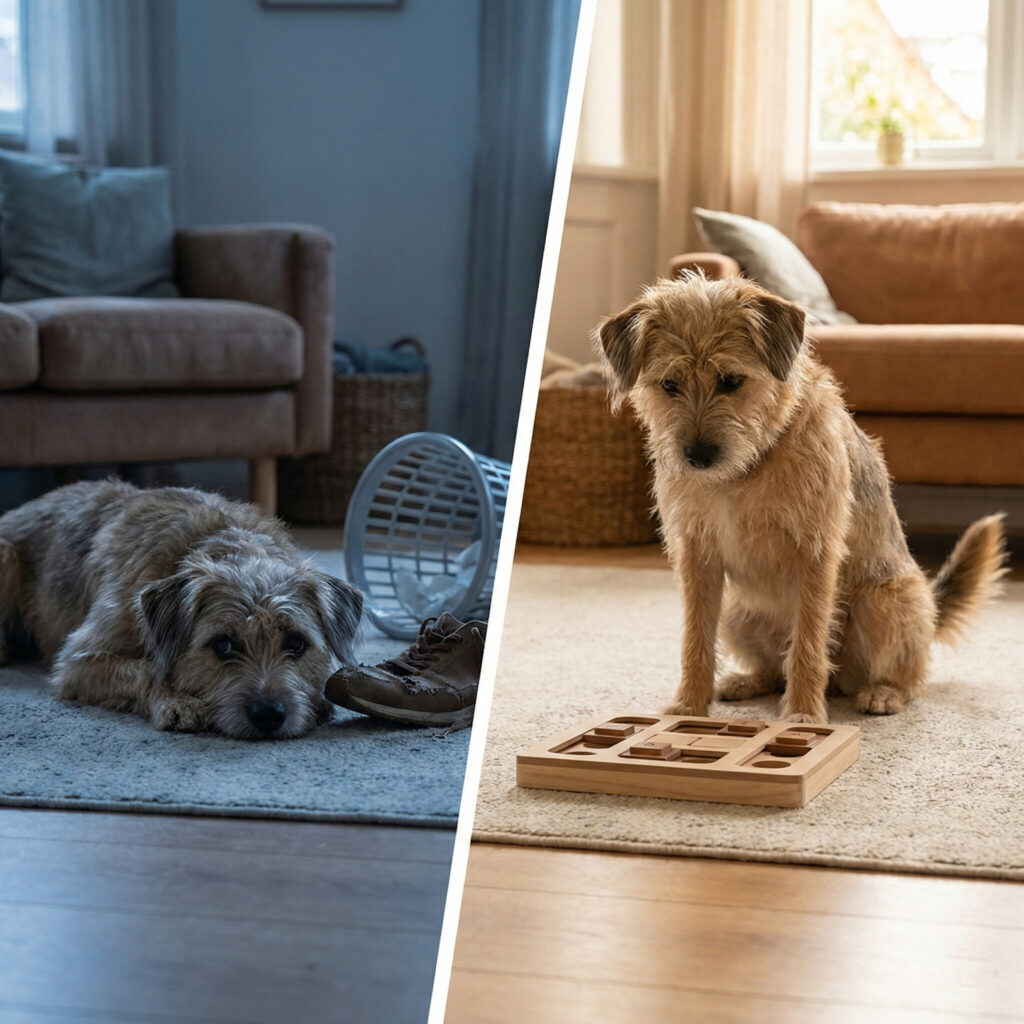
Mental stimulation reduces bad behavior in dogs by channeling their excess energy and natural instincts into productive tasks rather than destructive habits. When a dog is mentally challenged through puzzles, training, and scent work, they experience cognitive fatigue, which is often more tiring than physical exercise. This reduces boredom, the leading cause of chewing, barking, and digging, resulting in a calmer, more satisfied pet.
Summary Table
| Feature | Details |
| Main Goal | To tire the dog’s brain, not just their body. |
| Common Issues Solved | Excessive barking, chewing furniture, digging, hyper-arousal, anxiety. |
| Top Methods | Puzzle feeders, scent games, trick training, “sniffaris” (scent walks). |
| Time Required | 15–20 minutes of mental work can equal 1 hour of physical play. |
| Key Benefit | Increases dopamine (happiness) and lowers cortisol (stress). |
How Mental Stimulation Reduces Bad Behavior
Many dog owners make the mistake of thinking their dog is acting out of anger or spite when they find a chewed-up shoe or a hole in the garden. The reality is usually much simpler: your dog is bored.
Dogs were bred for centuries to perform specific jobs. Border Collies were bred to herd, Terriers to hunt vermin, and Retrievers to fetch. When these intelligent animals are left in a house with nothing to do, they “employ” themselves.
Unfortunately, the jobs they choose for themselves, like “Home Demolition Expert” or “Neighborhood Watch Barker,” are rarely appreciated by their human owners.
Mental stimulation is the missing link in many dog behavior plans. While physical exercise is vital for health, it often builds stamina without actually tiring the dog out.
A physically fit but mentally bored dog is simply a dog with more energy to destroy your house. Mental enrichment provides an outlet for their natural drives, leading to a significant reduction in unwanted behaviors.
The Science: How Brain Games Calm Dogs
When a dog engages in problem-solving, their brain uses a significant amount of glucose. This cognitive effort is exhausting. You might have experienced this yourself after a long day of studying or learning a new skill, you feel tired even if you haven’t run a marathon.
Furthermore, successful completion of mental tasks releases dopamine, a neurotransmitter associated with pleasure and reward. This naturally calms the dog and creates a sense of satisfaction.
Conversely, a lack of stimulation can increase cortisol, the stress hormone, leading to anxiety and reactive behaviors.
By providing enrichment, you are biologically altering your dog’s brain chemistry to favor calmness over chaos.
Read Also: How to Train an Older Dog
Signs Your Dog Needs More Mental Stimulation
If you notice these behaviors, your dog is likely crying out for a brain workout:
- Destructive Chewing: Targeting furniture, baseboards, or shoes.
- Demand Barking: Barking at you for attention or at nothing in particular.
- Pacing and Restlessness: Inability to settle down even after a walk.
- Tail Chasing or Obsessive Licking: Repetitive behaviors often stem from anxiety or boredom.
- Digging: Excavating the yard or scratching at carpets.
Core Methods of Mental Stimulation
You do not need to be a professional trainer to provide mental enrichment. The goal is to make your dog work for their rewards rather than getting them for free.
1. Ditch the Food Bowl
The easiest way to introduce mental stimulation is to stop feeding your dog out of a standard bowl. A dog can inhale a meal in 30 seconds from a bowl, leaving them with nothing to do for the rest of the day. Using food puzzles turns mealtime into a 20-minute event that engages their brain.
- Snuffle Mats: Fabric mats with strips of felt where you hide kibble. The dog must sniff and search to find the food.
- Slow Feeders: Plastic bowls with ridges and mazes that require the dog to navigate around obstacles to eat.
- Stuffable Toys: Rubber toys (like a Kong) that can be stuffed with wet food or peanut butter and frozen. This requires licking and chewing, which are naturally soothing behaviors for dogs.
2. Scent Work and “Sniffaris.”
A dog’s sense of smell is their primary way of seeing the world. Processing scents is incredibly mentally taxing for them.
- The “Sniffari” Walk: Instead of walking your dog at a fast pace for exercise, take a “decompression walk.” Put them on a long leash and let them sniff whatever they want for as long as they want (as long as it is safe). Even if you only walk one block in 20 minutes, the mental information they gather is vast.
- Hide and Seek: Hide treats around the living room while your dog stays in another room. Give the command “Find it” and let them use their nose to hunt down the snacks.
- The Box Game: Save your delivery boxes. Put treats inside some of them and let your dog tear the boxes apart or nudge them open to get the reward. (Supervise this to ensure they don’t eat the cardboard.
3. Training and Trick Learning
Obedience training is not just about manners; it is intense mental work. Learning a new command requires focus, impulse control, and memory.
- Shaping Games: This involves waiting for your dog to offer a behavior (like looking at a box) and clicking/rewarding it, then slowly raising the criteria until they perform a complex action (like stepping into the box).
- Impulse Control: Teach commands like “Wait,” “Leave it,” or “Stay.” Stopping themselves from doing what they want to do requires massive brainpower.
- New Tricks: Teach silly tricks like “spin,” “shake,” or “roll over.” These are fun and build a bond between you and the dog while burning energy.
Read Also: Why Do Dogs Regress in Training?
Targeting Specific Bad Behaviors
Mental stimulation is not a one-size-fits-all cure, but it targets the root cause of specific behavioral issues. Here is how enrichment helps common problems.
Reducing Destructive Chewing
Dogs chew to relieve stress and boredom. When you provide a dedicated “legal” outlet for chewing and problem-solving, the desire to chew “illegal” items (like your sofa) decreases.
- The Fix: Provide frozen stuffed toys. The cold soothes the gums (great for puppies), and the challenge of getting the food out occupies the mouth and brain for extended periods.
Stopping Excessive Barking
Barking is often a self-reinforcing behavior fueled by excess energy. A tired dog is a quiet dog.
- The Fix: Engage in a scent game 20 minutes before you need the dog to be quiet (e.g., before a Zoom call). Follow this up with a long-lasting chew. The mental fatigue from the scent game lowers their arousal levels, making them less likely to react to minor noises outside.
Managing Separation Anxiety
Anxiety often stems from a fear of being alone and a lack of confidence. Puzzle solving builds confidence.
- The Fix: Give a high-value puzzle toy right before you leave the house. This creates a positive association with your departure. The dog learns that “Human leaving = Good things happen.” Additionally, the mental focus shifts their brain from “panic mode” to “work mode.”
Creating a Daily Enrichment Schedule
You do not need to spend hours a day on this. Integrating small moments of stimulation into your existing routine is sustainable and effective.
Sample Routine for a High-Energy Dog:
Morning (7:00 AM)
- Breakfast: Served in a frozen Kong or a slow-feeder bowl. (0 minutes extra time for you).
- Walk: 20-minute “Sniffari” allowing the dog to lead the way and sniff intently.
Mid-Day (12:00 PM)
- Training: 5-minute session practicing “Sit,” “Stay,” or a new trick.
- Activity: A quick game of “Find it” with a handful of treats tossed in the yard or living room.
Evening (6:00 PM)
- Dinner: Served in a Snuffle Mat or scattered in the grass (if you have a yard).
- Relaxation: A Lick Mat (a textured rubber mat smeared with yogurt or peanut butter) to soothe the dog before bed.
Read Also: How to Build Focus in Easily Distracted Dogs
Important Considerations for Safety and Success
While mental stimulation is beneficial, it must be introduced correctly to avoid frustration.
Watch for Frustration
If a puzzle is too hard, a dog may give up or become destructive (e.g., chewing through the plastic puzzle instead of solving it).
- Start Simple: Begin with easy puzzles where the food falls out easily.
- Help Them: If your dog is struggling, help them solve it the first few times to build their confidence.
- Supervise: Always watch your dog with new toys to ensure they don’t swallow parts.
The “Over-Tired” Dog
Just like toddlers, dogs can get cranky if they are over-stimulated. If your dog becomes nippy or hyperactive after a lot of play, they may need a nap, not more stimulation. Enforced naps in a crate or a quiet room are essential for processing the mental work they have done.
Breed-Specific Needs
Tailor the stimulation to your dog’s breed traits (genetics).
- Retrievers: Enjoy carrying items and playing fetch variations.
- Terriers: Love digging and shredding (make them a “dig pit” or give them cardboard to shred).
- Hounds: Thrive on scent work and trailing exercises.
- Herding Breeds: Need impulse control games and “flirt pole” play (a toy on a string at the end of a pole).
Conclusion
Mental stimulation is not a luxury; it is a necessity for canine welfare. By understanding that your dog is an intelligent creature with needs beyond simple walking, you can drastically reduce bad behaviors. The formula is straightforward: replace boredom with brain games.
When you invest time in your dog’s cognitive health, you stop fighting against their instincts and start working with them. The result is a relationship built on trust, fun, and mutual respect, and a home that is safe from destruction.
Start small today: throw away the food bowl and let your dog work for their dinner. You will likely see a difference in their behavior immediately.