
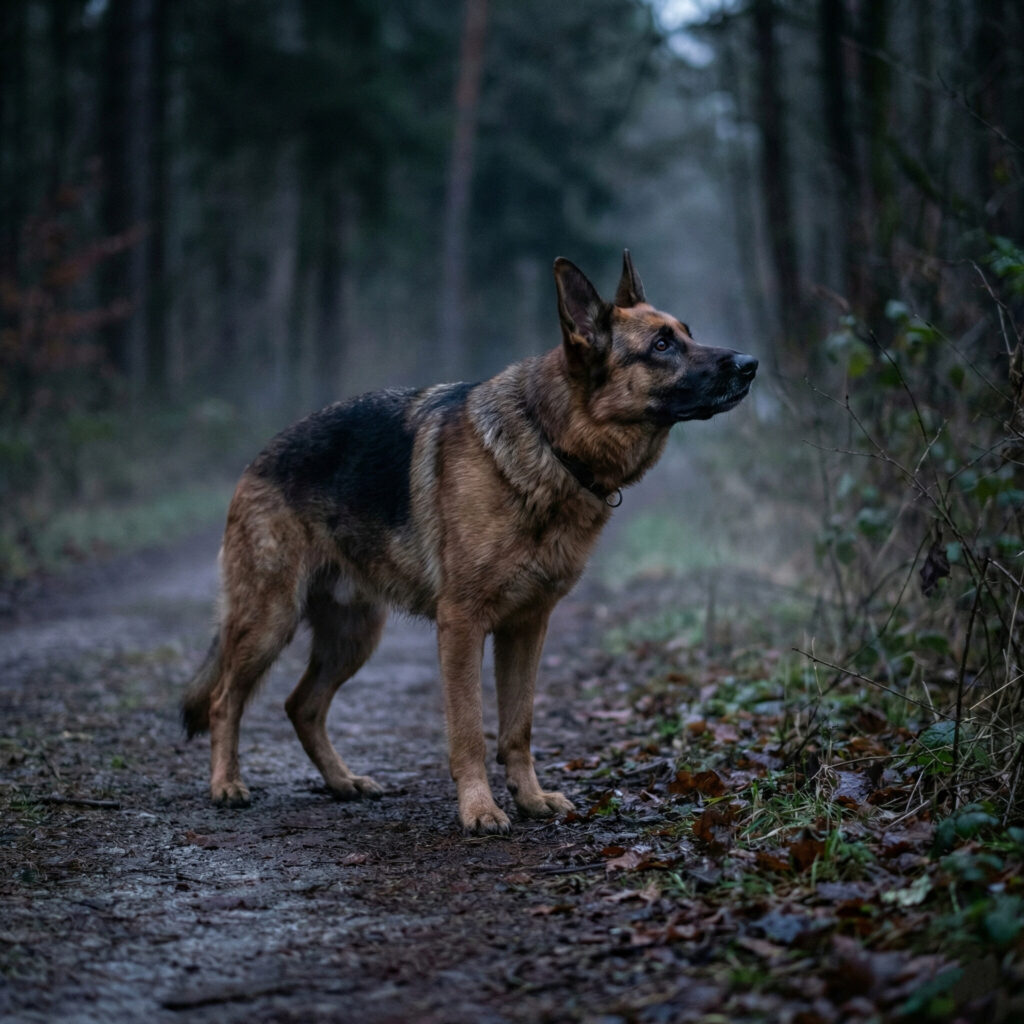
Dogs sense danger using a combination of their highly evolved biological senses, which are significantly more acute than humans’. Their primary tool is their sense of smell, allowing them to detect chemical signals (pheromones) released by humans or other animals experiencing fear or aggression. They also have superior hearing, capable of detecting sounds at far greater distances and higher frequencies than we can. Furthermore, dogs are expert observers of visual cues, reading subtle changes in human body language and noticing minute movements in their environment.
Summary Table
| Sense/Mechanism | Key Function | Dangers Detected |
| Olfaction (Smell) | Detects chemical changes, hormones, and pheromones. | Someone approaching from afar, unusual mechanical noises, noises from other animals, and early signs of storms. |
| Audition (Hearing) | Intruders, fearful people, aggressive animals, gas leaks, smoke, and certain medical crises (like seizures). | Someone approaching from afar, unusual mechanical noises, noises from other animals, early signs of storms. |
| Vision & Observation | Notices motion in low light and reads body language. | Hidden movement at night, tense or aggressive posture in people/animals, micro-expressions of fear in owners. |
| Environmental Sensitivity | Feels shifts in atmospheric pressure or vibrations. | Impending thunderstorms, tornadoes, or earthquakes before they strike. |
How Dogs Sense Danger
Every dog owner has experienced it. You are sitting quietly at home when suddenly, your dog’s head snaps up. Their ears swivel, a low growl starts in their throat, and they stare intently at a seemingly empty corner or out a dark window. You see nothing. You hear nothing. But your dog knows something is wrong.
For centuries, humans have relied on dogs as guardians because of their uncanny ability to detect threats long before we are aware of them. It often feels like a mystical “sixth sense,” but the reality is rooted in biology. Dogs don’t have supernatural powers; they have super-powered senses. They perceive the world through a completely different lens and nose than humans do.
This article breaks down the fascinating science of how dogs detect danger, exploring their powerful olfactory system, their acute hearing, and their incredible powers of observation.
Read Also: How to Teach Dogs to Be Calm Around Strangers
1. The Nose Knows: Smell is Their Superpower
The primary way a dog understands the world is through its nose. While humans rely heavily on sight, dogs rely on smell. It is difficult for us to comprehend just how powerful a dog’s sense of smell truly is.
A human has roughly 5 million scent receptors in their nose. A medium-sized dog has about 125 million to 300 million, depending on the breed (Bloodhounds have the most). Furthermore, the part of a dog’s brain devoted to analyzing smells is about 40 times larger than ours in proportion to their total brain size.
This olfactory horsepower allows them to detect danger in ways we cannot imagine.
Detecting “Fear” Smells
When a human or an animal gets scared, their body chemistry changes instantly. Adrenaline pumps through the system, and cortisol (the stress hormone) levels rise. These internal changes alter the chemical composition of sweat and other bodily secretions.
Dogs can smell these chemical shifts. They don’t just see a person acting strangely; they literally smell the fear radiating off them.
If an intruder is hiding outside your house, nervous about breaking in, they are releasing “fear pheromones.” Your dog picks up on this scent, distinct from that of a normal passerby.
This is why a dog might bark aggressively at one person but ignore another; their nose is telling them the first person is experiencing intense emotions associated with danger.
Smelling Illness and Medical Crises
Danger isn’t always an external threat like a burglar. Sometimes the danger is internal.
Dogs have been trained to detect specific volatile organic compounds (VOCs) associated with diseases.
- Cancer: Some dogs can smell certain cancers on a person’s breath or skin.
- Diabetes: Diabetic alert dogs can smell changes in blood sugar levels (hypoglycemia or hyperglycemia) on their owner’s breath before the owner feels symptoms.
- Seizures: Some dogs can detect chemical changes that precede an epileptic seizure, alerting their owner to get to a safe place before the episode begins.
Environmental Dangers
Their noses act as early warning systems for physical threats in the home. A dog will smell smoke from a distant fire long before a human does. They are highly sensitive to natural gas leaks, often reacting to the sulfur additive (mercaptan) in gas before the concentration is high enough for human detection.
2. Super Hearing: Detecting Sounds Beyond Our Range
While their nose is their primary tool, a dog’s hearing is a close second in its threat-detection arsenal. Dogs hear sounds very differently from how humans do.
Higher Frequencies
Humans generally hear sounds in a frequency range between 20 hertz (Hz) and 20,000 Hz. Dogs, however, can hear sounds up to 45,000 Hz to 65,000 Hz. This means they hear high-pitched noises that are completely silent to us.
Many mechanical devices emit high-frequency whines when they are malfunctioning or about to break. A dog might become agitated by an appliance that sounds perfectly normal to human ears because they hear the ultrasonic distress signal of the machine.
Distance and Direction
The physical shape of a dog’s ears helps them locate danger. Their ears are mobile and can swivel independently like radar dishes. This allows them to pinpoint the exact location of a sound. They can hear sounds at roughly four times the distance that humans can.
If someone is walking quietly on the pavement two streets over in the middle of the night, you won’t hear it. Your dog will. They hear the footfalls, the rustle of clothing, and the jingle of keys long before the person is visible.
When a dog suddenly runs to the door barking, they have likely heard an approach that is still outside human auditory range.
Read Also: How to Safely Break Up a Dog Fight
3. Master Observers: Reading Body Language
We often assume dogs don’t understand what is happening because they don’t speak our language. In reality, dogs are fluent in a language we often ignore: body language.
Because dogs are pack animals, their survival historically depended on reading the subtle cues of other pack members to understand the social hierarchy and detect threats. They have transferred this skill to reading humans.
Reading Human Tension
Dogs are masters at noticing micro-expressions and tiny shifts in posture. If you become tense, your breathing changes, your muscles tighten, and your facial expression shifts minutely. Your dog notices this instantly.
Often, when a dog seems to sense danger, they are actually sensing your anxiety about a situation. If you are walking at night and see a suspicious group of people, you might stiffen up without realizing it. Your dog feels that tension through the leash and sees it in your stride. They immediately go on alert because their leader is on alert.
Detecting Abnormal Behavior
Dogs thrive on patterns and routine. They know how normal people walk, move, and act. When someone behaves outside of this norm, moving stealthily, crouching, or staring intensely, it triggers a dog’s suspicion.
A person moving with the intent to harm looks very different physically than someone just jogging by, and a dog can spot that difference in body mechanics.
4. Environmental Sensitivity: The “Weather Sense”
Have you ever seen your dog pace nervously or try to hide in the bathtub hours before a thunderstorm hits? Many people believe dogs can “feel” upcoming weather events or even natural disasters like earthquakes. Science suggests they are reacting to physical changes in the environment.
Barometric Pressure
Before a major storm, there is usually a significant drop in barometric pressure. Dogs are sensitive to this change in pressure, which they may feel in their ears or joints. This sudden shift in the atmosphere can be unsettling or even painful for them, causing anxiety that we interpret as them “predicting” the storm.
Seismic Activity
In the case of earthquakes, some researchers believe dogs (and other animals) can detect the primary waves (P-waves) of a quake. These travel faster than the secondary, damaging waves (S-waves). P-waves create subtle vibrations through the ground that humans cannot feel, but a dog, especially one lying on the floor, might detect.
Some theories also suggest they may hear high-frequency sounds generated by grinding rocks deep underground before the surface shakes.
Read Also: How to Read Warning Signs Before a Dog Bite
5. How Dogs React to Sensed Danger
When a dog’s senses detect a threat, their reaction depends on their personality, breed, and training. However, there are common behaviors they display to alert their pack (you) or defend themselves.
- Alert Barking: This is a sharp, persistent bark intended to raise the alarm. It says, “Something is here, pay attention!”
- Growling: A low warning sound indicating the dog is ready to defend itself or its territory if the threat gets closer.
- Piloerection (Raised Hackles): The hair along the dog’s spine stands straight up. This is an involuntary reflex caused by adrenaline. It is meant to make the dog look bigger and more intimidating to a potential attacker.
- Posturing: A confident dog may stand tall, chest out, ears forward, staring directly at the threat. A fearful dog may lower its body, tuck its tail, and show the whites of its eyes (whale eye).
- Herding or Guarding: Some breeds will try to move their family members away from the perceived danger, while others will position themselves between their owner and the threat.
Conclusion
When your dog acts strangely, staring into the dark or growling at a seemingly empty space, it is easy to dismiss them as just being silly. However, thousands of years of evolution have crafted them into highly efficient biological alarm systems.
They are not psychic. They are just paying very close attention to a world filled with sights, sounds, and smells that we are completely oblivious to. By understanding the mechanics of their incredible senses, their powerful noses, ultrasonic hearing, and keen observation skills, we can better appreciate their warnings.
When your dog tells you something is wrong, it is usually worth investigating. They are using their superpowers to keep their pack safe.