
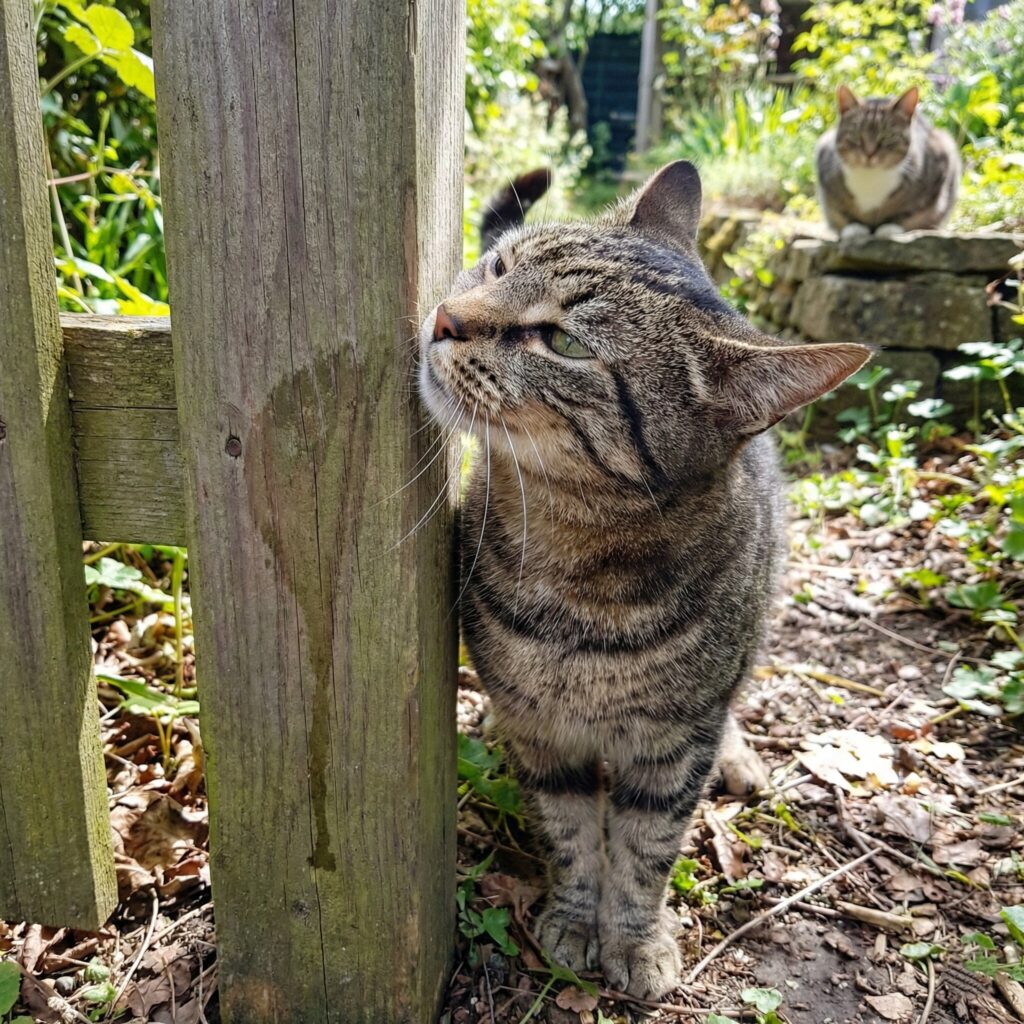
Cats establish indoor territory primarily through scent marking, visual signals, and routine. They release pheromones by rubbing their cheeks on objects (bunting) and scratching surfaces to deposit scent from their paws. This creates a comforting “scent map” that defines their safe zone. In addition to chemical signals, cats use vertical space (like cat trees) to survey their domain and practice “time-sharing,” where they occupy specific spots at specific times of day to avoid conflict in multi-cat households.
Summary Table
| Method | Action | Purpose |
| Facial Rubbing (Bunting) | Rubbing cheeks/head on corners and furniture. | Marks items as “safe” and “mine” using friendly pheromones. |
| Scratching | Clawing vertical or horizontal surfaces. | Leaves a visual mark (shredding) and a scent mark (from paw pads). |
| Patrolling | Walking a set route around the home. | Checks for intruders and reinforces boundaries. |
| Vertical Height | Climbing shelves, fridges, or trees. | Establishes dominance and provides a safe vantage point. |
| Urine Marking | Spraying vertical surfaces (tail quivering). | A stress reaction or signal to ward off rivals (different from peeing). |
| Time-Sharing | Using a specific chair only in the morning. | Avoids conflict by scheduling when a space is used. |
Why Territory Matters to Your Cat
To a human, a house is just a place to live. To a cat, the home is their entire ecosystem. In the wild, a cat’s survival depends on knowing exactly where their resources are, food, water, and shelter, and keeping competitors away.
Even though your indoor cat doesn’t need to hunt for mice or fight off coyotes, those ancient instincts are still driving their behavior. Establishing territory is not just about being bossy; it is about security. A cat that feels their territory is secure is confident, affectionate, and relaxed. A cat that feels their territory is threatened becomes anxious, aggressive, or withdrawn.
Understanding how your cat claims space helps you solve behavioral issues and creates a happier home environment.
Read Also: How to Help a Senior Cat Stay Active
The Role of Scent: The Invisible Fence
The primary way cats define their space is through a hidden language of smells. Humans rely on sight, but cats rely on their noses. They build a “scent map” of your home that tells them exactly where they are and who has been there.
Facial Rubbing (Bunting)
You have likely seen your cat rub their face against the corner of a wall, the leg of a table, or even your shin. This behavior is called bunting.
Cats have scent glands located on their lips, cheeks (temporal glands), chin, and forehead. When they rub these areas against an object, they deposit facial pheromones. These specific pheromones are distinct from other scents because they are associated with comfort, safety, and familiarity.
When a cat bunts the sofa, they are not just scratching an itch. They are tagging the sofa as “safe.” This is why cats often re-mark the same spots every day. The scent fades, so they must refresh it to maintain their sense of security.
- Cheek rubbing: usually marks low-stress, familiar objects.
- Head bunting: often reserved for social bonding with humans or other cats.
Scratching: The Dual Signal
Scratching is one of the most misunderstood feline behaviors. Many owners think cats scratch furniture to sharpen their claws or out of spite. In reality, scratching is a powerful territorial claim that serves two purposes at once:
- Visual Marker: The shredded fabric or wood leaves a clear sign to other animals that “a cat lives here.” The higher the scratch marks, the larger and more imposing the cat appears.
- Chemical Marker: Cats have scent glands in their paw pads (interdigital glands). When they scratch, they leave behind pheromones embedded in the shredded material.
This is why cats often scratch prominent areas, like the arm of a sofa or a doorframe. They want their message to be seen and smelled by anyone entering the room.
Urine Marking vs. Elimination
There is a major difference between a cat peeing on the floor because the litter box is dirty and a cat spraying to mark territory.
- Elimination: The cat squats and empties their bladder on a horizontal surface. This is usually a litter box issue or a medical problem.
- Spraying: The cat stands up, quivers their tail, and sprays a small amount of urine backward onto a vertical surface (like a wall or curtain).
Spraying is a loud, chemical shout. It contains pungent pheromones that signal high stress, sexual availability (in unneutered cats), or a desperate need to defend territory against a perceived threat (like a neighborhood cat seen through the window).
Visual Markers and Physical Presence
While scent is the foundation, physical placement plays a massive role in how cats control a room.
The “High Ground” Advantage
In the feline world, height equals status and safety. A cat on the floor is vulnerable. A cat on top of the refrigerator or a tall cat tree is a king surveying his kingdom.
Vertical territory allows a cat to:
- Monitor: They can see threats approaching from any direction.
- Escape: It provides a route to get away from dogs, children, or other cats.
- Dominate: The cat occupying the highest spot is often the most confident or dominant in the social hierarchy.
If you have a nervous cat, adding vertical territory (shelves, trees) effectively increases the square footage of your home and gives them a way to “own” the room without having to fight for floor space.
Patrolling the Perimeter
Cats are creatures of routine. Part of establishing territory involves patrolling. You might notice your cat doing a “perimeter check” every morning or evening. They walk the same route, sniffing the same corners, and checking the windows.
This patrol confirms that their scent marks are still fresh and that no intruders have entered. If you move furniture or bring in a new object (like a delivery box), you disrupt this map. The cat will immediately investigate and likely rub against the new item to integrate it into their territory.
Read Also: Common Mobility Issues in Older Cats
Time-Sharing: Territory Management in Multi-Cat Homes
If you have more than one cat, you might wonder why they aren’t constantly fighting over the best sleeping spot. The answer is a sophisticated system called time-sharing.
Cats are masters of scheduling. Instead of fighting over physical space, they divide the space by time.
- Cat A gets the sunny window hammock from 9:00 AM to 1:00 PM.
- Cat B gets the hammock from 1:00 PM to 4:00 PM.
As long as the schedule is respected, peace is maintained. Conflict usually arises only when the schedule is disrupted or if there is a shortage of resources (not enough sunbeams or beds).
This is why you rarely see two cats in the same spot unless they are a bonded pair (cats that groom and sleep together). Non-bonded cats living in the same house will simply avoid each other by being in different rooms at different times.
Signs Your Cat Feels Insecure in Their Territory
When a cat feels their territory is slipping away or is threatened, their behavior changes drastically. It is crucial to recognize these signs early.
1. Hiding
A confident cat owns the center of the room. An insecure cat hugs the walls or stays under the bed. If your cat spends all day under the sofa, they have effectively surrendered their territory because they feel unsafe patrolling it.
2. Over-Grooming
Stress can lead to psychogenic alopecia (over-grooming). The cat licks their belly or legs until they are bald. This is a self-soothing mechanism triggered by territorial anxiety.
3. Aggression (Resource Guarding)
If a cat blocks a doorway, sits in front of the litter box to prevent others from using it, or hisses when you approach their food bowl, they are resource guarding. They feel that resources are scarce and must be defended violently.
4. Middening
This is a rare but severe sign where a cat leaves feces in a very open, obvious place (like the center of your bed or the living room rug). Unlike spraying, which marks boundaries, middening is often a desperate attempt to cover the home in their scent because they feel completely overrun.
Read Also: What Is Single Kitten Syndrome?
How to Help Your Cat Establish Secure Territory
You can’t explain to your cat that they are safe, but you can change the environment to tell them so. Here is how to solidify their territory.
Increase “Scent Soakers”
Provide items that absorb and hold scent well. Cardboard scratchers, plush beds, and rugs are excellent “scent soakers.” Place these in key social areas like the living room. When the cat scratches or sleeps on them, they establish ownership of that zone.
The Rule of “One Plus One”
To prevent territorial disputes over resources, follow the “one plus one” rule. You should have one litter box per cat, plus one extra. The same goes for food bowls and water stations.
If you have two cats, you need:
- 3 Litter boxes
- 3 Water sources
- 3 Scratching posts
Spread these out. If you put all three litter boxes in one room, that counts as one territory location. A dominant cat can guard that single room and block the other cat from all three boxes.
Create Vertical Escape Routes
Ensure every room has a way for a cat to get up high. If you live in a small apartment, clear off the top of a bookshelf or install a window perch. This increases the total territory size without needing more floor space.
Respect the Patrol
Try not to constantly move their furniture. If you must move the litter box or cat tree, do it gradually (a few inches a day). Sudden changes erase their “scent map” and force them to start the stressful process of marking all over again.
Conclusion
Cats are not just living in your house; they are actively managing a complex territory through scent, sight, and routine. Their behavior, from the cheek rub on your leg to the scratch on the couch, is a constant effort to build a safe, predictable environment.
By understanding the mechanisms of bunting, scratching, and time-sharing, you can decode your cat’s behavior. Instead of seeing a scratched chair as a behavioral problem, you can see it as a request for a better scratching post in that location.
When you provide adequate resources and respect their need for territory, you satisfy their deepest evolutionary instincts. The result is a cat that is not just a pet, but a confident and content co-inhabitant of your home.