
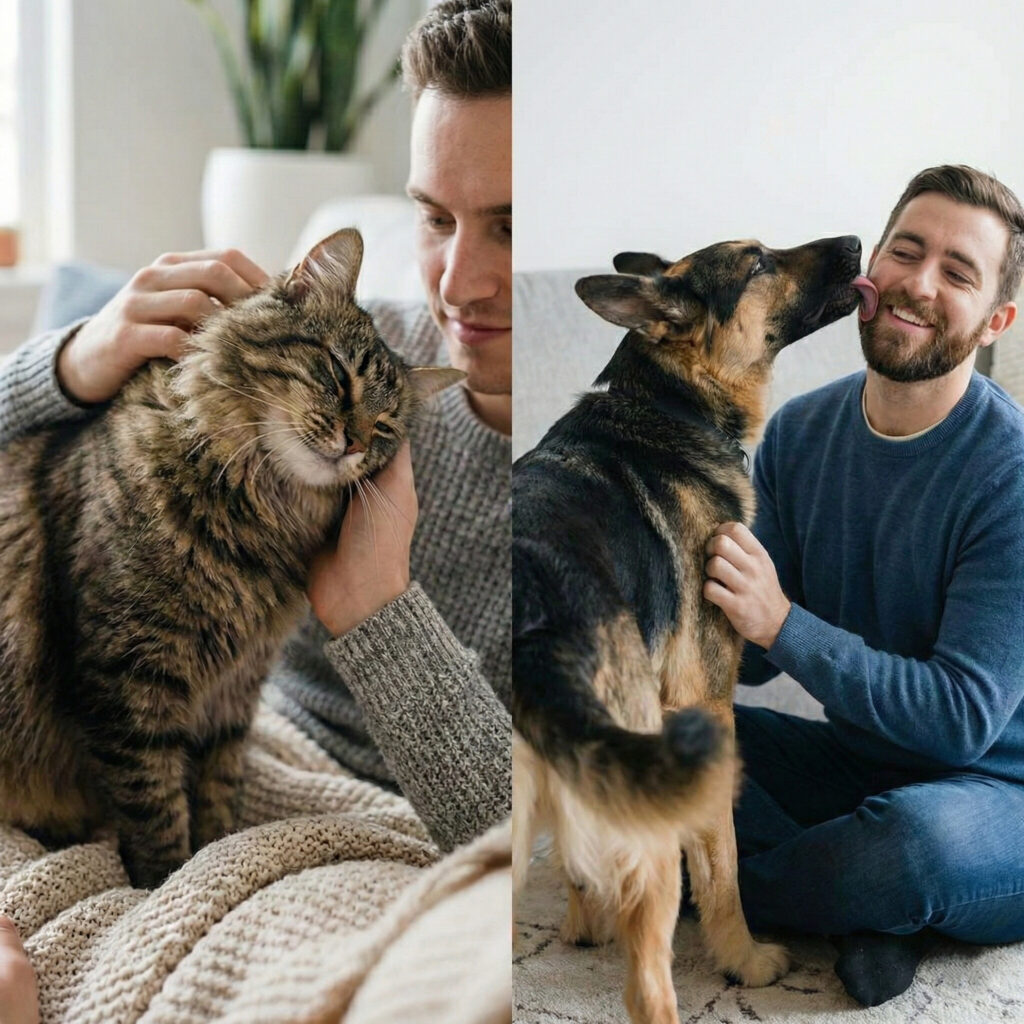
Dogs typically show affection through high-energy, obvious physical behaviors like wagging tails, licking, leaning against their owners, and maintaining eye contact. These actions stem from their history as pack animals. Cats, generally being more subtle and independent, express love through quiet gestures of trust such as slow blinking, head bunting (rubbing their face on you), purring, and kneading. While dogs seek active engagement, cats often demonstrate affection simply by choosing to be in your presence.
Summary Table
| Feature | How Dogs Show It | How Cats Show It |
| Greeting Style | Jumping, barking, rapid tail wags | Rubbing against legs, upright tail |
| Eye Contact | Staring deeply (release of oxytocin) | Slow blinking (a “kitty kiss”) |
| Physical Touch | Leaning, cuddling, licking | Head bunting, kneading, sitting nearby |
| Belly Exposure | Request for belly rubs | Sign of ultimate trust (usually “look, don’t touch”) |
| Vocalization | Excited barks, whines | Purring, chirping, trilling |
| Social Nature | Pack-oriented, dependent | Independent, selective social bonding |
How Cats and Dogs Show Affection Differently
For centuries, pet owners have debated which animal is more loving: the dog or the cat. The truth is that both species are capable of deep emotional bonds with humans. The difference lies not in the amount of love they feel, but in the language they use to express it.
Understanding these differences is crucial for any pet owner. When we expect a cat to act like a dog, we miss the subtle signals of devotion they are sending. Conversely, misreading a dog’s intensity can lead to confusion. This guide breaks down the behavioral science behind why your pets act the way they do and how to spot the signs of true affection.
Read Also: Why Dogs Seek Approval but Cats Don’t
The Dog: Wearing Their Heart on Their Sleeve
Dogs are biologically engineered to work in groups. As pack animals, their survival historically depended on clear communication and tight social bonds. This evolutionary background makes their affection generally easier for humans to understand because it is often loud, physical, and enthusiastic.
The Tail Wag
The most famous sign of dog happiness is the tail wag, but it is nuanced.
- Full Body Wag: When a dog’s tail wags so hard that their entire rear end shakes, it is a sign of pure joy and friendliness.
- Helicopter Tail: A tail spinning in a circle is often reserved for beloved people they haven’t seen in a while.
- Direction Matters: Studies suggest that when a dog is happy to see someone, they tend to wag their tail more to the right side of their body.
The “Lean”
Has your dog ever walked up to you and leaned their full weight against your legs? This is essentially a dog hug. By leaning on you, they are invading your personal space in a friendly way to say, “I trust you, and I want to be close to you.” It is a passive way of asking for attention and security.
The Look of Love
In the animal kingdom, direct eye contact is often seen as a threat. However, dogs have evolved to use eye contact with humans differently. When your dog stares into your eyes calmly, their brain and yours releases oxytocin. This is the same “love hormone” that bonds mothers to their infants.
Licking and Grooming
Puppies are licked by their mothers immediately after birth. For dogs, licking is a submissive, caretaking gesture. When your dog licks your hand or face, they are grooming you. It is a sign of submission and affection, indicating they accept you as a central part of their family unit.
The Cat: Subtle Gestures of Trust
Cats are solitary hunters by ancestry. In the wild, showing vulnerability could get them killed. Therefore, a cat’s affection is often demonstrated by lowering their defenses rather than through overt excitement. If a dog is a cheerleader, a cat is a quiet partner.
The Slow Blink
This is the ultimate sign of feline love. If you catch your cat looking at you and slowly closing and opening their eyes, do not look away. This is often called a “cat kiss.” It signals that they are relaxed enough in your presence to close their eyes, surrendering their vigilance. You can return the affection by slowly blinking back at them.
Head Bunting
When a cat bumps their head against your hand, face, or legs, they are doing more than saying hello. Cats have scent glands located on their cheeks and forehead. By rubbing these areas against you, they are depositing pheromones. This marks you as “safe” and part of their territory. It is a possessive act of love that says, “This human belongs to me.”
Kneading (Making Biscuits)
This behavior dates back to kittenhood. Kittens knead their mother’s belly to stimulate milk flow. When an adult cat kneads your lap or a blanket while you are petting them, they are regressing to that kitten-like state of complete contentment and safety.
The Belly Up
One of the most misunderstood signals in the cat world is the exposed belly. When a cat rolls over and shows you their stomach, they are exposing their most vulnerable body part.
This is a massive sign of trust. However, unlike dogs, this is rarely an invitation for a belly rub. If you touch it, you may get scratched. The affection is the act of showing the belly, not the request for touch.
Shared Behaviors: Where Dogs and Cats Overlap
While their languages differ, there are a few universal signs of attachment that both species share, though the intensity may vary.
- Sleeping Near You: Both animals are most vulnerable when they sleep. If they choose to sleep in your bed, on your feet, or in the same room, they are looking to you for protection and offering their presence as a guard.
- Following You: If you have a “shadow” that follows you to the kitchen or the bathroom, it is a sign of attachment. Dogs may do it to see what you are doing; cats often do it simply to supervise or be in your vicinity.
- Greeting at the Door: While dogs may jump and bark, many cats also run to the door when they hear their owner’s car or keys. The cat’s greeting may just be a quiet meow or a figure-eight rub around the ankles, but the sentiment is the same: “You were gone, and I missed you.”
Common Misunderstandings and Signals
Because humans often view pets through a single lens, we frequently misinterpret signals, causing frustration for the animal.
The Tail Wag Confusion
A wagging tail on a dog usually means happiness. A wagging or lashing tail on a cat usually means irritation, overstimulation, or aggression. If you pet a cat and their tail starts thumping the floor, it is a warning to stop, even if they are purring.
Purring vs. Growling
We associate purring with happiness, and 90% of the time, that is correct. However, cats also purr when they are in pain or stressed, as the vibration can be self-soothing. Conversely, a dog’s growl is almost always a warning, but some vocal dogs make “grumbling” noises when playing that can be mistaken for aggression. Context is key.
Personal Space
Dogs generally have a low need for personal space; they enjoy hugs and close confinement. Cats are the opposite. A cat that walks away after a few minutes of petting isn’t “mean.” They simply have a lower threshold for tactile stimulation. Respecting their need to walk away actually builds more trust, making them more likely to return later.
Read Also: Why Cats Ignore Commands but Dogs Follow Them
How to Reciprocate Their Love
To build the strongest bond, you must speak your pet’s language.
For Dogs:
- Physical Touch: Give them belly rubs, scratches behind the ears, and lean against them.
- Active Play: Engage in fetch or tug-of-war. Cooperative play strengthens the “pack” bond.
- Training: Positive reinforcement training is a way of communicating. Dogs love having a job to do for you.
For Cats:
- The Slow Blink: Look at your cat, blink slowly, and turn your head away slightly.
- Respect Boundaries: Let the cat come to you. Don’t force hugs.
- Scent Mixing: Allow your cat to rub against you. Avoid washing your bedding with strong detergents that mask your scent, as your scent comforts them.
- Play the Hunter: Use wand toys to simulate hunting. It builds their confidence and associates you with fun.
Conclusion
Comparing the affection of a dog to that of a cat is like comparing a handwritten letter to a text message. Both communicate a message, but the medium is entirely different. Dogs are overt, enthusiastic, and physically dependent. Cats are subtle, independent, and discerning.
When a dog loves you, they view you as their whole world, their leader, and their best friend. When a cat loves you, they view you as a trusted companion and an equal. Recognizing the quiet “I love you” in a slow blink is just as rewarding as the enthusiastic “I love you” in a tail wag. By understanding these differences, you can appreciate the unique way your pet chooses to bond with you.