
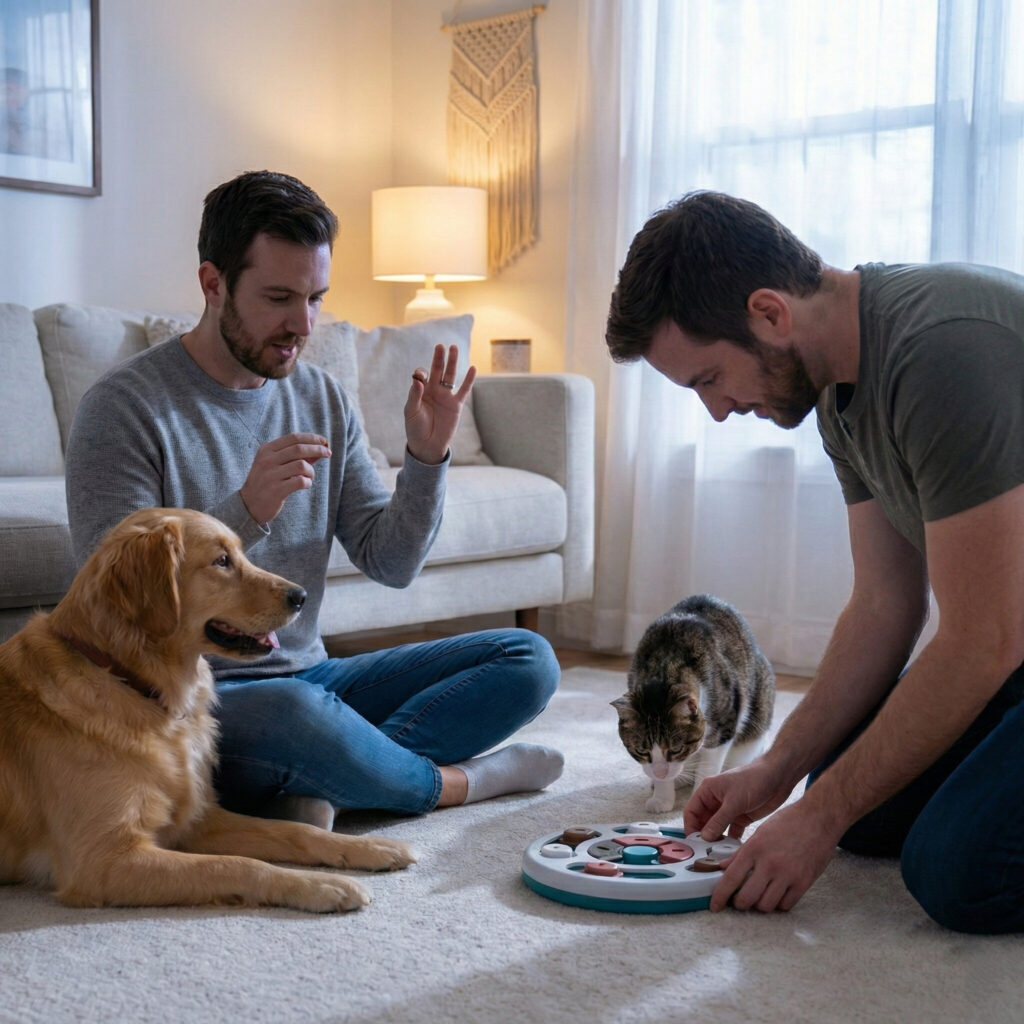
Cats and dogs learn from humans primarily through observational learning, social referencing, and associative conditioning. While dogs (pack animals) often look to humans for guidance and can imitate actions directly (“Do as I Do”), cats (solitary hunters) are more independent, relying on subtle cues like tone of voice and emotional atmosphere rather than direct instruction. Both species are experts at reading human body language, facial expressions, and pointing gestures to gauge safety and acquire rewards.
| Feature | Dogs | Cats |
| Primary Learning Style | Social & Cooperative (look for help) | Independent & Observational (watch and wait) |
| Social Referencing | Low (rarely imitates direct actions) | Moderate (check the owner only in high stress) |
| Imitation Ability | High (can learn “Do as I Do”) | Low (rarely imitate direct actions) |
| Evolutionary Origin | Pack animals (co-evolved for work) | Solitary hunters (self-reliant) |
| Response to Pointing | Excellent (innate understanding) | Good (can follow, but often choose not to) |
| Motivation | Social praise & food | Food & intrinsic curiosity |
How Cats and Dogs Learn From Humans
Have you ever felt like your dog knows you’re sad before you even cry, or that your cat knows exactly when you’re about to open the treat cabinet? You aren’t imagining it. Our pets are constant observers of our lives.
While we often think we are “teaching” them through sit-and-stay commands, they are actually learning from us every minute of the day. However, biology and evolution mean that a Golden Retriever and a Siamese cat process human behavior in very different ways.
1. The Science of “Social Referencing”
One of the most fascinating ways pets learn is through a psychological concept called social referencing. This happens when an animal looks to a human to figure out how to react to something new or scary.
How Dogs Do It
Dogs are the masters of social referencing. In scientific studies where a strange object (like a fan with ribbons) is placed in a room:
- The Look Back: Most dogs will immediately look at their owner’s face.
- Reading the Room: If the owner looks happy and calm, the dog will approach the object. If the owner looks fearful or tense, the dog will stay away.
- Dependence: This shows that dogs view humans as partners in navigating the world. They actively ask, “Mom, is this safe?”
How Cats Do It
Cats use social referencing, too, but it is much more subtle.
- The Slow Glance: A cat may not make direct eye contact like a dog. Instead, they might glance at you and then look back at the object.
- Emotional Atmosphere: Cats are highly sensitive to the “vibe” of the room. A study found that while cats are less likely to look to humans for help with a puzzle, they do modify their behavior based on their owner’s emotional cues, becoming more wary if the owner seems stressed.
2. Observational Learning: The “Do As I Do” Method
Observational learning is the ability to learn a new behavior simply by watching someone else do it. This is a sign of high intelligence.
The “Do As I Do” Protocol in Dogs
Scientists have proven that dogs can actually imitate human actions. This is called the “Do As I Do” training method.
- The Setup: A dog is trained to understand a “copy me” command.
- The Test: The human performs a novel action, like touching a box with their nose or spinning in a circle.
- The Result: Upon command, the dog copies the action even if they have never done it before. This proves dogs have a level of self-awareness and can map human body movements onto their own bodies.
The Cat’s Approach: Watch and Wait
Cats are less likely to imitate your physical movements (you won’t see a cat jumping just because you jumped). Instead, they engage in emulation.
- They watch results, not actions.
- If a cat watches you open a door handle, they aren’t trying to copy your hand movement. They are learning “turning that lever makes the door open.”
- They will then figure out their own way to turn the lever (usually by hanging on it), rather than mimicking your exact motion.
3. The Power of Pointing
Human communication relies heavily on gestures, specifically pointing. This seems simple, but it is actually cognitively complex. It requires the animal to understand that your finger is an arrow directing attention away from you and toward an object.
- Dogs: Puppies understand pointing almost from birth. Even wolves cannot do this well. It is a skill dogs evolved specifically to communicate with us during hunting.
- Cats: Surprisingly, studies show cats can follow pointing gestures to find hidden food almost as well as dogs. The difference? They often just don’t care to. If a cat ignores your point, it’s usually a motivation issue, not an intelligence issue.
4. Associative Learning: Predicting the Future
Both species are experts at associative learning. This is when they link two events together. This is why your pet knows the sound of the can opener or the jingle of car keys.
Emotional Contagion
Pets don’t just associate sounds with food; they associate your body language with safety or danger.
- The Suitcase Trigger: If you feel anxious while packing for a trip, your pet learns that “suitcase = owner leaving = stress.”
- The Leash Tension: If you tighten up on the leash when you see another dog, your dog learns “other dogs = tension/danger,” which can actually cause leash aggression.
5. Why Do They Learn Differently?
To understand how they learn, we have to look at their history.
The Dog: The Co-Worker
- Ancestry: Wolves (pack hunters).
- Style: Cooperative. They evolved to work with others.
- Learning Result: They look for commands and enjoy working for praise. They want to be part of the team.
The Cat: The Lone Ranger
- Ancestry: Wildcats (solitary hunters).
- Style: Independent. They evolved to solve problems alone.
- Learning Result: They rely on their own senses first. They learn from humans if it benefits them immediately (e.g., getting food), but they don’t naturally look to humans for permission.
6. Practical Tips: Teaching Your Pet
Knowing these differences can change how you train your animals.
For Dogs
- Be a Leader: Since they look to you for social cues, stay calm in new situations. If you are calm, they are calm.
- Use Gestures: Incorporate hand signals. Dogs are visual learners and often read hands better than they hear words.
- Model Behavior: Use the “Do As I Do” concept. Show them what you want.
For Cats
- Use Motivation: Praise rarely works. Use high-value treats or play.
- Timing is Key: Cats have a shorter attention span for social lessons. Capture the behavior the moment it happens.
- Respect Independence: Don’t force eye contact. Let them watch you from a distance; they are still learning even if they look uninterested.
Summary
Your pets are biological learning machines. Dogs have evolved to be our partners, constantly checking our faces for instructions. Cats have adapted to live alongside us, observing our routines to maximize their own comfort.
By understanding these unique learning styles, you can communicate better and build a deeper bond with your furry family members.