
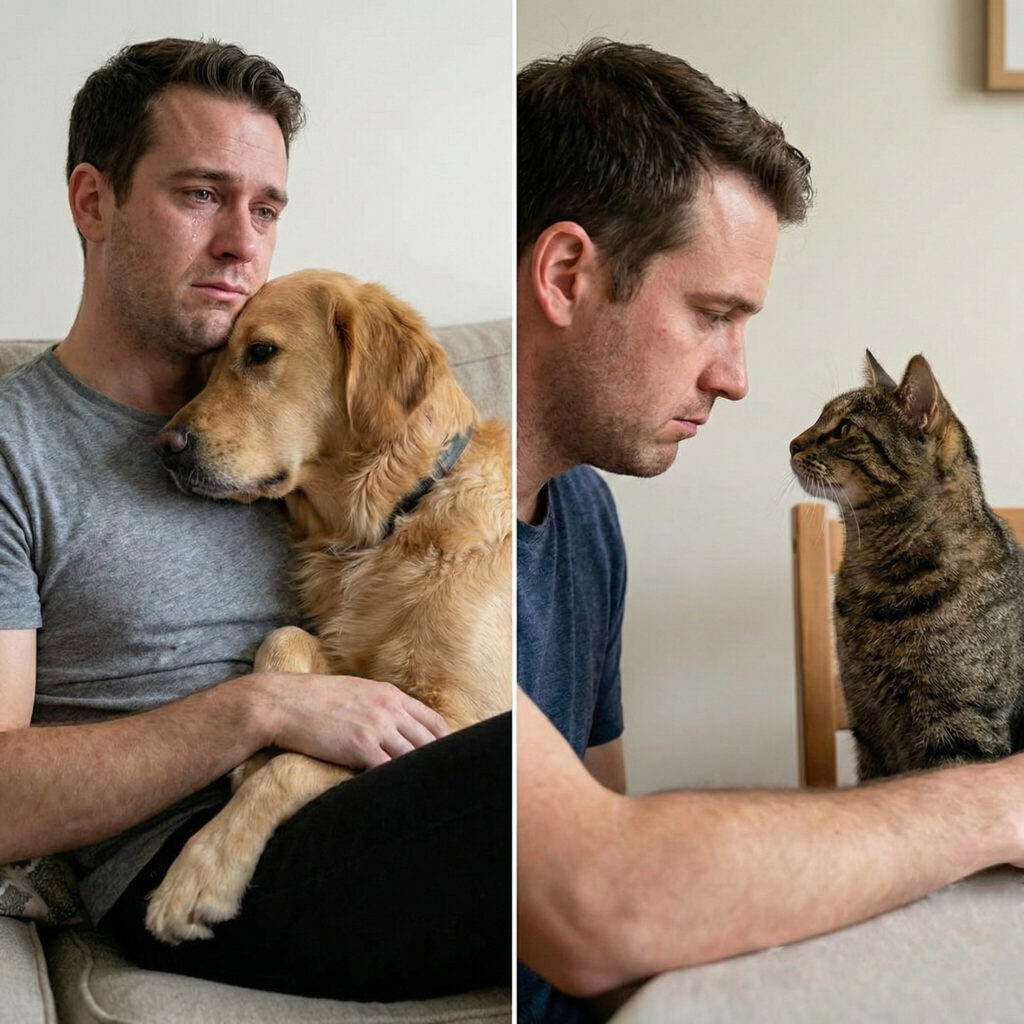
Research suggests that dogs currently have the edge in understanding human emotions due to a longer history of co-evolution. Studies show dogs can distinguish between happy and angry facial expressions, understand human vocal tones, and even smell fear or stress. However, recent studies on feline cognition indicate that cats also recognize human emotional cues, particularly from their owners, but react less overtly than dogs. While dogs are wired to assist and mirror humans, cats process emotions with a more independent, observational approach.
Summary Table
| Feature | Dogs | Cats |
| Domestication History | ~30,000 years (Co-evolved to work with humans) | ~10,000 years (Self-domesticated as pest control) |
| Facial Recognition | High. Can distinguish smiles vs. frowns. | Moderate. Can distinguish the owner’s voice but may ignore it. |
| Vocal Cues | High. Responsive to tone and pitch (e.g., “baby talk”). | Moderate. Can distinguish owner’s voice but may ignore it. |
| Reaction to Stress | Seek physical contact (nuzzling, licking). | Often retreat or observe from a distance. |
| Eye Contact | Use it to bond (increases oxytocin). | Prolonged eye contact is often seen as a threat. |
| Social Structure | Pack animals (dependent on group harmony). | Solitary hunters (independent decision makers). |
Dogs vs Cats: Who Understands Human Emotions Better
The debate has raged for decades. Dog owners swear their pups know exactly when they are sad, offering a comforting paw or a nudge on the knee.
Cat owners argue that their feline friends are just as perceptive, purring on their chest after a long, hard day. But when we strip away anecdotal evidence and look at the science, who actually understands human emotions better?
For a long time, science ignored cats, assuming they were too aloof to study. However, modern research into animal cognition is finally leveling the playing field.
To answer this question, we have to look at how these animals evolved, how they read our faces, and even how they smell our chemical signals.
Read Also: Cats vs Dogs: Who Learns Faster?
The Evolutionary Gap: Why History Matters
To understand how pets read our minds, we first have to understand how they came into our lives. The length and type of domestication play a massive role in emotional intelligence.
The Co-Evolution of Dogs
Dogs have been by our sides for roughly 30,000 years. This isn’t just a long time; it is enough time for biological changes to occur. Dogs didn’t just live near us; they lived with us. They hunted with humans, protected human camps, and shared food.
This created a unique evolutionary pressure. The dogs that could understand human gestures (like pointing) and human emotions (like anger or approval) survived and reproduced. This is known as co-evolution. Scientists have found that dogs have actually developed specific muscles above their eyes to produce “puppy dog eyes.”
This muscle allows them to raise their inner eyebrows, mimicking human sadness to trigger a nurturing response in us. They evolved specifically to hack our emotional systems.
The Self-Domestication of Cats
Cats have a very different story. They entered human society much later, around 10,000 years ago, likely when agriculture began. Grain stores attracted mice, and mice attracted cats.
We call this commensalism. Cats essentially domesticated themselves. They hung around because the food was good, not because they needed humans to lead them.
Because they are solitary hunters, they never needed to read social cues to survive in a pack. Their ability to read us is a happy accident of living in our homes, rather than a biological necessity bred into them over millennia.
Reading Facial Expressions
Humans are visual creatures. We smile when happy, frown when sad, and widen our eyes when scared. Can our pets actually tell the difference, or are they just looking at us blankly?
How Dogs Read Faces
Dogs are masters of facial discrimination. In various studies, dogs were shown photos of happy faces and angry faces. The results showed that dogs could distinguish between the two, even if they only saw half of the face (just the eyes or just the mouth).
More importantly, dogs look at our eyes to gather information. This is rare in the animal kingdom. In the wild, staring is a threat. But dogs have learned that human eyes hold data.
When a dog encounters a confusing object (like a new vacuum cleaner), they will engage in “social referencing.” They look at the object, then look at their owner’s face. If the owner looks calm, the dog remains calm. If the owner looks fearful, the dog backs away.
How Cats Read Faces
Cats are more challenging to study, but a study published in the journal Animal Cognition showed that cats can also distinguish facial expressions. When shown their owners’ faces, cats behaved differently depending on whether the owner was smiling or frowning.
However, the difference is in the reaction. When a dog sees a smile, they approach. When a cat sees a smile, they might purr, but it is less likely to change their physical position. Cats do not rely on eye contact the way dogs do.
In “cat language,” a slow blink is a sign of trust, while a wide-eyed stare is aggressive. If you stare deep into your cat’s eyes to convey love, they might misinterpret it as hostility.
Read Also: Dog vs Cat Training: Why One Is Easier
The Science of Voice and Tone
Have you ever used a “baby voice” to talk to your pet? Scientists call this Pet-Directed Speech. It turns out, both dogs and cats pay attention to this, but they process it differently.
The Canine Response to Pitch
Dogs process language in a way strikingly similar to humans. A study using MRI scanners on awake dogs showed that they process the meaning of words in the left hemisphere of their brain and the tone (intonation) in the right hemisphere.
If you say “Good boy!” in a happy tone, the reward centers of their brain light up. If you say “Good boy!” in a neutral or angry tone, the effect is lost. They are analyzing your emotional pitch constantly. They know the difference between a sigh of exhaustion and a sigh of contentment.
The Feline Auditory Skill
Cats have excellent hearing, better than dogs and humans. They can hear the ultrasonic noises of rodents. But do they care about our voices?
A study from the University of Paris found that cats can distinguish their owner’s voice from a stranger’s voice. They also react strongly when their owner uses a high-pitched “cat-directed” voice compared to a normal speaking voice. When the cats heard their owners speaking directly to them, their ears swiveled, and their pupils dilated.
The catch? They didn’t move. The study concluded that cats filter out background noise effectively. They hear you, they know you are emotional, but they choose not to interrupt their rest unless they feel it is necessary.
Smelling Fear and Happiness
This is the frontier of animal science. We often forget that emotions are biological events. When you are stressed, your cortisol spikes, and you sweat differently. When you are happy, your chemical output changes.
Chemoreception in Dogs
Dogs have a sense of smell that is 10,000 to 100,000 times more acute than ours. A study involving sweat samples proved that dogs can smell human fear.
In the experiment, dogs were exposed to sweat samples collected from humans watching scary movies and humans watching happy movies.
- Fear Sweat: Dogs displayed more stressful behaviors, sought reassurance from their owners, and had higher heart rates.
- Happy Sweat: Dogs were more inquisitive and relaxed.
This means a dog doesn’t even need to look at you to know you are upset; they can literally smell the stress hormones evaporating off your skin.
Read Also: How Cats and Dogs Learn From Humans
Chemoreception in Cats
Cats also have a phenomenal sense of smell, far superior to humans, utilized largely through their vomeronasal organ (or Jacobson’s organ) located on the roof of their mouth. This allows them to “taste” scents in the air (flehmen response).
While there are fewer studies on cats smelling human fear specifically, we know they are highly sensitive to pheromones and chemical changes in their environment. If an owner comes home smelling “wrong” (due to hospital visits or high stress), a cat is likely to re-mark the owner with their own scent glands (head bunting) to reclaim them and restore familiarity. Their reaction to emotional scents is often to reclaim territory rather than comfort the human.
Attachment Styles: The Secure Base Effect
Psychologists use a concept called the Secure Base Effect to measure bonding. This is usually used for human infants. It implies that a baby can explore a new environment confidently as long as their mother is present. If the mother leaves, the baby becomes distressed.
Dogs as “Infants”
When tested, dogs fit this model perfectly. In a strange room, dogs will explore happily if their owner is there. If the owner leaves, the dog stops exploring and waits by the door. This suggests that dogs view humans emotionally the same way a toddler views a parent. They rely on us for emotional regulation.
Cats and Autonomy
Cats, generally, do not fit this model as neatly. In similar tests, many cats explore the room regardless of whether the owner is there or not. Previously, this was interpreted as cats not caring.
However, newer interpretations suggest cats are simply autonomously attached. They view the owner as a resource and a partner, but not necessarily a safety blanket. They don’t need you to hold their hand to feel safe, which is a compliment to their confidence, though it feels less “loving” to a human who wants to be needed.
Read Also: Problem-Solving Skills: Dogs vs Cats
The Verdict
So, who wins? If “understanding” means noticing a change in emotion and reacting in a way that humans find comforting, dogs are the clear winners.
Dogs are biologically engineered to be in sync with us. Their survival depended on it. They mimic our behaviors, look us in the eyes, and mirror our stress levels. They are active participants in our emotional lives.
However, cats are not oblivious. The old myth that cats are sociopaths who only want food is dead. Cats know when we are happy or sad. They recognize our voices and faces. The difference is in motivation. A dog’s motivation is group cohesion. They want to fix the problem so the pack is stable. A cat’s motivation is personal safety and environmental maintenance.
If you are crying:
- The dog thinks: “The pack leader is upset! I must offer physical contact to restore balance!”
- The cat thinks: “The environment has become loud and unstable. I see you are upset. I will sit nearby and purr to lower the vibration, or I will leave until you are calm.”
What This Means for Pet Owners
Understanding how your pet processes emotion can change how you interact with them.
For Dog Owners:
- Be mindful of your stress: Your dog absorbs your anxiety like a sponge. If you are anxious, they will be too.
- Use your face: Exaggerate your smiles. Your dog is watching your expressions for clues on how to behave.
- Eye contact: Don’t be afraid to gaze at your dog; it releases oxytocin for both of you.
For Cat Owners:
- Respect the blink: If you want to tell your cat you love them, don’t stare. Look at them and blink very slowly. If they blink back, that is a high compliment.
- Tone matters: Even if they ignore you, they hear your tone. Soft, high-pitched greetings make them feel secure.
- Don’t force comfort: If you are sad and your cat sits three feet away, that is their version of support. Forcing a hug might stress them out.
Conclusion
In the battle of Dogs vs. Cats, dogs take the title for the most responsive emotional companions. They have the biological hardware and the evolutionary software to read us like an open book. But cats are catching up in the eyes of science. They are subtle, observant, and sensitive creatures who understand us more than they let on. They just prefer to keep their cards close to their chest.
Whether you prefer the active empathy of a canine or the quiet companionship of a feline, both animals have bridged the species gap to connect with us. And that, in itself, is a biological miracle.