
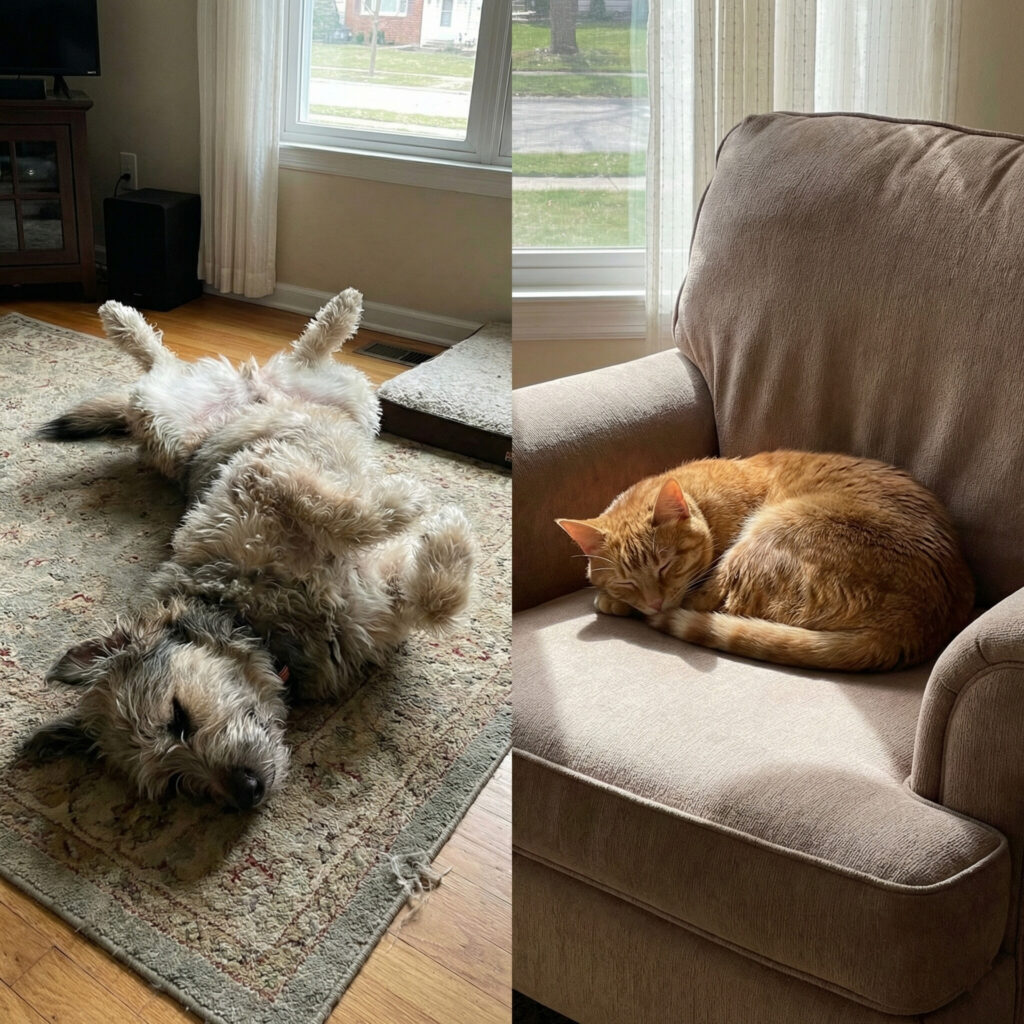
Dogs and cats have distinct sleeping habits driven by their evolutionary history. Dogs are social sleepers that have adapted to a diurnal (daytime) schedule to match their humans, though they remain polyphasic (sleeping in multiple short bursts). Cats are crepuscular, meaning they are most active at dawn and dusk, and are solitary sleepers that prioritize concealment. While both species experience REM sleep and dreaming, dogs typically sleep 12–14 hours a day, whereas cats average 12–16 hours, often retaining a “ready-for-action” state even while dozing.
Summary Table
| Feature | Dogs | Cats |
| Average Daily Sleep | 12–14 Hours | 12–16 Hours |
| Activity Pattern | Diurnal (Daytime active) | Crepuscular (Dawn/Dusk active) |
| Sleep Style | Polyphasic (Multiple naps) | Polyphasic (Multiple naps) |
| REM Sleep % | ~10% of sleep time | ~20-25% of sleep time |
| Social Preference | Social (likes sleeping near others) | Solitary (prefers hidden/high spots) |
| Ancestral Drive | Pack hunter (safety in numbers) | Solitary hunter (safety in stealth) |
| Deep Sleep Signs | Twitching, paddling, vocalizing | Twitching ears/paws, rapid eye movement |
Dog vs Cat Sleeping Habits Compared
We often envy the lives of our pets. They seem to spend the vast majority of their lives snoozing in sunbeams or curled up on the rug. However, the way your dog sleeps is fundamentally different from how your cat sleeps. These differences aren’t just personality quirks; they are deeply rooted in biology, evolution, and survival instincts.
Understanding these differences helps us provide better care, identify health issues, and stop taking it personally when the cat wakes us up at 4:00 AM.
Read Also: How Cats and Dogs Show Affection Differently
1. The Biological Clock: Diurnal vs. Crepuscular
The biggest difference between dogs and cats lies in their circadian rhythms. This internal clock dictates when they feel alert and when they crash.
Dogs Are Socially Diurnal
Ancestrally, wolves are often crepuscular or nocturnal depending on human pressure, but the domestic dog has evolved to be diurnal. This means they are naturally active during the day and sleep at night.
Over thousands of years of domestication, dogs adjusted their schedules to maximize interaction with humans. If you are awake, they want to be awake.
- Adaptability: Dogs are highly adaptable. If you work a night shift, your dog will likely shift their sleep schedule to match yours.
- Motivation: Their sleep schedule is driven by social connection. They wake up when the “pack” (you) wakes up.
Cats Are Crepuscular
Cats are not nocturnal (active all night) as many people believe. They are crepuscular, biologically hardwired to be most active at dawn and dusk. In the wild, this is when their prey (mice, birds, bugs) is most active.
- The “Zoomies” Window: This explains why your cat sprints down the hallway at 5:00 AM or gets a burst of energy right as you are settling in for the evening.
- Light Sleepers: Even during the day, a cat’s sleep is often lighter than a dog’s because they are solitary predators who must always be on guard.
2. The Science of the Nap: Sleep Cycles and REM
Humans are monophasic sleepers (one long sleep block). Dogs and cats are polyphasic sleepers, meaning they sleep in multiple bouts throughout the 24-hour cycle. However, the quality of that sleep differs.
The Dog Sleep Cycle
Dogs enter deep sleep much faster than humans, usually within 10 to 20 minutes, but they wake up frequently.
- REM Shortage: Dogs spend only about 10% of their sleep in REM (Rapid Eye Movement), the restorative phase where dreaming occurs. Humans get about 25%.
- Quantity over Quality: Because they get less REM per sleep cycle, dogs need to sleep more total hours to accumulate enough rest. This is why a dog might nap all afternoon; they are playing catch-up on REM.
The Cat Sleep Cycle
Cats have a unique ability to control their sleep depth.
- The Cat Nap: Most of a cat’s sleep (about 70%) is “light sleep.” Their ears will still swivel toward sounds, and their nose is still active. They can go from asleep to full attack mode in seconds.
- Deep Sleep: The remaining 30% is deep REM sleep. When a cat is in deep sleep, they are often curled tight or stretched fully out, and they are harder to wake. Unlike dogs, cats often drift into REM and back out to light sleep seamlessly.
Read Also: Why Dogs Seek Approval but Cats Don’t
3. Evolutionary Roots: Why They Sleep Where They Sleep
Where your pet chooses to sleep tells you a lot about their ancestral survival strategies.
Dogs: Safety in Numbers
Canines are pack animals. In the wild, sleeping together provided warmth and protection. A lone wolf is vulnerable; a pack is a fortress.
- Touching: This is why your dog leans against your leg or tries to squeeze into bed with you. Physical contact signals safety.
- Protective Instincts: Many dogs sleep facing the door or at the foot of the bed. This is a guarding behavior, ensuring they can alert the pack to threats.
Cats: Safety in Stealth
Felines (excluding lions) are solitary hunters. They are predators, but they are small enough to be prey for larger animals (like coyotes or owls).
- Vertical Advantage: Cats prefer sleeping in high places, cat trees, top shelves, or the back of the sofa. Height gives them a vantage point to spot threats and keeps them out of reach of ground-level predators.
- Enclosed Spaces: A cat sleeping in a cardboard box or a laundry basket is seeking security. Enclosed sides mean they don’t have to watch their back.
4. Decoding Sleeping Positions
The position your pet chooses is a direct, specific indicator of their comfort level and body temperature.
Common Dog Positions
- The Lion’s Pose: Paws extended forward, head resting on paws. This dog is dozing but ready to jump up instantly.
- The Donut: Curled in a tight ball with nose to tail. This conserves body heat and protects vital organs. Common in cold weather or anxious dogs.
- The Dead Roach: Lying on its back, legs in the air. This exposes the belly (the most vulnerable area). A dog only does this when they feel 100% safe and secure. It also helps them cool down.
- Superman: Belly down, legs stretched front and back. Common in puppies and high-energy breeds. It allows for immediate popping up to play.
Common Cat Positions
- The Loaf: Paws tucked under the chest. The cat is relaxed but preserving heat and ready to mobilize.
- The Crescent: Similar to the dog’s “Donut.” Curled tight for warmth and organ protection.
- The Belly Trap: Lying on the back with the belly exposed. Like dogs, this signals trust. However, unlike dogs, this is often a defensive trap. If you touch the belly, all four sets of claws can engage instantly.
- The Monorail: Lying flat on a narrow surface (like a railing or chair arm) with legs dangling. This is for balance and surveillance.
5. Sleep Needs by Age
Sleep requirements change drastically as pets age. Understanding these shifts prevents unnecessary worry.
Puppies and Kittens (The Growers)
- Duration: 18–20 hours a day.
- Reason: Growing consumes massive amounts of energy. Their brains and bodies develop primarily during sleep.
- Behavior: They have an “on/off” switch. They will play frantically for 20 minutes and then pass out mid-stride.
Adults (The Maintainers)
- Dogs: 12–14 hours. varies by breed (Large breeds like Mastiffs sleep more; working breeds like Border Collies sleep less).
- Cats: 12–16 hours. Indoor cats often sleep more than outdoor cats simply out of boredom.
Seniors (The Conservers)
- Duration: 18+ hours a day.
- Reason: Metabolism slows down, and joints may be achy. Sleep becomes the default state.
- Sundowning: Senior pets, especially dogs, may experience cognitive decline (dementia), leading to confusion at night and sleeping more during the day.
Read Also: Why Cats Ignore Commands but Dogs Follow Them
6. Do They Dream?
Science suggests that yes, both dogs and cats dream. The structural activity of their brains during REM sleep is nearly identical to that of humans.
- What Dogs Dream About: Since dogs are breed-specific, researchers believe they dream about their “jobs.” Pointers point, retrievers chase, and guard dogs bark in their sleep. You will often see paddling legs and muffled woofs.
- What Cats Dream About: Experiments in the 1960s (where the muscle-paralysis part of the brain was temporarily disabled) showed cats acting out hunting behaviors during sleep, stalking, pouncing, and arching their backs. They are likely dreaming of the hunt.
7. Health Watch: When to Worry
While “sleeping a lot” is normal, changes in sleep patterns are often the first sign of illness. Animals are stoic; they hide pain well. Sleep is one of the few tells they have.
Red Flags for Dogs
- Insomnia/Pacing at Night: Could indicate pain (arthritis), anxiety, or cognitive dysfunction.
- Sleeping in Odd Places: If a dog who loves the bed suddenly sleeps in the closet, they might be hiding due to illness.
- Excessive Lethargy: There is a difference between a lazy dog and a lethargic one. A lazy dog wakes up for a treat; a lethargic dog does not.
Red Flags for Cats
- Sleeping in the Litter Box: This is a major distress signal. It usually means the cat is very ill or terrified.
- Insomnia with Vocalization: An older cat yowling at night and not sleeping can be a sign of hyperthyroidism or high blood pressure.
- Failure to Groom: If the cat sleeps so much that they stop cleaning themselves (matted fur), a vet visit is needed immediately.
Conclusion
The battle of Dog vs. Cat sleeping habits reveals the core of who they are. The dog is your diurnal co-pilot, adjusting their life to match your rhythm, seeking safety in your presence, and grabbing naps to catch up on missed REM. The cat is the crepuscular guardian, retaining the instincts of a solitary hunter, balancing deep restorative sleep with a constant state of readiness.
Respecting these differences, giving the cat high perches and the dog a spot near your feet, ensures that everyone in the house, human and animal alike, gets a good night’s rest.