
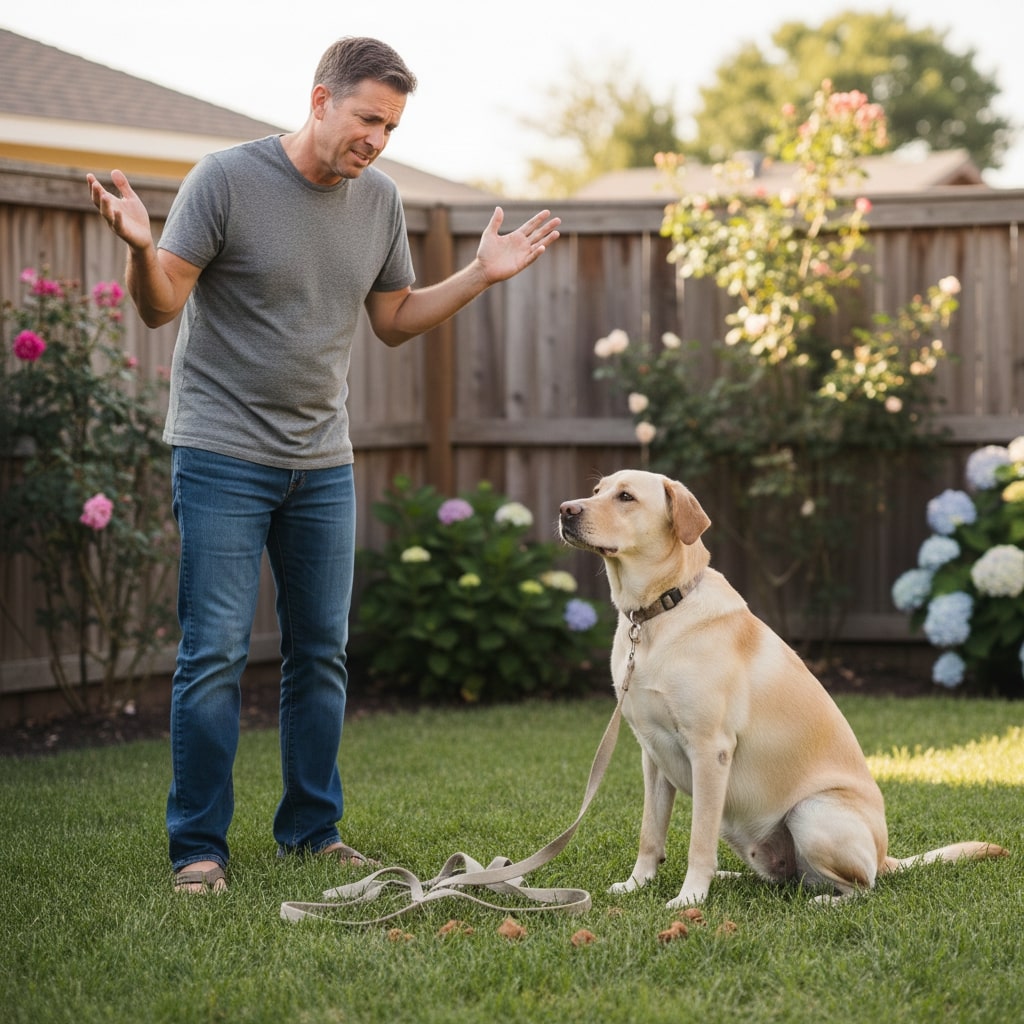
One of the most common dog training mistakes is inconsistency. When owners change rules, use different command words, or reward behaviors randomly, dogs become confused and anxious. Effective training requires clear communication, precise timing of rewards, and agreement among all family members on the rules. Success comes from positive reinforcement, patience, and gradual socialization, not punishment or dominance.
Summary Table: Common Dog Training Mistakes
| Mistake | Why It Fails | The Quick Fix |
| Inconsistency | Confuses the dog; they don’t know the rules. | Agree on rules and cue words with all family members. |
| Bribery vs. Reward | Dog only listens when they see food. | Hide the treat; produce it after the behavior is done. |
| Cue Nagging | Teaches the dog to ignore the first command. | Say the command once. If they fail, reset and try again. |
| Poisoning Cues | Dog associates a command with punishment. | Never call your dog to you for something unpleasant (like a bath). |
| Long Sessions | Causes boredom and frustration. | Keep sessions under 5-10 minutes. End on a win. |
| Skipping Generalization | Dog only obeys in the kitchen. | Practice commands in new locations (park, driveway, pet store). |
10 Common Dog Training Mistakes Owners Make
Training a dog is one of the most rewarding parts of pet ownership, but it can also be incredibly frustrating. You might feel like you are doing everything right, yet your dog still jumps on guests, ignores your recall, or pulls on the leash. Often, the issue isn’t that the dog is stubborn or “bad.” The problem usually lies in subtle communication errors we make as humans.
Dogs speak a different language. They rely heavily on body language, tone, and immediate consequences. When we misunderstand how they learn, we unintentionally sabotage our own efforts.
This guide outlines the specific, common mistakes dog owners make and offers actionable, science-based solutions to address them.
Read Also: How Long Does It Take to Train a Dog?
1. Inconsistency with Rules and Commands
Inconsistency is the number one killer of training progress. Dogs thrive on routine and clear structure. If the rules change depending on your mood, your dog will never learn what is expected of them.
Mixed Signals from Family Members
A classic example is the “couch rule.” If you forbid the dog from the couch, but your partner invites them up for cuddles when you aren’t looking, the dog enters a state of confusion. To a dog, this isn’t a “special treat”; it is a breakdown of the rules. This leads to anxiety and testing boundaries because the boundary doesn’t seem to exist.
Changing Command Words
Using different words for the same action is another major pitfall. If you say “Down” to mean “lie down,” but later say “Down” to mean “get off the couch,” your dog has no way to distinguish the two.
The Fix:
- Hold a family meeting to agree on all rules (e.g., is begging allowed? furniture access?).
- Create a “vocabulary list” for your dog. Decide that “Off” means get down, and “Down” means lie down. Stick to it.
- Consistency builds trust. When your dog knows exactly what leads to a reward, they will offer that behavior more often.
2. Accidental Reinforcement of Bad Behavior
Many owners unknowingly train their dogs to misbehave. This happens because we often confuse “attention” with “scolding.” To a bored dog, even negative attention is better than no attention at all.
The Jumping Paradox
When a dog jumps on you, your instinct might be to push them off and say, “No, get down!” However, you just touched the dog and spoke to them. You gave them interaction. In the dog’s mind, jumping worked—it got your attention.
Barking for Demands
If your dog barks at you while you are eating, and you eventually yell “Quiet!” but toss them a piece of crust to shut them up, you have just taught them a powerful lesson: If I bark long enough, I get food.
The Fix:
- Practice ignoring unwanted attention-seeking behaviors. Turn your back, cross your arms, and look at the ceiling.
- Reward the dog only when all four paws are on the floor or they are quiet.
- This is called differential reinforcement: rewarding the absence of the bad behavior.
Read Also: Can Dogs Eat Avocado?
3. Relying on Bribery Instead of Rewards
There is a distinct difference between a bribe and a reward, though they look similar. This mistake creates a dog that will only obey if they see the treat in your hand. If the hand is empty, they ignore you.
The Bribe
You hold a piece of cheese in front of the dog’s nose and say “Sit.” The dog sits because they are following the food. They are not thinking about the command; they are fixated on the lure.
The Reward
You say “Sit.” The dog sits. Then, you reach into your pocket, produce the treat, and give it to them. The reward comes after the choice is made.
The Fix:
- Fade the lure quickly. Once the dog understands the motion, stop holding the food in your hand.
- Keep treats in a pouch or on a counter, not in your working hand.
- Use a marker word (like “Yes!” or a clicker) to mark the exact moment the dog obeys, then reach for the food. This teaches the dog that the action produces the reward, not the sight of the food.
4. Poisoning the “Come” Cue (Recall Errors)
Recall is the most important safety command, yet it is the easiest to ruin. “Poisoning” a cue means you have associated a command with something negative.
The “Come” Trap
Imagine your dog is playing in the yard. You call “Buddy, Come!” Buddy runs to you. You immediately grab his collar, drag him inside, and put him in the bath (which he hates).
In this scenario, “Come” signaled the end of fun and the start of something unpleasant. The next time you call, Buddy will hesitate. He will weigh his options: “Do I want to go to the human and potentially get a bath, or stay here and sniff the grass?”
The Fix:
- Never use the recall command for something your dog dislikes (baths, nail trims, leaving the park).
- If you need to do something unpleasant, go get the dog; don’t call them to you.
- Practice “catch and release.” Call your dog, give them a high-value treat (like chicken), and immediately say “Go Play!” and let them run off again. This teaches them that coming to you doesn’t always end the fun.
5. Repeating Commands (Cue Nagging)
“Sit. Sit. Sit! Sit down. Sit.”
If you have to say a command more than once, your training is failing in that moment. Repeating the command creates “background noise.” The dog learns that the first “Sit” is optional. They might wait until the fifth “Sit” when your voice gets louder to actually comply.
The Fix:
- Say the command one time in a clear, neutral tone.
- Wait 3-5 seconds to give the dog time to process.
- If they do not obey, do not repeat the word. Instead, use a non-verbal prompt (like a hand signal) or reset the dog by moving a few steps away and trying again.
- Make sure you have actually taught the behavior before you expect them to do it on a verbal cue alone.
6. Training Sessions Are Too Long
Humans think in 30-minute blocks. Dogs do not. Attempting to train a puppy for 30 minutes straight is a recipe for burnout.
When a dog gets tired, they lose focus. They may start sniffing the ground, scratching, or wandering off. If you push through this, you will both get frustrated. You might end up correcting the dog for being tired, which damages your bond.
The Fix:
- Keep sessions to 5 to 10 minutes maximum.
- Do “micro-sessions” throughout the day (e.g., while the coffee is brewing or during commercial breaks).
- Always end on a high note. If the dog does a perfect trick, jackpot them (give lots of treats) and stop immediately. Leave them wanting more.
7. Skipping Socialization or Doing It Wrong
Socialization is often misunderstood. It does not mean letting your dog run up to every dog and human they see. That actually teaches over-excitement and reactivity.
True socialization means exposure to the world while remaining calm and focused on you. If you skip this during the critical puppy window (up to 16 weeks), you risk raising a fearful or reactive dog.
Conversely, if you force a fearful dog into a crowded dog park, you can traumatize them.
The Fix:
- Focus on neutrality. Take your dog to a park bench and just watch the world go by. Reward them for looking at a stranger and not barking or lunging.
- Expose them to sounds, textures (grass, gravel, tile), and objects (umbrellas, bikes) at a distance where they feel safe.
- Advocate for your dog. Do not let strangers rush up and pet them if your dog looks nervous.
Read Also: Can Dogs Eat Sausage?
8. Incorrect Timing of Rewards
Dogs live in the present moment. You have about 1 to 2 seconds to mark a behavior for the dog to associate it with the reward.
If your dog sits, and you spend 5 seconds fumbling with a zipper to get a treat, by the time you feed them, they might have already stood up or looked away. You just rewarded standing up, not sitting.
The Fix:
- Use a clicker or a verbal marker word like “Yes!”
- The sequence is: Behavior happens -> “Yes!” (immediately) -> Reach for treat -> Feed treat.
- The marker bridges the gap in time between the action and the food. It tells the dog exactly which split-second movement earned the prize.
9. Failing to Generalize Behaviors
“My dog is perfect in the kitchen, but deaf at the park.”
This is a failure to generalize. Dogs are contextual learners. If you teach “Sit” in the kitchen, the dog learns that “Sit” means “put my butt on the linoleum floor in front of the fridge.”
They do not automatically understand that “Sit” applies on the grass at the park with squirrels running by.
The Fix:
- Train in layers. Start in a quiet room.
- Once mastered, move to the backyard.
- Then move to the front driveway.
- Then the quiet corner of a park.
- Increase distractions gradually. You cannot expect a toddler to solve math problems at a rock concert; don’t expect your dog to heel perfectly at a busy dog park without practicing the intermediate steps.
10. Ignoring Emotional State (The Threshold)
You cannot train a dog that is in a state of panic or extreme excitement. This is often called being “over threshold.”
If your dog is lunging at another dog, barking hysterically, or shaking with fear, their brain has shut down the learning center. They are in survival mode. Shouting commands like “Sit!” or “Look at me!” in this moment is useless. It is like trying to teach someone algebra while they are being chased by a bear.
The Fix:
- Recognize stress signals: lip licking, yawning, whale eye (showing whites of eyes), or freezing.
- Create distance. Move away from the trigger (the other dog, the scary truck) until your dog can take a treat and look at you again.
- Only train when the dog is under threshold and capable of cognitive thought.
Conclusion
Avoiding these common dog training mistakes requires a shift in mindset. It requires moving away from the idea of “controlling” your dog and moving toward “communicating” with them.
Remember that patience is your best tool. Your dog is not trying to be difficult; they are simply trying to figure out how to navigate a human world. By being consistent, timing your rewards correctly, and respecting your dog’s emotional limits, you will build a bond that goes far beyond basic obedience.