
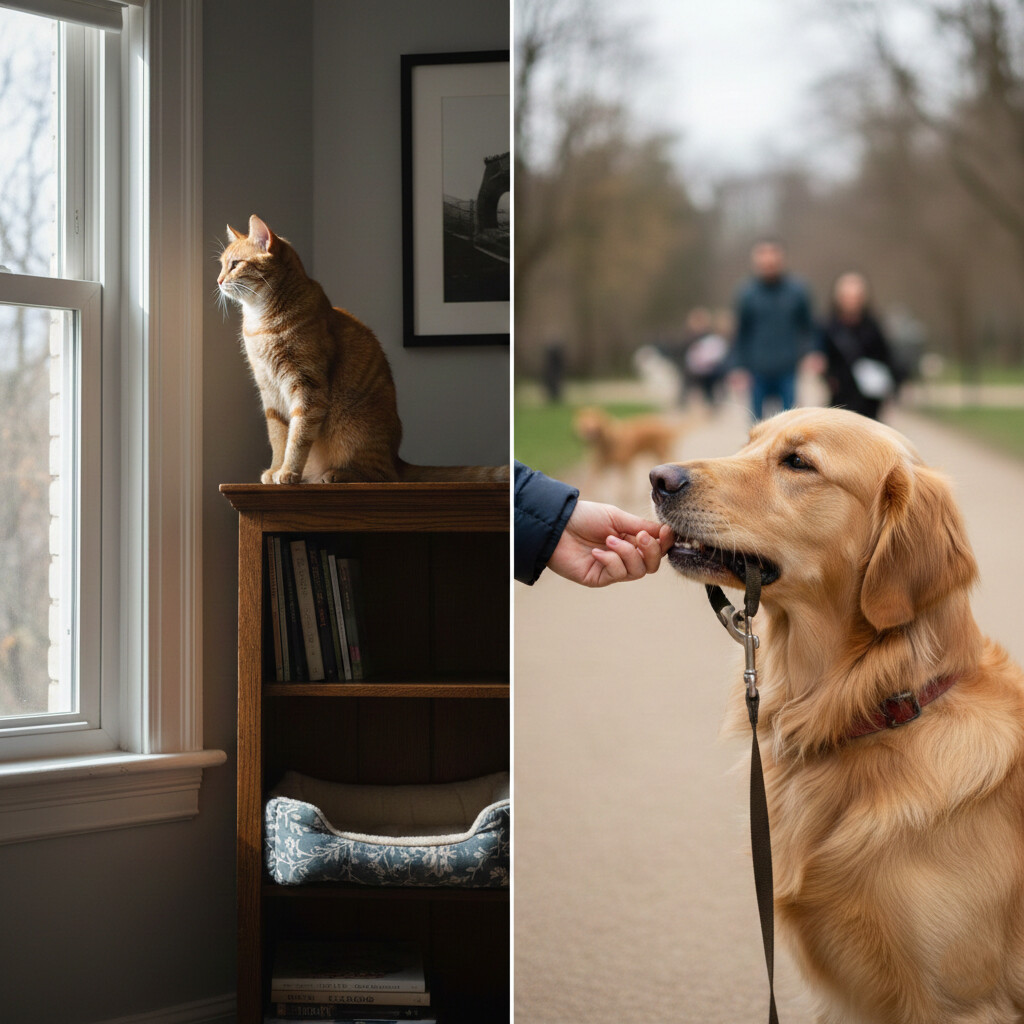
Generally, cats are considered more independent than dogs. This is largely due to their evolutionary history; dogs were bred to work alongside humans and rely on the pack structure, while cats are solitary hunters by nature. Cats require less direct supervision, can handle being alone for longer periods, and often choose when to interact, whereas dogs typically crave constant companionship and direction.
Summary Table
| Feature | Cats | Dogs |
| Primary Nature | Solitary Hunter | Pack Animal |
| Social Needs | Low to Moderate; enjoys “alone time” | High; craves constant company |
| Training Style | Independent; does not seek approval | Eager to please; looks for direction |
| Time Alone | Can handle 8–12+ hours (if prepared) | Struggles after 4–6 hours |
| Affection Style | Subtle; on their own terms | Low to Moderate; enjoys “alone time.” |
| Best For | Busy professionals, apartment dwellers | Overt, physical, and constant |
Cats vs. Dogs: Who Is More Independent?
Choosing between a cat and a dog often comes down to one major lifestyle factor: independence. If you work long hours or travel frequently, you might wonder which pet can handle solitude better. While every animal is an individual, understanding the biological and historical differences between these two popular pets can help you make the right choice.
This guide breaks down the “independence scale” of cats and dogs, looking at their history, social needs, and daily care requirements.
Read Also: How to Prepare for Emergencies With Dogs
The Evolutionary Background
To understand why your dog follows you to the bathroom while your cat ignores you for hours, you have to look at their ancestors.
Dogs: The Pack Mentality
Dogs (Canis lupus familiaris) are descendants of wolves. Wolves survive by working together in packs. They hunt together, sleep together, and protect one another. When humans domesticated dogs thousands of years ago, we essentially became their new “pack.”
Because of this history, a dog’s brain is wired for connection. They look to their human leaders for guidance, security, and cues on how to behave. Being alone feels unnatural to them because, in the wild, a lone wolf is a vulnerable wolf.
Cats: The Solitary Hunter
Cats (Felis catus) descend from the African wildcat, a solitary hunter. Unlike wolves, wildcats hunt small prey alone. They do not rely on a group to take down a gazelle; they rely on their own stealth and silence to catch a mouse.
Domesticated cats have kept this “lone wolf” attitude. They view humans as companions or roommates rather than pack leaders. They are self-sufficient by nature, which is often interpreted as aloofness or independence.
Social Needs and Attention
The biggest difference in independence shows up in how these pets socialize.
The “Velcro” Dog
Most dogs are social butterflies. They rely on you for their emotional well-being.
- Constant Companionship: Many dogs will follow you from room to room.
- Separation Anxiety: Dogs are prone to anxiety when left alone for long periods. They may bark, chew furniture, or pace.
- Validation: Dogs often look at you to check if they are doing the right thing. They want to please you.
The “Roommate” Cat
Cats enjoy affection, but they prefer it on their own terms.
- selective Socializing: A cat might sit on your lap for twenty minutes and then leave to sleep in a closet for three hours.
- Self-Soothing: Cats are generally better at entertaining themselves. A cardboard box or a window with a view of birds can keep them occupied for hours.
- Low Anxiety: While cats can miss their owners, they rarely destroy the house due to separation anxiety (though boredom is a different issue).
Read Also: How Dogs Sense Danger
Training and Obedience
Independence often looks like “stubbornness” when it comes to training.
Dogs: Eager to Please
Because dogs are pack animals, they want to contribute to the group. If you ask a dog to sit and then reward them, they feel a sense of accomplishment. They rely on you to tell them the rules. This makes them less “independent” thinkers, but excellent partners for training.
Cats: “What’s in it for Me?”
Cats are intelligent, but they do not feel a biological need to please you. You can train a cat, but the motivation must be intrinsic. If a cat does a trick, it is because it wants the treat, not because it wants to make you happy. This independent streak means you cannot simply command a cat to do something; you have to convince them it is a good idea.
Daily Care and Maintenance
How much time does each pet require from you every single day?
Bathroom Needs
- Dogs: They are entirely dependent on you. You must physically take them outside to relieve themselves multiple times a day, rain or shine. You cannot leave a dog alone for 12 hours without a plan for a bathroom break.
- Cats: They are highly independent here. Once you provide a clean litter box, they handle the rest. You can leave for a long workday without worrying about accidents on the rug.
Exercise
- Dogs: You are their gym partner. Most dogs need 30 to 60 minutes of active walking or running daily. If you are tired, the dog still needs to go out.
- Cats: They exercise in short bursts, usually the “zoomies.” You can engage them with a laser pointer or a feather wand from the comfort of your couch.
Being Left Alone: The Time Limit
This is the practical side of independence. How long can you actually leave them?
The Dog Limit
Generally, adult dogs should not be left alone for more than 4 to 6 hours.
- Bladder Control: This is the physical limit for many dogs.
- Mental Health: Beyond this time, dogs can become depressed or destructive.
- Puppies: They require even more attention and can only be left for 1–2 hours.
The Cat Limit
Adult cats can safely be left alone for 8 to 12 hours (a full workday).
- Self-Sufficiency: As long as they have food, water, and a clean litter box, they are fine.
- Overnight: You can occasionally leave a cat overnight (24 hours) with ample supplies, though it is not recommended to do this often.
- Kittens: Like puppies, kittens need more supervision and should not be left alone for long periods.
Exceptions to the Rule
It is important to note that “breed” and “personality” play a huge role. Not all cats are aloof, and not all dogs are clingy.
Independent Dog Breeds
Some dog breeds are known for being more cat-like and independent. These often include livestock guardian breeds or hunting hounds that worked far away from their handlers.
- Shiba Inu: Known for being fastidious and reserved.
- Chow Chow: Often described as having a cat-like personality.
- Basenji: Independent thinkers that groom themselves like cats.
Dependent Cat Breeds
Some cat breeds are incredibly social and act more like dogs.
- Siamese: Vocal, demanding, and prone to separation anxiety.
- Ragdoll: Known for going limp in your arms and following you everywhere.
- Sphynx: Crave physical touch (partly for warmth) and hate being alone.
Read Also: How to Teach Dogs to Be Calm Around Strangers
Which Pet Fits Your Lifestyle?
When deciding between a cat and a dog, be honest about your schedule.
Choose a Cat If:
- You work long hours or have an unpredictable schedule.
- You enjoy spontaneous weekend trips (and have an automatic feeder).
- You want a pet that offers affection but respects your personal space.
- You live in an apartment without easy access to a yard.
Choose a Dog If:
- You have ample free time and want a partner for activities.
- You work from home or can take your pet to work.
- You are looking for a pet that provides constant emotional support and security.
- You enjoy the routine of daily walks and outdoor exercise.
Final Verdict
In the battle of Cats vs Dogs, the cat is the clear winner for independence. Their biological history as solitary hunters makes them naturally self-sufficient. They do not need you to take them to the bathroom, they do not need constant reassurance, and they are generally content with their own company.
However, “independent” does not mean “loveless.” Cats bond deeply with their owners, but they do so as equals rather than dependents. If you want a friend who has their own life but loves to see you when you get home, a cat is the perfect choice. If you want a baby that never grows up and thinks you are the center of the universe, get a dog.