
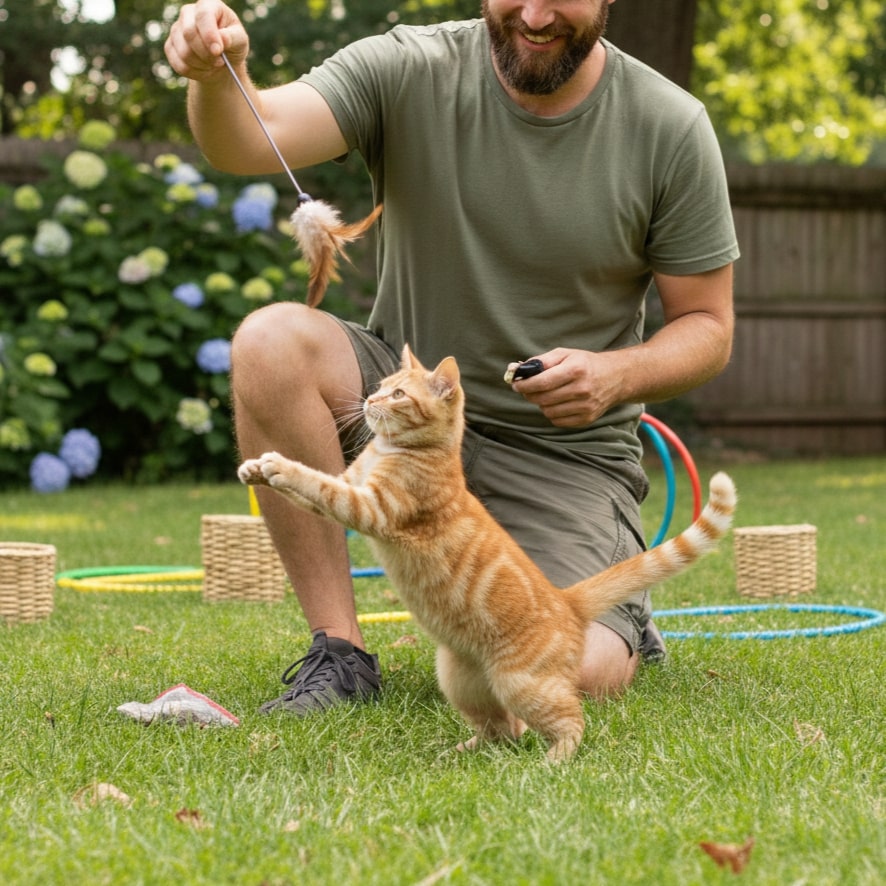
Yes. Science confirms that cats are highly trainability via operant conditioning. Unlike dogs, who are often motivated by social praise, cats are primarily motivated by high-value rewards (food or play). Studies show that positive reinforcement, rewarding desired behaviors rather than punishing bad ones, is the only effective method for feline learning. Punishment causes stress and fear, hindering the learning process.
Summary Table: Is it Possible to Train Cats?
| Feature | Details |
| Primary Method | Operant Conditioning (Learning by consequence) |
| Best Technique | Positive Reinforcement (Clicker training + Treats) |
| Key Motivator | Food (High-value treats like freeze-dried chicken) |
| Cognitive Ability | Comparable to dogs; capable of problem-solving, memory, and associative learning |
| Major Difference | Cats lack the “eager to please” pack drive of dogs; they ask “What’s in it for me?” |
| Do Not Use | Punishment or negative reinforcement (Causes aggression and avoidance) |
Can Cats Be Trained? What Science Says
The stereotype of the aloof, untrainable cat is deeply ingrained in pop culture. While dogs are viewed as eager students, cats are often seen as stubborn masters of their own domain. However, modern ethology (the study of animal behavior) proves this wrong.
Read Also: What Are The Signs Of A Stressed Cat?
Cats are not only trainable; they are constantly learning. Every time your cat runs to the kitchen when they hear a can opener, they are demonstrating that they have been trained. The difference is that they usually train themselves based on environmental cues. By understanding the science of feline cognition, you can harness this learning ability to teach useful life skills and fun tricks.
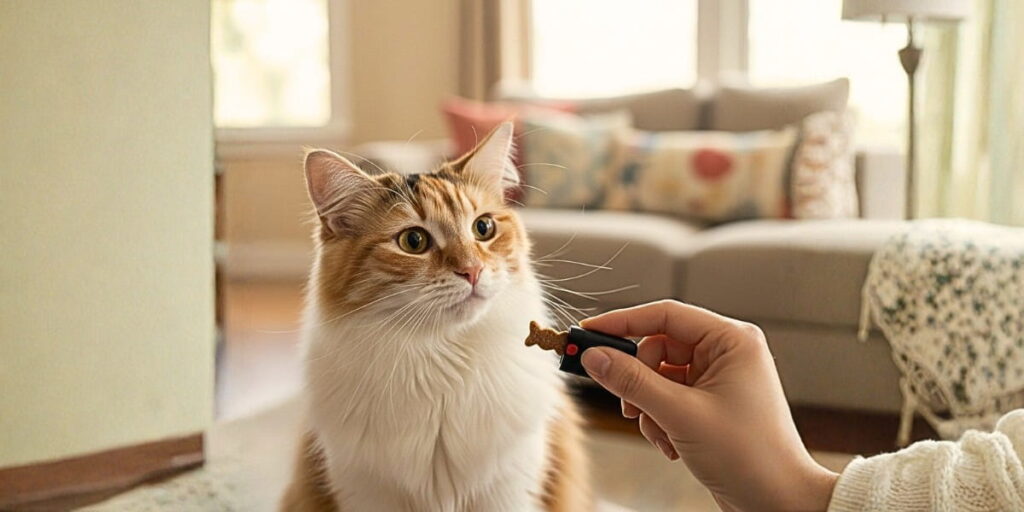
The Science of How Cats Learn
To train a cat, you must understand Operant Conditioning. This is a learning principle championed by psychologists like B.F. Skinner and Edward Thorndike.
The Law of Effect
Thorndike’s research with cats in “puzzle boxes” established the Law of Effect. This law states that actions followed by a pleasant consequence (a treat) are likely to be repeated, while actions followed by an unpleasant consequence are less likely to occur.
When a cat accidentally steps on a lever and gets food, they learn to step on that lever on purpose. This is associative learning. Your cat isn’t doing it to make you happy; they are doing it because they have learned that Action A results in Reward B.
Why Punishment Fails
Scientific studies on feline behavior consistently show that punishment does not work for cats. Unlike dogs, who might look “guilty” (which is actually fear) and submit to a pack leader, cats view punishment as a random act of aggression.
If you spray water at a cat for scratching the couch, they do not learn “scratching is bad.” They learn “you are dangerous” or “I should scratch when you aren’t looking.” This increases stress and can lead to behavioral issues like litter box avoidance or aggression.
Cats vs. Dogs: The Motivation Gap
If the science is the same, why is training a cat harder than training a dog? It comes down to evolutionary history and social structure.
- Dogs (Pack Animals): Dogs have been selectively bred for thousands of years to work alongside humans. They are socially motivated. A “Good boy!” and a pat on the head are often reward enough.
- Cats (Solitary Hunters): Cats are solitary predators. In the wild, they do not answer to a leader. They are motivated by self-interest, specifically hunting and eating.
To train a cat, you cannot rely on social praise. You must answer their question: “What is in it for me?” This usually means finding a food reward that is higher value than whatever else they are doing.

The Tool: Clicker Training
The most scientifically backed method for training cats is Clicker Training. This uses a distinct sound (a click) to mark the exact moment a cat does the right thing.
Why It Works
A verbal “Good job” is often too slow and inconsistent. A click is a sharp, unique sound that cuts through the noise.
- The Marker: The click tells the cat, “That specific movement you just did earned you a treat.”
- The Bridge: It bridges the gap in time between the action (sitting) and the reward (eating).
Read Also: Why Do Cats Prefer Certain People?
Step-by-Step Guide to Training Your Cat
You do not need a professional animal behaviorist to start. You need patience, a clicker (or a retractable pen), and high-value treats.
1. Prime the Clicker (Charging)
First, you must teach the cat that the sound means food.
- Sit with your cat in a quiet room.
- Click the clicker.
- Immediately give a treat.
- Repeat this 10 – 20 times.
- Goal: You want to see the cat’s ears perk up or their head turn toward you immediately when they hear the click. This is a Conditioned Emotional Response.
2. Shaping (The Baby Steps)
Cats rarely do the full behavior immediately. You use a technique called Shaping, which rewards small steps toward the final goal.
- Goal: Teach the cat to “Sit.”
- Step 1: Wait for the cat to lower their bottom slightly. Click and treat.
- Step 2: Wait for them to lower it further. Click and treat.
- Step 3: Only click when their bottom hits the floor.
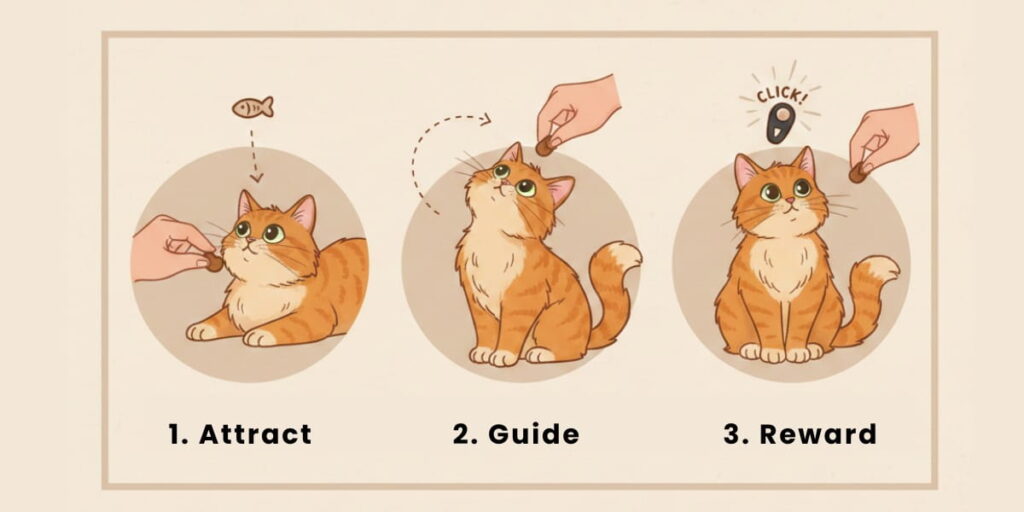
3. Luring
You can also use a target stick or a treat to guide the cat into position.
- Hold a treat above the cat’s nose and move it slowly backward toward their ears.
- As their head goes up to follow the treat, their butt will naturally go down.
- The moment they sit, Click and give the treat.
5 Useful Things You Can Train a Cat To Do
Training provides cognitive enrichment, preventing boredom and destruction. Here are functional behaviors to teach.
1. Recall (Come when called)
This is a safety skill. If your cat escapes, a strong recall can save their life.
- Start very close (2 feet away).
- Say their name or a cue word (“Here!”).
- Click and treat when they look at you or take a step toward you.
- Gradually increase distance.
2. Carrier Training
Most cats hate carriers because they only appear before vet visits. Science suggests desensitization.
- Leave the carrier out year-round with a soft blanket inside.
- Click and treat whenever the cat looks at the carrier.
- Click and treat when they step inside.
- Eventually, they will view the carrier as a safe resting spot.
3. Target Training (Touch)
Teach your cat to touch their nose to a stick or your finger. This allows you to guide them onto scales at the vet or off kitchen counters without picking them up.
- Hold a finger near their nose.
- When they sniff it, click and treat.
- Add the word “Touch.”
Read Also: Why Do Cats Meow More at Night?
4. High Five
A fun trick that builds a bond.
- Wait for the cat to lift a paw (often happens when they want the treat).
- Click and treat the paw lift.
- Gradually hold your hand flat to meet their paw.
5. Nail Trimming Acceptance
Using Counter-Conditioning, you can change their emotional response to having paws handled.
- Touch a paw -> Click -> Treat.
- Touch a toe -> Click -> Treat.
- Expose one claw -> Click -> Treat.
- Do this daily without cutting a single nail until they are relaxed.
Common Training Mistakes
Even well-meaning owners fail because they ignore the biology of the cat.
- Sessions are too long: Cats have short attention spans for work. Keep sessions to 1 – 3 minutes maximum.
- Low-value rewards: Dry kibble usually won’t work. Use freeze-dried minnows, Churu (squeeze treats), or small bits of boiled chicken.
- Bad Timing: If you click 3 seconds after the cat sits, you just rewarded them for standing up or looking away. The click must be instantaneous.
- Repeating the Cue: Do not say “Sit, sit, sit, sit.” This is just white noise. Say it once, wait, and reward success.
The Verdict
Can cats be trained? Absolutely. The science of learning applies to all mammals. By using positive reinforcement, respecting their need for high-value motivation, and keeping sessions short, you can teach your cat behaviors that make life easier and safer.
Training is not just about control; it is about communication. It bridges the species gap, allowing you and your cat to understand each other in a common language of clicks and rewards.
Ready to Start?
Next Step for You: Go to your kitchen right now and test three different treats (cheese, chicken, commercial treat) to see which one makes your cat meow or purr the loudest. That is your new training currency. Start with “Target Training” your cat to touch your finger today.