
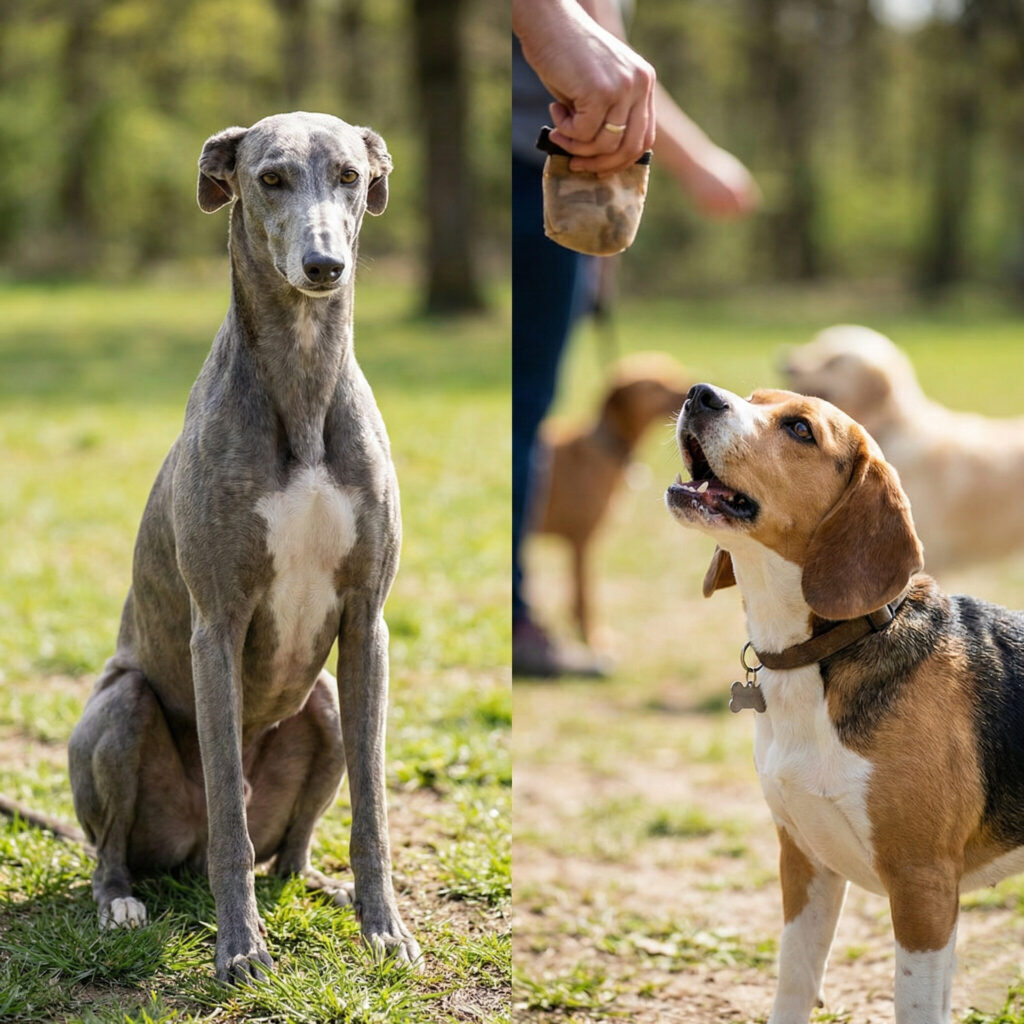
Some dog breeds are more vocal because of genetics and selective breeding historically used to create them. Humans specifically bred certain types of dogs to use their voices for a job. For example, hounds were bred to bay while hunting so their owners could find them in deep woods, and herding dogs were bred to bark to control movement in livestock. These ingrained instincts make those breeds naturally louder than dogs bred for quiet companionship or stealth.
Summary Table
| Breed Category | Examples | Primary Reason for Noise | Common Sound Types |
| Scent Hounds | Beagle, Basset Hound, Coonhound | Alerting hunters to a scent trail over long distances while out of sight. | Baying, prolonged howling. |
| Herding Breeds | Corgi, Border Collie, Australian Shepherd | Moving stubborn animals (cattle, sheep) and controlling their direction. | Sharp, repetitive, “bossy” barking. |
| Guard/Watchdogs | German Shepherd, Rottweiler, Doberman | Warning the family of perceived threats or intruders on the property. | Deep, loud, warning barks. |
| Toy Breeds | Chihuahua, Pomeranian, Yorkshire Terrier | Acting as alarm systems to alert owners to anything new in the environment. | High-pitched, rapid yapping. |
| Northern Breeds | Siberian Husky, Alaskan Malamute | Communicating with pack members over vast, snowy distances. | Howling, “talking,” singing (less barking). |
| “Silent” Breeds | Greyhound, Basenji, Whippet | Bred for stealth hunting or have physical limitations on barking. | Quiet, occasional whining; Basenjis yodel. |
Why Some Breeds Are More Vocal?
If you spend time at a local dog park, you will quickly notice a pattern. Some dogs play silently, only making noise when they bump into something hard. Others seem to provide a running commentary on everything happening around them. They bark when chasing a ball, bark when another dog approaches, and bark just because the wind blows.
Many new dog owners are surprised when they bring home a cute puppy, only to realize a few months later that they have adopted a noise machine. While any dog can be taught to be quiet, and any dog can learn to be loud, the tendency to use their voice is heavily influenced by their DNA.
Understanding why certain breeds are more vocal than others is crucial before choosing a dog for your lifestyle. If you live in a thin-walled apartment with strict noise rules, a coonhound is probably a bad choice.
This article explores the reasons why some dogs seem born to bark, while others rarely make a peep.
The Genetic Blueprint: Bred to Bark
The primary reason for differences in vocalization levels comes down to history. For thousands of years, dogs were not just pets; they were tools used by humans to perform specific jobs.
When early humans were developing different types of dogs, they selected traits that helped the dog do its job better. Sometimes, that trait was speed. Sometimes it was strength. And very often, that trait was a loud voice.
Selective breeding means that humans choose the loudest dogs and breed them together to create offspring that are even louder. Over countless generations, the instinct to bark became hardwired into their genetic makeup.
It is important to remember that for these dogs, barking is not “bad behavior.” It is exactly what they were designed to do. When a Beagle bays at a rabbit scent, he is fulfilling the purpose his ancestors were bred for centuries ago.
The Usual Suspects: Breeds Known for Noise
We can generally categorize noisy dogs based on the historical jobs they performed.
The Hounds (The Trackers)
Hounds, specifically scent hounds, are perhaps the most notoriously noisy group of dogs. This group includes Beagles, Basset Hounds, Bloodhounds, and Coonhounds.
These dogs were bred to track prey like rabbits, foxes, or raccoons through dense forests or swamps. Often, they would be far ahead of the hunter, completely out of sight. The hunter needed a way to know where the dog was and if they had found the scent.
The solution was the “bay.” A bay is not a standard bark; it is a loud, deep, prolonged howl. It carries for miles. When a hound catches a scent, they open up with this distinctive sound to tell their owner, “I found it, and I am over here!” Asking a beagle never to howl is like asking a bird never to fly.
Herding Dogs (The Managers)
Herding breeds like Corgis, Australian Shepherds, Border Collies, and Shetland Sheepdogs are also known for being very vocal. Their historical job was to move large groups of animals, like sheep or cattle, in specific directions.
Livestock can be stubborn, large, and sometimes dangerous. A fifty-pound dog cannot physically push a one-thousand-pound cow. Instead, they use intimidation. A sharp, loud, repetitive bark right at the heels of a cow gets it moving.
These dogs are bred to be bossy and excitable to do their job well. In a modern home, this translates to a dog that barks at vacuum cleaners, children running in the yard, or anything else they feel needs “managing.” Their barks are usually higher-pitched and rapid-fire compared to the deep bay of a hound.
Toy Breeds and Watchdogs (The Alarm Systems)
Size has nothing to do with volume. In fact, some of the smallest dogs are the biggest barkers. Breeds like Chihuahuas, Yorkshire Terriers, Pomeranians, and Miniature Schnauzers are famous for their vocal abilities.
Historically, many small dogs were bred as companions, but they also served an important secondary role: alarm systems. In days before electronic security, a small dog sleeping on the bed would be the first to hear a window break or a footstep outside.
They were not bred to attack an intruder; they were bred to make enough noise to wake up the humans who could deal with the intruder. These dogs are naturally hyper-aware of their environment.
Today, that instinct means they bark at the mail carrier, a squirrel on the fence, or a leaf blowing past the front door. They are alerting you to a change in their environment.
Read Also: How Dogs Adapt to Physical Limitations
The Northern Breeds: Pack Communicators
Breeds that originated in cold, northern climates, such as Siberian Huskies, Alaskan Malamutes, and Samoyeds, are incredibly vocal, but they don’t always “bark” in the traditional sense.
These dogs have a closer genetic connection to their ancient wolf ancestors than many other breeds. Wolves rarely bark; they howl to communicate with pack members over vast distances across the tundra.
Huskies are famous for “talking.” They produce a wide range of howls, woos, yips, and grumbles that sound eerily like human speech patterns. They howl when they are lonely, excited, or just because it feels good. While they may not bark sharply at the doorbell, they will definitely let their presence be known through song.
The Strong, Silent Types
To understand vocal dogs, it helps to look at why some dogs are quiet. If a dog were bred for a job that required stealth, barking would be a genetic failure.
Sighthounds, such as Greyhounds, Whippets, and Salukis, were bred to chase down prey using explosive speed in open fields. If they barked while chasing a rabbit, they would waste energy and alert the prey. Therefore, these breeds are generally very quiet in the home.
Another unique example is the Basenji. This small African breed is often called the “barkless dog.” Due to the unusual shape of their larynx (voice box), they cannot produce a standard barking sound. Instead, they make a sound described as a yodel or a “barroo.” They are not silent, but they are incapable of nuisance barking.
Physical Traits Influencing Sound
Besides brain wiring, physical anatomy plays a role in the sounds a dog makes.
- Size: Just like musical instruments, larger instruments make deeper sounds. A Great Dane or Mastiff has a massive chest and a large larynx, producing booming, deep barks that you can feel in your chest. A toy poodle has tiny vocal cords, producing high-pitched, sharp yaps.
- Snout Shape: Brachycephalic breeds (flat-faced dogs like Pugs, Bulldogs, and French Bulldogs) have crowded airways and shorter snouts. While they can bark, they often communicate more through snorting, grunting, snuffling, and wheezing sounds because it is easier for them physically.
Read Also: How Aging Affects Dog Sleep Patterns
It’s Not Just Genes: Environment vs. Nurture
While genetics loads the gun, the environment pulls the trigger. A breed’s natural tendency to bark is the baseline, but how the dog is raised plays a massive role in their final behavior.
A naturally quiet breed can become a nuisance barker if neglected, and a naturally loud breed can learn to control its impulses through training.
Here are factors beyond genetics that cause vocalization:
- Boredom: This is the number one cause of excessive barking in modern dogs. A working breed (like a Border Collie or Beagle) left alone in a backyard with nothing to do will bark at a falling leaf just to entertain themselves. They have high energy and need a job; if you don’t give them one, they will invent one, and it usually involves noise.
- Attention Seeking: Dogs are smart. If they bark and you immediately look at them, talk to them, or let them inside, they learn that barking works. They will repeat the behavior to get what they want.
- Anxiety and Fear: Dogs with separation anxiety often howl or bark frantically for hours when left alone. This is a panic response, not a behavioral problem. Dogs that are poorly socialized may also bark out of fear when they encounter new people or dogs.
- Health Issues: As dogs age, some develop canine cognitive dysfunction (similar to dementia in humans), which can cause them to become confused and bark randomly, especially at night. Pain or deafness can also increase vocalization.
Conclusion
The volume of a dog is rarely an accident. It is usually the result of centuries of careful breeding designed to help humans survive and work.
The deep bay of a hound, the sharp bark of a sheltie, and the persistent yap of a terrier are echoes of their ancestral jobs. Recognizing that this behavior is instinctual, rather than just an annoying habit, is the first step in managing it.
If you own a vocal breed, understand that you cannot train the instinct out of them completely. You can manage it with exercise, mental stimulation, and training cues like “quiet,” but you cannot turn a Beagle into a Greyhound. Appreciating the history behind the noise can help owners have more patience with their chatty canine companions.