
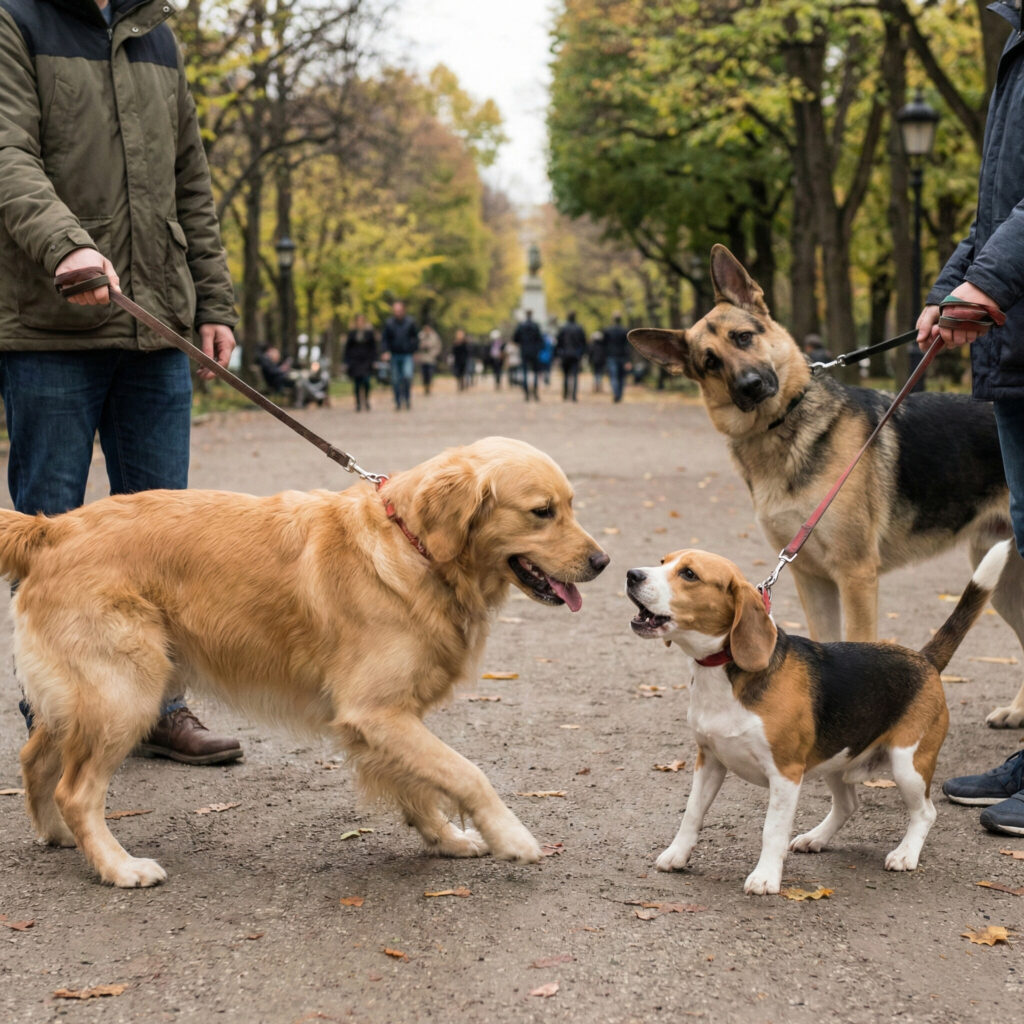
Dogs react differently on a leash primarily due to leash reactivity, which stems from feeling restricted. Without the option to flee or move naturally, a dog’s “fight or flight” response is disrupted. This reaction is usually caused by barrier frustration (wanting to greet but can’t), fear (feeling trapped near a threat), or learned behavior (barking makes the scary thing go away). It is rarely pure aggression; it is usually communication.
Summary Table
| Key Concept | Description |
| Leash Reactivity | An overreaction to stimuli (dogs, people, cars) while tethered. |
| Primary Causes | Barrier Frustration (excitement), Fear (anxiety), Medical Issues. |
| The “Trigger” | The specific thing that causes the dog to react (e.g., a bike, another dog). |
| Threshold | The distance at which your dog notices a trigger but doesn’t react yet. |
| The Solution | Management (avoidance) combined with Desensitization and Counter-Conditioning. |
| Golden Rule | Never punish a reactive dog; it increases anxiety and worsens the behavior. |
Why Dogs React Differently on Leash
Walking your dog should be the best part of your day. It is a time to bond, get some fresh air, and let your companion explore the world. However, for thousands of dog owners, the daily walk is a source of dread. You might find yourself scanning the horizon for other dogs, hiding behind parked cars, or holding onto the leash with white knuckles as your normally sweet dog transforms into a barking, lunging terror.
This phenomenon is known as leash reactivity. It is one of the most common behavioral issues dog owners face, yet it is also one of the most misunderstood. The most important thing to know is that your dog is not “bad” or “dominant.” They are struggling with a specific set of emotions that they cannot handle while tethered to you.
This guide will break down exactly why this happens, the psychology behind the reaction, and the steps you can take to make walks peaceful again.
Read Also: Training a Dog to Be Alone at Home
What Is Leash Reactivity?
Leash reactivity is not a personality trait; it is a behavior. It refers to a dog that overreacts to a specific stimulus, often called a trigger, only when they are on a leash.
Triggers can be anything, but the most common include:
- Other dogs
- Strangers or children
- Bicycles, skateboards, or scooters
- Squirrels or cats
- Loud trucks or buses
The key distinction is that many reactive dogs are perfectly friendly when they are off-leash. You might see a dog that plays beautifully at the dog park but screams like a banshee when they see a dog across the street while on a walk. This drastic change in behavior is what confuses owners the most.
The Psychology: Why The Leash Changes Everything
To understand the behavior, you have to look at the world from your dog’s perspective. In the animal kingdom, survival relies on two main options when facing a threat or something exciting: Fight or Flight.
When a dog is off-leash, they have the freedom to move. If they are scared of another dog, they can create distance (flight). If they want to say hello, they can approach in a polite arc, sniffing the ground and signaling they are friendly.
The leash removes these options. It removes the option of flight. When a dog feels trapped and cannot move away from something that scares them, they switch to the only option left: Fight. This doesn’t mean they want to kill the other dog; it means they are putting on a display to make the scary thing go away.
There are generally three main categories of leash reactivity:
1. Barrier Frustration ( The “I Want to Say Hi!” Dog)
This is common in highly social dogs, like Labradors or Golden Retrievers. These dogs love other dogs. When they see a friend, their brain floods with excitement. They want to rush over and play.
However, the leash stops them. They pull, but they can’t get there. This frustration builds up rapidly. The dog begins to bark and lunge, essentially screaming, “Let me go! I want to see them!” Ironically, this aggressive-looking display often scares the other dog away.
2. Fear and Anxiety (The “Stay Away!” Dog)
This is the most common cause of reactivity. The dog sees a trigger (like a strange man or a big dog) and feels unsafe. Because they are tethered, they know they cannot run away.
To protect themselves, they try to look as big and scary as possible. They bark, growl, and lunge to say, “Don’t come any closer! I am dangerous!” When the other dog or person walks away (which they were going to do anyway), the reactive dog thinks, “It worked! My barking saved me.” This reinforces the behavior.
3. Learned Associations
Sometimes, owners unintentionally teach their dogs to react. If you tighten the leash every time you see another dog, your dog feels that tension. They learn that “Other Dog = Owner Gets Tense.” This makes them nervous, leading to a reaction.
Additionally, if a dog has had a traumatic experience while on a leash, such as being attacked by an off-leash dog, they will be highly defensive in the future.
Read Also: How to Stop Jumping on Guests
Decoding Canine Body Language
Reactivity rarely happens “out of nowhere.” Dogs give many subtle signals before they explode into barking. If you can spot these early signs, you can prevent the reaction.
Early Warning Signs (The “Yellow Zone”)
- Freezing: The dog stops moving and stands stiffly.
- The Hard Stare: The dog locks eyes with the trigger and closes their mouth tight.
- Lip Licking: A quick flick of the tongue over the nose (a sign of stress).
- Whale Eye: Showing the whites of their eyes.
- Piloerection: The hair on their back (hackles) stands up.
The Reaction (The “Red Zone”)
- Lunging at the end of the leash.
- Deep, guttural barking or high-pitched screaming.
- Redirected aggression (biting the leash or the owner’s leg in frustration).
- Spinning in circles.
The Concept of “Threshold”
To fix reactivity, you must understand Threshold. Think of the threshold as an invisible bubble around your dog.
- Under Threshold: The dog sees the trigger (e.g., another dog) but is far enough away that they remain calm. They can still eat treats and look at you.
- Over Threshold: The dog is too close to the trigger. Their brain has switched into survival mode. They cannot hear you, they will not eat treats, and they are reacting.
You cannot train a dog that is over threshold. They are not giving you a hard time; they are having a hard time. Physiological changes, such as a spike in cortisol and adrenaline, make learning impossible in that moment.
How to Manage Leash Reactivity
Before you can train, you must stop the practice of the behavior. Every time your dog practices lunging and barking, the neural pathways for that behavior get stronger. Management means preventing the reaction from happening in the first place.
1. The Emergency U-Turn
Teach your dog that “Let’s Go!” means we are turning 180 degrees and getting a treat. If you see a trigger coming and you know it’s too close, don’t wait. Say “Let’s Go!” and turn around immediately to create distance.
2. Visual Barriers
Use the environment to your advantage. If a dog is approaching, duck behind a parked car, a large tree, or a trash can. Breaking the line of sight can help your dog reset their brain.
3. Walk at Odd Hours
If your neighborhood is crowded at 5:00 PM, do not walk then. Walk early in the morning or late at night. The fewer triggers you encounter, the lower your dog’s cortisol levels will be, making training easier.
Read Also: What to Do If Your Dog Is Stubborn
Training Techniques to Fix the Problem
The goal of training is not to force the dog to submit, but to change how they feel about the trigger. We use two scientific concepts: Desensitization (gradual exposure) and Counter-Conditioning (changing the association).
Method 1: The “Look at That” (LAT) Game
This game teaches the dog that looking at a trigger results in a treat from you.
- Find a distance where your dog is Under Threshold. They can see the dog, but they aren’t barking.
- When your dog looks at the other dog, immediately click a clicker or say “Yes!”
- Your dog will turn back to you to get the treat. Feed them a high-value reward (chicken, cheese, hot dog).
- Repeat.
- Eventually, the dog will see a trigger and automatically look at you, expecting a treat. You are rewiring the brain to think: “Other Dog = Yummy Snack.”
Method 2: The Engage-Disengage Game
This is an advanced version of LAT.
- Engage: The dog looks at the trigger. You mark it (“Yes!”) and treat.
- Disengage: Once the dog gets good at step 1, you wait. The dog looks at the trigger, then chooses to look away at you.
- The moment they look away from the trigger to look at you, mark and treat them heavily.
- You are rewarding the dog for making the choice to ignore the scary thing.
Equipment That Helps (and Hurts)
The right tools can make a massive difference in handling a powerful, reactive dog.
Recommended Gear
- Front-Clip Harness: A harness where the leash clips to the chest. If the dog pulls or lunges, the harness turns their body toward you, reducing their power.
- Head Hollar (Gentle Leader): Good for very strong dogs, as it controls the head. However, it requires conditioning so the dog is comfortable wearing it.
- Double-Ended Leash: Clipping to both the front and back of a harness provides two points of contact for better steering.
Gear to Avoid
- Retractable Leashes (Flexi-leads): These are dangerous for reactive dogs. They offer no control, can cause burns, and if the handle is dropped, the noise can terrify the dog, worsening the fear.
- Prong/Choke/Shock Collars: Pain-based tools suppress behavior but do not change the emotion. A dog might stop barking because they are afraid of the shock, but their internal fear of the stranger increases. This is a ticking time bomb that can lead to a bite without warning.
Read Also: How to Train a Dog With High Energy
Common Mistakes to Avoid
Even well-meaning owners make errors that slow down progress.
- Tightening the Leash: As mentioned, a tight leash signals tension. Keep the leash loose (a “J” shape) whenever possible.
- Asking for a “Sit”: When a dog is scared, they feel vulnerable. Asking them to sit and stay while a scary dog passes removes their ability to move, which increases anxiety. It is often better to keep moving to the side or do a U-turn.
- Flooding: This is forcing the dog to face their fear up close, hoping they “get over it.” Dragging a fearful dog to a busy market will not socialize them; it will sensitize them and make the fear worse.
- Scolding the Growl: Never punish a growl. A growl is a warning. If you punish the warning, the dog learns to skip the growl and go straight to the bite.
Factors That Influence Success
Reactivity is complex. Several factors dictate how fast you can fix it.
- Trigger Stacking: Stress hormones stay in the body for days. If your dog had a stressful vet visit in the morning, saw a cat in the yard at noon, and then heard thunder, their “stress bucket” is full. They will react much faster on the evening walk.
- Pain: If a dog has hip dysplasia or arthritis, they may feel vulnerable. If another dog bumps them, it hurts. Always check with a vet to ensure pain isn’t the cause of aggression.
- Genetics: Some breeds are wired to be more alert and reactive (e.g., Herding breeds, Terriers).
When to Hire a Professional
If your dog has bitten a person or another dog, or if you feel unsafe walking them, you need a professional. Look for a Certified Professional Dog Trainer (CPDT-KA) or a Veterinary Behaviorist.
Avoid trainers who use terms like “alpha,” “pack leader,” or imply you need to dominate your dog. Reactivity is an emotional issue, not a hierarchy issue. You need a trainer who uses positive reinforcement and science-based methods to change the dog’s emotional state.
Conclusion
Living with a reactive dog is emotionally draining. It can feel isolating and embarrassing. But remember, your dog is having a hard time, not giving you a hard time. They are relying on you to be their advocate and protector.
By understanding the “Why”, whether it’s frustration or fear, and applying consistent management and positive training, you can change the story. It takes time, patience, and a pocket full of treats, but helping your dog feel safe in the world is the greatest gift you can give them.