
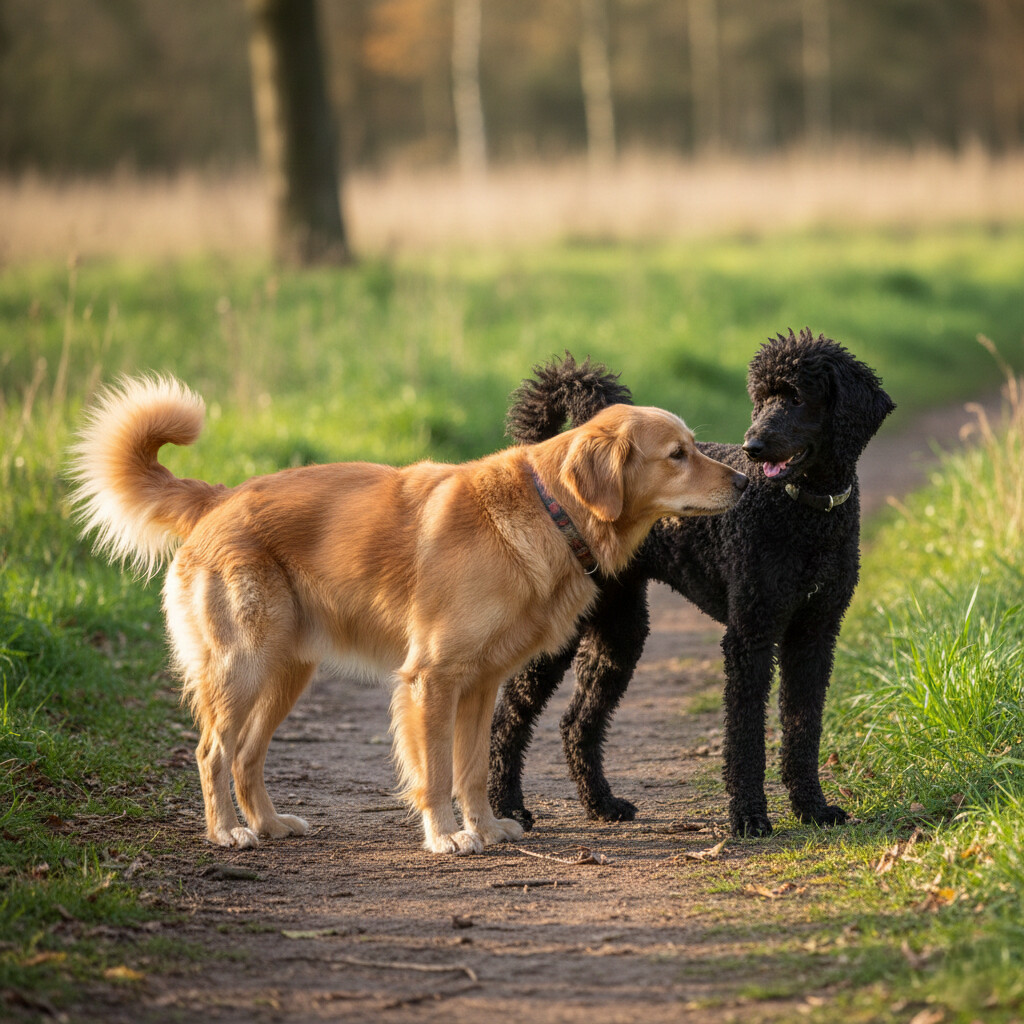
Dogs sniff each other primarily to gather vital social and biological information. Through a specialized scent-processing system involving the Jacobson’s organ, dogs detect pheromones released from another dog’s anal glands. This “chemical handshake” instantly reveals the other dog’s gender, health status, diet, mood, and whether they have met before, acting as a complex form of identification and communication.
Summary Table: Dogs Sniffing Each Other
| Feature | Function |
| Primary Goal | To greet and gather identification. |
| Key Organ | Jacobson’s Organ (Vomeronasal Organ). |
| Target Area | Rear end (Anal Glands) and face. |
| Information Gained | Gender, reproductive status, diet, stress levels, health. |
| Human Equivalent | A handshake, reading a bio, or checking social media profiles. |
Why Do Dogs Sniff Each Other So Much?
If you are a dog owner, you have seen it a thousand times. You are on a walk, your dog spots another dog, and they immediately go for the rear end. It can feel awkward for us humans, but for dogs, this is the most polite and natural way to say “Hello.”
Think of sniffing as a chemical handshake. While humans use eyes and words to get to know someone, dogs use their noses. They are not just smelling odors; they are reading a detailed biography of the other dog.
This behavior is crucial for their social structure and helps them navigate the world safely.
Read Also: What It Means When a Dog Growls While Playing
The Super-Powered Nose
To understand why they sniff, we first need to understand how they sniff. A dog’s sense of smell is a superpower.
- Olfactory Receptors: Humans have about 6 million smell receptors. Dogs have up to 300 million.
- Brain Power: The part of a dog’s brain dedicated to analyzing smells is 40 times larger than ours.
- 3D Smelling: Dogs can smell separately with each nostril, allowing them to determine exactly where a smell is coming from and build a 3-D scent map of their surroundings.
This incredible hardware means your dog isn’t just smelling “dog.” They are smelling layers of complex information that we can’t even imagine.
The Jacobson’s Organ: The Secret Weapon
Dogs have a special tool that humans lack. It is called the Jacobson’s organ (or vomeronasal organ). It is located inside the nasal cavity, just above the roof of the mouth.
This organ doesn’t detect ordinary smells like pizza or flowers. It is designed specifically to detect pheromones. Pheromones are chemical hormones that carry social signals.
When your dog sniffs intently and maybe chatters their teeth or foams slightly at the mouth, they are using this organ to “taste” the scent and send signals directly to the emotional center of their brain.
Why The Butt? (The Science of Anal Glands)
The most common question is, “Why the rear end?” The answer lies in anatomy.
Inside the rectum of every dog are two small sacs called anal glands. These glands produce a strong-smelling fluid that is unique to every single dog. It is their personal chemical signature.
When dogs sniff this area, they are checking a “status update.” The scent released from these glands tells them:
- Identity: “Have I met you before?”
- Gender: “Are you male or female?”
- Diet: “What did you eat recently?”
- Health: “Are you sick or healthy?”
- Mood: “Are you anxious, aggressive, or friendly?”
Because this scent is so concentrated in the rear, that is the first place dogs investigate. It is efficient and gives them the most accurate data.
Read Also: Why Do Dogs Get Zoomies?
Social Hierarchy and Greetings
Sniffing is not just about data; it is about manners. In the dog world, there is a protocol for who gets to sniff whom.
- Mutual Sniffing: If two dogs are friendly and confident, they may sniff each other simultaneously or take turns. This is a sign of a healthy, balanced interaction.
- Dominance: Sometimes, a more dominant or confident dog will initiate the sniffing while the other dog stands still. This establishes a temporary social ranking.
- Submission: A submissive dog might lower their tail and allow themselves to be sniffed to show it is not a threat.
Understanding these signals can help you know if a playdate is going well or if you need to separate the dogs.
Beyond the Butt: Sniffing the Face and Ears
While the rear end holds the most info, dogs also sniff faces. This usually happens after the initial greeting.
- Breath Check: Sniffing the mouth allows dogs to smell what the other dog has eaten and check their dental health.
- Ear Check: The ears contain glands that also release pheromones, providing a secondary source of information.
- Pacifying Behavior: Sometimes a dog will lick or sniff another dog’s face as an “appeasement signal,” essentially saying, “I come in peace, please don’t hurt me.”
Read Also: Why Do Dogs Lean on People?
When Sniffing Becomes a Problem
Usually, you should let dogs sniff. It helps them feel secure. However, there are times when you should intervene.
1. Obsessive Sniffing
If your dog refuses to stop sniffing another dog who is trying to move away, it is rude. In dog language, this can be seen as bullying or harassment. You should call your dog away to prevent a fight.
2. Human Sniffing
Dogs sometimes sniff human crotches. This is embarrassing, but for the dog, it is the same principle. Humans have sweat glands there (apocrine glands) that release pheromones. Your dog is just trying to say hello and learn about you. You can train this behavior out of them by redirecting their attention to a “sit” or “shake” command when guests arrive.
3. Safety First
Always ask the other owner before letting your dog approach. Not all dogs want to be sniffed. If the other dog has stiff body language, a high tail, or a hard stare, do not let your dog engage.
Conclusion
Next time you are on a walk, and your dog pulls toward a tree, a fire hydrant, or another dog, remember that they are checking their “pee-mail.” They are reading the news of the neighborhood.
Allowing your dog to sniff is good for their mental health. It engages their brain, lowers their pulse, and reduces anxiety. It is not just a walk for exercise; it is a walk for information. So, carry extra patience and let them sniff, it is what makes them dogs.