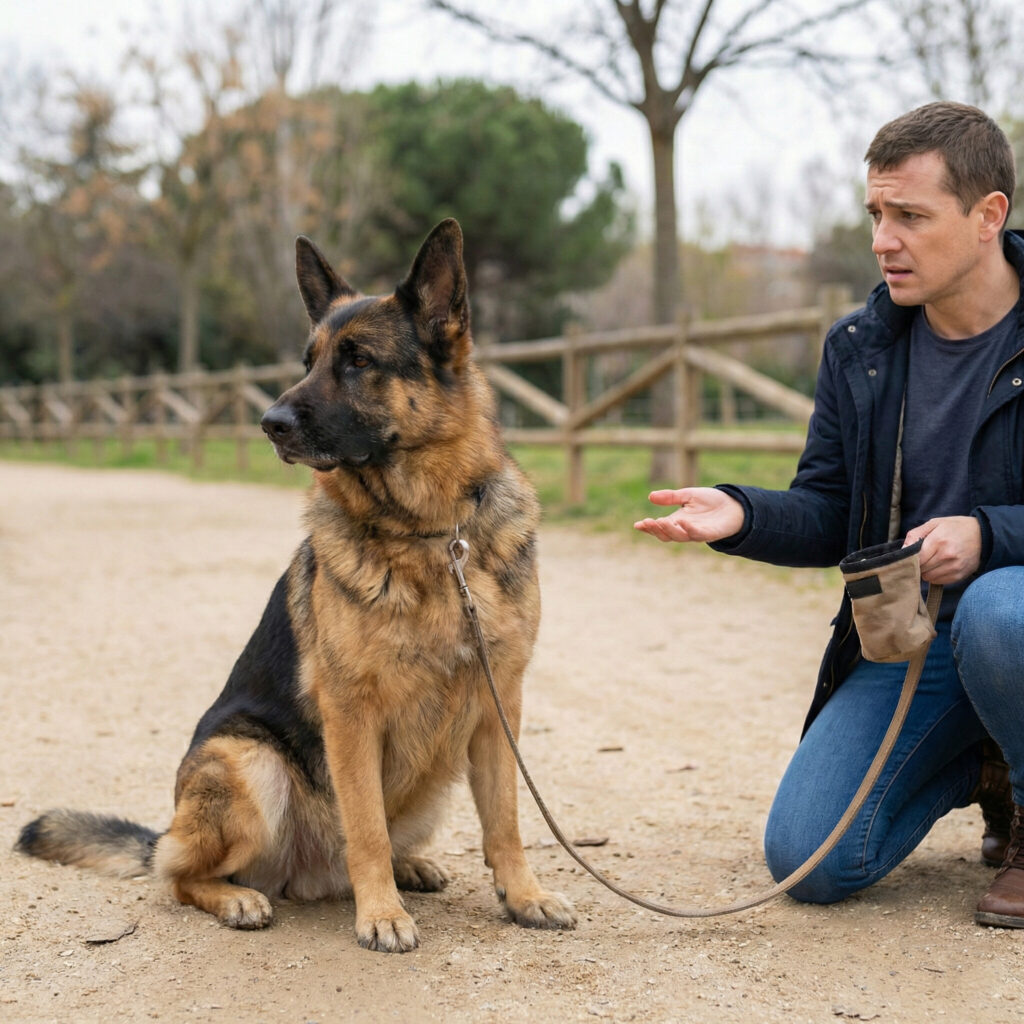
Dog training regression happens when a dog suddenly stops performing known behaviors or commands. It is a normal part of the learning process, often caused by adolescence (“teenage phase”), stress, medical issues, or inconsistent training cues. Most regression is temporary and can be resolved by going back to basics, ruling out health problems, and maintaining a consistent routine.
Summary Table
| Cause | Typical Age/Timing | Primary Signs | Quick Solution |
| Adolescence | 6 to 18 months | Ignoring commands, testing boundaries | Patience, exercise, reinforce basics |
| Extinction Burst | During behavior modification | Bad behavior gets worse temporarily | Do not give in; wait it out |
| Medical Issues | Any age | Sudden accidents, aggression, lethargy | Visit the veterinarian immediately |
| Stress/Changes | After a move or routine shift | Anxiety, chewing, house soiling | Re-establish routine and safety |
| Poisoned Cues | Any age | Hesitation or confusion when called | Retrain the command with a new word |
Why Dogs Regress in Training
Many dog owners experience a moment of panic. Your puppy was sitting, staying, and potty training perfectly. Then, seemingly overnight, they look at you blankly when you say “sit,” or they start having accidents in the house again. This is called training regression.
It is vital to understand that learning is not a straight line. It is a jagged curve with ups and downs. Regression does not mean your dog is “bad” or “stubborn.” It does not mean you have failed as a trainer. It is a natural biological and psychological response to internal or external changes.
Understanding the “why” is the first step to getting your dog back on track.
Read Also: How to Build Focus in Easily Distracted Dogs
1. The “Teenage” Phase (Adolescent Regression)
The most common reason for regression is adolescence. Just like humans, dogs go through a teenage phase. Depending on the breed, this occurs between 6 months and 18 months of age.
During this time, a dog’s brain is physically changing. The hormones are surging (even if they are fixed, though to a lesser degree), and the brain is “pruning” neural pathways to become more efficient. This biological restructuring often creates a disconnect between what they know and what they do.
Signs of Adolescent Regression
- Selective Hearing: The dog hears you but chooses to sniff the grass instead.
- Increased Independence: They wander further away during off-leash time.
- Fearfulness: Sudden fear of objects they were previously fine with (secondary fear periods).
How to Handle It
You must lower your criteria. If your dog could stay for 30 seconds before, go back to asking for 5 seconds. Treat them like they are a young puppy again. Heavy reinforcement and patience are key here. Do not punish the dog for biological changes they cannot control.
2. The “Extinction Burst”
If you are trying to stop a bad habit, you might see the behavior get significantly worse before it stops. This is a psychological concept called an “extinction burst.”
Imagine you put a dollar in a vending machine and press the button, but the soda doesn’t come out. You don’t just walk away immediately. You press the button again, harder. You might shake the machine. You try everything to get the result you are used to.
Your dog does the same thing. If they used to get attention for barking, and you stop giving them attention, they will bark louder and longer to see if that works.
Why This Happens
- The dog is frustrated that the old “rules” typically don’t work.
- They are testing the variability of the reward.
If you give in during an extinction burst, you teach the dog that “barking louder” is the new key to the reward. You must ride out the burst without reacting.
3. Medical and Physical Issues
Before assuming a behavior problem is psychological, you must rule out physical causes. Dogs cannot speak to tell us they are in pain. They communicate discomfort through behavior changes.
Common Medical Causes for Regression
- Urinary Tract Infections (UTI): If a housetrained dog starts urinating inside, it is almost always physical. A UTI makes it impossible for them to hold it.
- Joint Pain or Arthritis: A dog that refuses to “sit” or “down” might be in pain. The movement hurts, so they stop complying.
- Dental Issues: If a dog stops chewing toys and starts snapping when you touch their face, they might have a toothache.
- Vision or Hearing Loss: Senior dogs may not ignore you; they simply might not hear the command or see the hand signal.
If regression is sudden and unprovoked, a vet visit is the mandatory first step.
Read Also: Why Dogs React Differently on Leash
4. Poisoned Cues
A “poisoned cue” occurs when a command becomes associated with something negative or confusing. This ruins the training you have built around that specific word.
How Cues Get Poisoned
- Recall for Punishment: You called your dog to you (“Come!”) and then immediately bathed them, clipped their nails, or scolded them. The dog now thinks “Come” equals “Bad things happen.”
- Over-Repetition: Repeating “Sit, sit, sit, sit” without a response teaches the dog that the command is background noise, not an immediate instruction.
- Tone of Voice: Using a command in an angry voice can make the dog anxious about performing the action.
The Fix
Stop using the poisoned word. If “Come” is broken, start training “Here” or “Touch.” If “Down” is broken, switch to “Drop.” It is easier to teach a new word than to fix a word with negative emotional baggage.
5. Changes in Routine and Environment
Dogs are creatures of habit. They thrive on predictability. A major change in their environment can shatter their sense of security, leading to regression in training.
Triggers for Environmental Stress
- Moving Houses: A new house smells different and has different layouts. Potty training often resets completely in a new home.
- New Family Members: A new baby, partner, or pet changes the social hierarchy and attention distribution.
- Schedule Changes: If you switch from working at home to working in an office, the dog’s potty and exercise schedule is disrupted.
When a dog is stressed, their ability to learn and retain information drops. They enter survival mode rather than learning mode. You must re-establish a routine immediately to provide a sense of safety.
6. Inconsistency Among Handlers
Dogs are context-specific learners. They do not automatically generalize rules. If one person in the house allows the dog on the couch, and another forbids it, the dog does not learn “stay off the couch.” They learn “stay off the couch when Dad is home.”
This is not rebellion; it is confusion. If the criteria for a reward change constantly, the dog will regress to the behavior that requires the least amount of energy (usually the unwanted behavior).
The Solution
Hold a family meeting. Everyone must use the same command words and enforce the same boundaries. If the dog is not allowed to jump on guests, no one is allowed to pet the dog when it jumps.
Read Also Training a Dog to Be Alone at Home
7. Overtraining and Burnout
It is possible to train too much. If you drill the same commands for hours every day, the dog will get bored and frustrated. This is called “burnout.”
Signs of Burnout
- The dog performs the command slowly (latency).
- The dog walks away during a session.
- The dog yawns or licks their lips frequently (calming signals indicating stress).
Keep training sessions short and fun. Five minutes is often better than thirty minutes. Always end on a high note where the dog succeeds and gets a big reward.
How to Fix Training Regression: A Step-by-Step Guide
If you are currently in a regression phase, do not panic. Follow this systematic approach to get back on track.
1. The Vet Check
As mentioned, rule out illness first. A urinalysis for potty accidents or a physical exam for obedience refusal is non-negotiable.
2. Go Back to Kindergarten
Drop your expectations. If your dog is struggling, make the task easier.
- Potty Training: Go back to taking them out every hour and rewarding heavily.
- Leash Walking: Go back to practicing indoors with no distractions before trying the busy street again.
- Recall: Practice on a long line (leash) so the dog cannot fail.
3. Increase the Reinforcement Rate
You might have stopped giving treats too early. During regression, the “paycheck” needs to increase. Use high-value rewards (boiled chicken, cheese) to remind the dog that listening to you is worth it.
4. Manage the Environment
If the dog is chewing shoes again, stop leaving shoes out. Management prevents the dog from practicing the bad behavior while you work on the training. Do not give them the opportunity to fail.
5. Mental Enrichment
Sometimes, regression is just boredom. A tired dog is a good dog. Physical exercise is not enough; they need brain work.
- Use puzzle toys.
- Teach new tricks (shaking hands, spinning).
- Play scent games (hiding treats around the room).
Frequently Asked Questions
Does neutering or spaying fix regression?
Neutering can help with hormonally driven behaviors like roaming or marking, but it is not a cure-all for training regression. It will not fix habits learned through inconsistency or boredom.
How long does the adolescent phase last?
It typically starts around 6 months and can last until the dog is 2 or even 3 years old, depending on the breed. Larger breeds tend to mature more slowly than smaller breeds.
Should I hire a trainer for regression?
If the regression involves aggression, severe separation anxiety, or if you feel overwhelmed, hiring a certified professional dog trainer (CPDT) is highly recommended. They can provide an objective view of what is going wrong.
Is it too late to train an older dog?
No. “You can’t teach an old dog new tricks” is a myth. Older dogs can learn just as well as puppies, though they may have more ingrained habits to unlearn first.
Conclusion
Regression is frustrating, but it is rarely permanent. It is a signal from your dog that something has shifted—whether it is their hormones, their health, or their environment.
The worst thing you can do is get angry. Punishment will only increase the dog’s stress and make the regression worse. Take a deep breath, assess the cause, and return to the basics. Consistency and patience will always win over frustration. Your dog wants to please you; they just need you to show them how to do it again.