
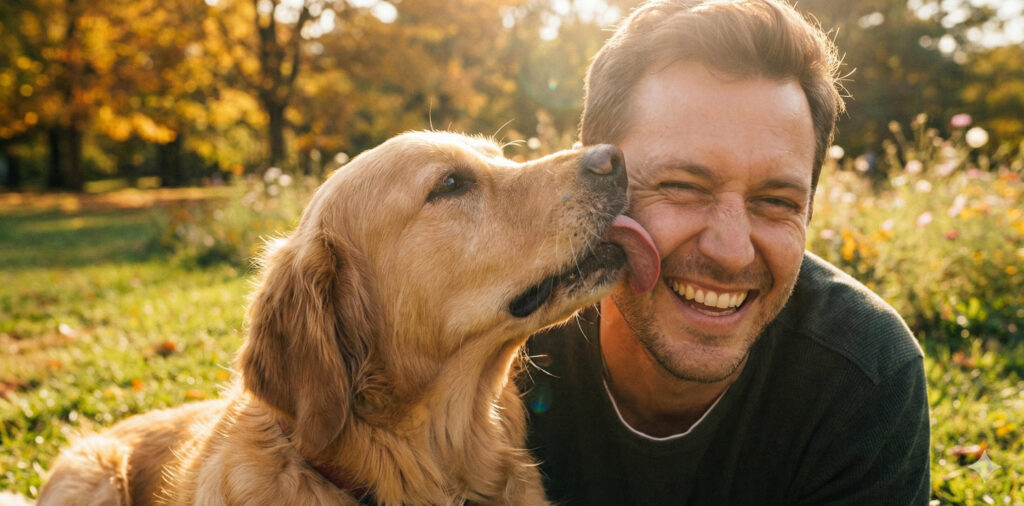
Dogs lick their owners primarily as a form of communication and social bonding. It is an instinctual behavior rooted in their wolf ancestry, used to show affection, signal submission, or solicit food. Licking releases endorphins in a dog’s brain, providing them with a sense of comfort and pleasure. Additionally, dogs may lick you to taste salt on your skin, because they enjoy the scent of your lotion, or simply to get your attention. While usually harmless, excessive licking can sometimes indicate anxiety, boredom, or an underlying medical issue.
Summary Table: Why Do Dogs Lick Their Owners
| Reason | Explanation | Key Trigger |
| Affection | “The Dog Kiss.” Strengthening the bond with the pack leader (you). | Relaxed posture, tail wagging. |
| Instinct | Mimicking mother-pup grooming or wolf behavior. | Cleaning, greeting. |
| Taste | They like the salt on your skin or residue from food. | Sweaty skin, after eating. |
| Attention | They learned that licking gets you to look or touch them. | Boredom, being ignored. |
| Submission | Showing respect to a dominant pack member. | Lowered body, ears back. |
| Medical | Soothing pain, nausea, or allergies. | Obsessive focus, drooling. |
Why Do Dogs Lick Their Owners? Detailed Guide
If you are a dog owner, you know the feeling. You walk through the door, sit on the couch, or even just wake up in the morning, and you are greeted by a wet, rough tongue.
For some people, these “doggy kisses” are the ultimate sign of love. For others, it’s a bit messy and gross. But regardless of how you feel about it, the behavior is nearly universal among canines.
To understand why your dog licks you, we have to look at the world through their eyes and their nose. Licking is not just one thing; it is a complex tool dogs use to interact with their environment and their social circle.
It is a mix of instinct, learned behavior, sensory exploration, and emotional expression.
Read Also: What Causes Separation Anxiety in Dogs?
1. The Instinctual Roots: From Wolf to Woof
To truly understand your domestic dog, you have to look at their ancestors: wolves. In the wild, licking plays a crucial role in the survival of the pack. It starts from the moment a puppy is born.
The Mother-Pup Connection
When puppies are born, the mother immediately licks them. This isn’t just to clean them. This rough grooming stimulates the puppies to breathe and helps their digestive systems start working.
This is the very first sensation a dog experiences: the comforting, rhythmic tongue of their mother. Because of this early imprint, dogs associate licking with safety, warmth, and care. When they lick you, they might be replicating that nurturing feeling.
The “Feed Me” Signal
In wolf packs, when the mother returns from a hunt, she has meat in her stomach. The puppies will lick her mouth to stimulate a regurgitation reflex, causing her to bring up food for them to eat.
While this sounds unappealing to humans, it is a survival mechanism. Your dog might be licking your face (especially around your mouth) because deep down in their DNA, there is an instinct that says licking a face yields a reward or food.
2. A Sign of Affection and Bonding
Most of the time, when your dog licks you, the answer is simple: they love you.
The Hormone Release
Licking is a pleasurable activity for dogs. When a dog engages in licking, their brain releases endorphins and oxytocin. Oxytocin is often called the “love hormone” or “cuddle chemical.” It is the same hormone that bonds human mothers and babies.
When your dog licks you, they are self-soothing. It calms them down and makes them feel good. It is their way of grooming you, just as they would groom a pack mate.
By cleaning you, they are reinforcing the social bond between you. They are saying, “You are part of my family, and I am taking care of you.”
3. Sensory Exploration: You Taste Good
Dogs experience the world primarily through scent and taste. Their sense of smell is thousands of times more sensitive than ours, and their tongues are tools for gathering information.
The Salty Skin Factor
Humans sweat, and sweat contains salt. Dogs often enjoy the salty taste of human skin. If you have just come back from a workout or a run, you might notice your dog is more eager to lick your arms or legs. To them, you are a tasty treat.
Lotions and Food Residue
Did you just eat a burger? Did you apply a coconut-scented moisturizer? Your dog knows. Even if you think you wiped your hands clean, microscopic food particles remain.
Your dog’s powerful nose detects these, and licking is their way of getting a taste. They are literally investigating what you have been doing and what you have been eating.
4. Communication and Submission
In the complex social hierarchy of dogs, body language is everything. Licking is a gesture of deference.
Submissive Licking
If a dog feels intimidated or wants to show that they are not a threat, they will often lower their body and lick the dominant dog’s chin or mouth. When your dog does this to you, they are acknowledging you as the leader of the pack (or at least the person in charge of the resources). It is a way of saying, “I respect you, please be nice to me.”
You might see this behavior if you scold your dog. They might approach you sheepishly and try to lick your hand. They are offering an “apology” and trying to diffuse the tension.
5. Attention Seeking: The Learned Behavior
Dogs are incredibly smart, and they learn quickly what works to get what they want. This is called “operant conditioning.”
Think about what happens when your dog licks you.
- You might laugh.
- You might say, “Stop it!” (which is still attention).
- You might pet them to push them away.
In all these scenarios, the dog got a reaction. If your dog is bored or feels ignored, they might start licking your hand or arm simply because they know it forces you to interact with them. Even negative attention (scolding) is better than no attention at all to a bored dog. If you pet them while they lick, you are positively reinforcing the behavior, guaranteeing they will do it again.
Read Also: Why Do Dogs Follow Their Owners Everywhere?
6. Anxiety and Compulsive Disorders
While most licking is normal, there is a darker side to this behavior. Excessive licking can be a sign that something is wrong emotionally.
Self-Soothing for Stress
Just as some humans bite their fingernails when they are nervous, dogs may lick when they are anxious. The release of endorphins during licking acts as a stress reliever.
If your dog is licking you, themselves, or the furniture obsessively, they might be suffering from separation anxiety, noise phobia (like thunderstorms), or general stress.
Obsessive-Compulsive Disorder (OCD)
In rare cases, licking can become a compulsive disorder. This is when the dog cannot stop licking and does it for hours on end. This usually requires professional intervention from a veterinarian or a canine behaviorist.
7. Medical Causes: When to Worry
Sometimes, the dog isn’t licking you because of you; they are licking because they feel sick.
Nausea
When a dog feels nauseous, they often hypersalivate and feel the need to lick surfaces to cope with the queasiness. If your dog is frantically licking your jeans, the floor, or their own lips, check to see if they look ill.
Allergies and Pain
If a dog is licking a specific spot on their own body, it usually indicates a hot spot, allergy, or pain in that area. However, if they are obsessively licking your specific body part, some anecdotal evidence suggests dogs can smell infection or illness, though this is less common than them simply liking the taste of your lotion.
Is Dog Saliva Safe?
This is a common question. Is it safe to let your dog lick your face?
The old myth that “a dog’s mouth is cleaner than a human’s” is false. It’s not necessarily cleaner or dirtier; it just contains different bacteria.
For most healthy people, a dog lick is harmless. However, dog saliva can carry bacteria like Capnocytophaga or Salmonella.
- Open Wounds: Never let a dog lick an open cut or scrape. It does not help it heal; it introduces bacteria that can cause infection.
- Immunocompromised People: Young children, the elderly, and those with weakened immune systems should avoid dog licks, especially near the mouth and nose.
How to Stop Excessive Licking
If you love your dog but hate the slobber, you can train them to stop. It requires patience and consistency.
1. The “Ignore” Technique
When your dog starts licking, completely withdraw attention. Do not look at them, do not talk to them, and do not touch them. Stand up and walk away if you have to.
When the licking stops, wait a few seconds, then praise them calmly. This teaches them that licking equals zero attention.
2. Redirect the Behavior
Give their mouth something else to do. If they try to lick you, immediately offer a chew toy or a bone. This satisfies their urge to lick and chew without using your arm as the target.
3. Change the Scent
If they are licking because of a lotion or taste, wash your skin with unscented soap. You can also use bitter sprays (specifically designed for dogs) on your skin if the behavior is persistent, though this is a last resort.
4. Exercise and Enrichment
A tired dog is a good dog. Often, excessive licking is a symptom of boredom. Ensure your dog is getting enough physical exercise (walks, runs) and mental stimulation (puzzle toys, training sessions). If they are exhausted, they will be more likely to sleep than to pester you with licks.
Read Also: Signs Your Dog Is Stressed (And How to Help)?
The Different Types of Dog Licks and What They Mean
It helps to categorize the type of lick to understand the motive.
The “Greeting” Lick
- Context: You just came home.
- Meaning: “I missed you! You are back! I am so happy!”
- Action: Excited, rapid licks, usually accompanied by a full-body wiggle.
The “Exploratory” Lick
- Context: You are sitting quietly, and the dog sniffs and then licks your hand.
- Meaning: “Where have you been? What is that smell? Is that tuna?”
- Action: Slow, deliberate licks focused on a specific area.
The “Submissive” Lick
- Context: The dog is approaching you slowly, perhaps after being scolded.
- Meaning: “I come in peace. Please don’t be mad.”
- Action: Small, tentative licks, often on the chin or hands, with a lowered posture.
The “Compulsive” Lick
- Context: The dog is licking the same spot on the couch or your leg for 10+ minutes.
- Meaning: “I am anxious/stressed/sick.”
- Action: Repetitive, intense, and hard to interrupt.
Conclusion
So, why do dogs lick their owners? There is no single answer because dogs are complex emotional creatures. It is a language. Sometimes they are saying “I love you,” sometimes they are saying “I’m hungry,” and sometimes they are saying “I’m bored.”
By paying attention to the context, when they do it, how they look when they do it, and what happens right after, you can decode your dog’s slobbery messages. Whether you embrace the kisses or gently train them away, understanding the “why” deepens the bond between you and your best friend. It reminds us that even though they live in our homes, they still carry the instincts of the wild, adapted perfectly to capture our hearts.
Next Step for You
Pay close attention to when your dog licks you for the next 24 hours. Is it right after a meal? When you come home? Or when you are watching TV? Identifying the trigger is the first step to understanding (or changing) the behavior.