
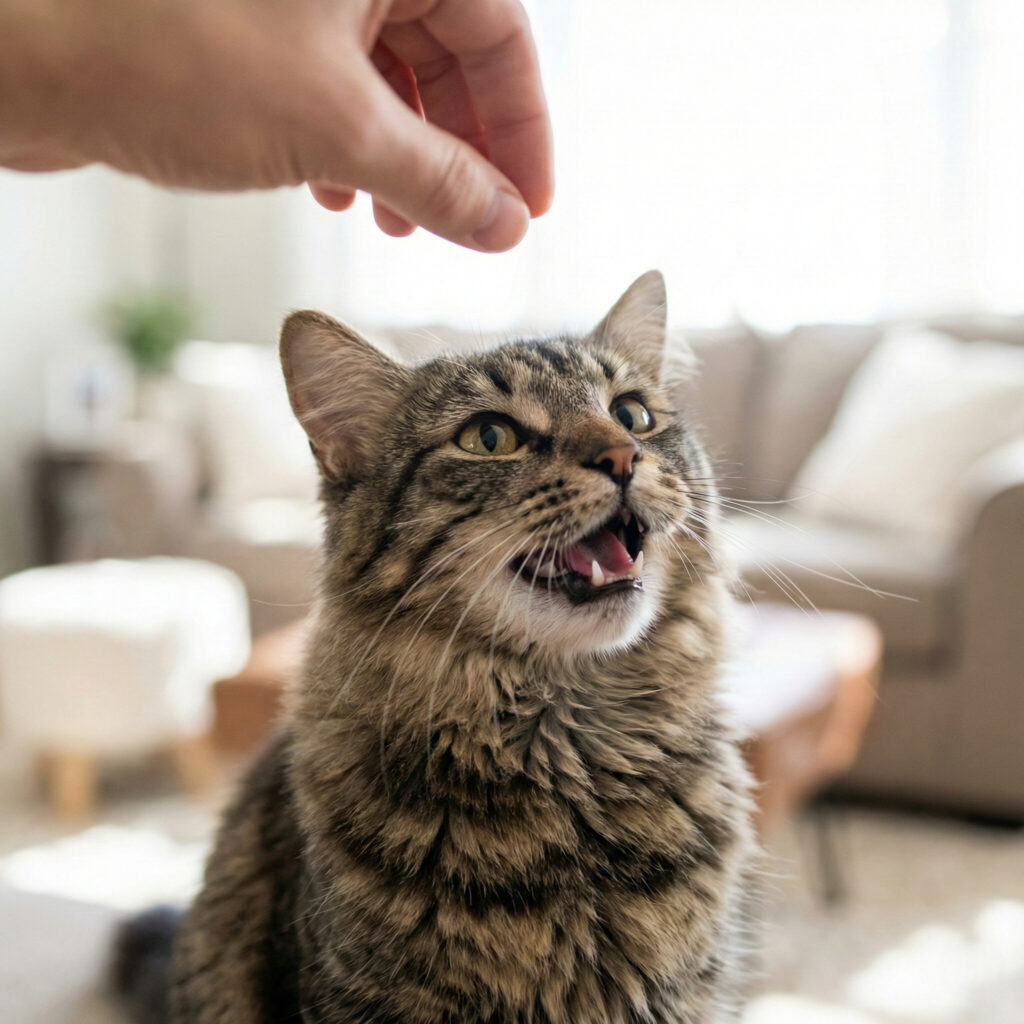
Why do adult cats meow almost exclusively at humans? It’s a learned behavior rooted in their kittenhood. Kittens vocalize to get their mother’s attention, but as adults in the wild, they rely mainly on scent and body language to communicate with other cats. Domestic cats have learned that humans respond strongly to vocal sounds. Over thousands of years of living with us, they have adapted their “kitten cries” into a complex range of meows to communicate their needs, desires, and feelings to their human caregivers, effectively creating a private language for their owners.
Summary Table
| Feature | Description |
| Primary Audience | Humans. Adult cats rarely meow at each other. |
| Origin of Behavior | Derived from kitten vocalizations used to signal their mother. |
| Reason for Persistence | Humans respond to vocal cues, reinforcing the behavior. |
| Types of Sounds | Includes meows, chirps, trills, purrs, hisses, and yowls. |
| Variations | Pitch, length, and volume change based on the cat’s need or emotion. |
| Key Drivers | Hunger, desire for attention, greeting, pain, or distress. |
| Important Context | Vocalizations should be interpreted along with body language. |
Why Do Cats Use Different Meows for Humans?
If you share your home with a cat, you know they are far from silent. They chirp when you open a can of food, they trill when you walk in the door, and they let out a loud, demanding meow when they decide it’s time for you to wake up. It feels like they are talking to us, and in a very real sense, they are. But have you ever noticed that your cat doesn’t seem to talk to other cats in the same way?
The truth is, the meow is a special form of communication that adult cats have developed almost exclusively for humans. It’s a secret language built over thousands of years of domestication, designed to grab our attention and get us to do what they want.
By understanding why cats use different meows for us, we can better understand our feline companions and strengthen the bond we share with them.
Read Also: What Does It Mean When a Cat Growls?
The Secret Language Built for Two
The most surprising fact about cat vocalization is that adult cats in the wild very rarely meow at each other. Feral cats in colonies will hiss, growl, or yowl during disputes or mating, but the friendly, conversational meow we know so well is largely absent from their interactions.
When cats communicate with other cats, they rely heavily on other senses.
- Scent: Cats have scent glands on their cheeks, paws, and flanks. They rub against objects (and other cats) to leave messages. Urine marking is another powerful way they communicate territory and reproductive status.
- Body Language: A cat’s tail position, ear orientation, and posture tell a detailed story to another cat. A high, twitching tail is a friendly greeting, while flattened ears signal fear or aggression.
- Subtle Sounds: They may use soft purrs or trills at close range, but loud, projection-based sounds like the meow are unnecessary and could even attract predators in the wild.
So, if they don’t use it with their own kind, why do they use it so much with us? The answer lies in their history as a domesticated species and their unique relationship with human beings.
From Kitten to Couch Potato: The Evolution of the Meow
The origin of the meow is actually in kittenhood. All kittens, whether wild or domestic, meow to their mothers. It is a distress signal. A cold, hungry, or lost kitten lets out a high-pitched mew so its mother can find it and provide care. Once the kitten is weaned and can fend for itself, this behavior typically fades away.
However, the story changed for the ancestors of our modern house cats. As cats began to live near human settlements to hunt rodents, a process of self-domestication began.
The cats that were less fearful of humans and more willing to tolerate our presence had a survival advantage.
Over time, these cats discovered something important: humans are not exceedingly good at reading subtle feline body language or picking up on scent markers. We are, however, very responsive to sound.
When a domesticated adult cat used a “kitten” sound, a meow, towards a human, it likely got a reaction. Perhaps the human thought it was cute and offered food, or maybe they opened a door or provided a comforting pet. The cat learned a valuable lesson: Vocalizing at humans gets results.
This process is sometimes called “neoteny,” which is the retention of juvenile features or behaviors into adulthood.
By acting like a kitten dependent on its mother, the adult cat taps into our human nurturing instincts. We are hardwired to respond to cries for help, and the cat’s meow perfectly mimics that trigger.
Over generations, this behavior was reinforced, leading to the chatty companions we know today.
Read Also: Signs of Anxiety in Cats
Decoding the Meow: Types and Meanings
Cats don’t just have one single “meow.” They have developed a complex vocabulary of sounds, each with a different meaning tailored for their human audience. While there is no universal cat dictionary, as each cat develops a unique “pidgin” language with its owner, there are common types of vocalizations that most cat owners will recognize.
1. The “I Want” Meow (Demand)
This is perhaps the most common meow. It is a mid-length, persistent sound that is often repeated until the cat gets what it wants. It’s not necessarily aggressive, but it is insistent.
- Common triggers: Hunger, wanting a door opened, wanting you to wake up, wanting a specific toy.
- How it sounds: It’s a standard “meow” but with a sense of urgency. The pitch is usually in the middle range. The more the cat wants something, the more frequent and louder this meow will become.
2. The Friendly Greeting (Chirp or Trill)
This is a short, high-pitched, bird-like sound. It’s often described as a “prrrrup” or a rolled “meow.” It is almost always a positive, happy sound.
- Common triggers: You walking into a room, the cat waking up and seeing you, anticipation of a treat or pet.
- How it sounds: It’s soft, brief, and has a musical quality. Mother cats use this sound to tell their kittens to follow them. When your cat uses it on you, it’s a friendly “hello” and an invitation to interact.
3. The “Pay Attention to Me” Mew
This is a soft, high-pitched, short sound that sounds very much like a young kitten. It is a gentle solicitation for affection.
- Common triggers: Wanting to be petted, wanting to sit on your lap, just wanting you to look at them.
- How it sounds: It is a quiet, endearing “mew” rather than a full “meow.” It’s designed to be cute and elicit a nurturing response from you.
4. The Complaint or Warning (Low Pitch)
When a cat’s meow drops in pitch and becomes longer and more drawn-out, it’s usually a sign of displeasure.
- Common triggers: Being held when they don’t want to be, seeing an outdoor cat through the window, waiting too long for food, general annoyance.
- How it sounds: The tone is deeper, sometimes almost growl-like at the end. It sounds like a moan or a grumble. It’s a clear signal that the cat is becoming frustrated or agitated.
5. The Cry for Distress or Pain
This is a sound no cat owner wants to hear. It is distinct from a regular meow and is a clear signal of trouble.
- Common triggers: Being trapped in a closet, physical pain, sudden fright, intense stress (like a vet visit).
- How it sounds: It is loud, high-pitched, shrill, and prolonged. It sounds like a scream or a wail. It is an urgent call for help that is hard to ignore.
6. The Yowl (Mating or Territory)
While less common in spayed and neutered indoor cats, the yowl is a primal sound related to mating and territory.
- Common triggers: A female cat in heat calling for a mate, two male cats posturing before a fight or an older cat suffering from cognitive confusion or deafness.
- How it sounds: It is a long, loud, drawn-out wail that can sound eerie and distressing to human ears. It is much longer and more intense than a regular meow.
Read Also: Why Do Cats Prefer Certain People?
It’s Not Just What They Say, It’s How They Say It
Just like with human speech, the way a cat delivers a meow changes its meaning entirely. The pitch, duration, frequency, and volume all play a role in the message being conveyed.
- Pitch: Higher pitches are generally associated with friendliness, happiness, or kitten-like appeals. Lower pitches tend to indicate displeasure, aggression, or a serious demand.
- Duration: A short, quick meow is often a simple greeting or acknowledgment. A long, drawn-out meow is usually a demand or a complaint. The longer the sound, the more insistent the message.
- Frequency: A single meow might be a casual “hello.” A rapid-fire series of meows means the cat is very excited or very agitated about something. Think of the difference between someone saying “Hey” once and someone saying “Hey, hey, hey, hey!”
- Volume: This one is simple. A soft meow is a polite request. A loud meow is a shout. If your cat is screaming at you, they feel their needs are urgent and are not being met.
Context is Key: Reading the Whole Cat
While understanding the different types of meows is helpful, you can never fully understand what a cat is saying by sound alone. You must always look at the context and the cat’s body language to get the full picture.
For example, a loud meow combined with a cat rubbing against your legs in the kitchen at 6 a.m. clearly means “Feed me now.” But that same loud meow from a cat crouching under the bed with dilated pupils means “I am terrified; do not come near me.”
Here is a quick guide to reading the accompanying signals:
- Tail Up: Friendly, confident, happy.
- Tail Puffed Up: Fearful, agitated, trying to look bigger.
- Tail Flicking: Annoyed, getting ready to pounce, losing patience.
- Ears Forward: Interested, alert, happy.
- Ears Flat/Back: Scared, angry, defensive.
- Slow Blink: A sign of trust and affection. It’s a “cat kiss.”
- Dilated Pupils: Can mean fear, excitement, or that the cat is in hunting mode.
Read Also: Why Do Cats Suddenly Get the Zoomies?
How You Taught Your Cat to Talk
It’s important to remember that this communication is a two-way street. Your cat didn’t just wake up one day knowing the perfect meow to get you to open the treat jar. It was a learning process.
Every time your cat made a sound and you responded to it, you reinforced that behavior.
- If they meowed quietly and you ignored them, but then meowed loudly and you gave them food, they learned that loud equals food.
- If they chirped at you and you petted them, they learned that chirping is a good way to get affection.
This is why the “language” you share with your cat is unique. A sound that means “I want to go outside” in one household might mean “I want to play with the laser pointer” in another. You and your cat have co-created this system of communication through years of trial and error.
This also means that if your cat has a habit you don’t like, for example, screaming for food in the middle of the night, it’s likely a behavior that has been inadvertently rewarded in the past. Changing it requires patience and a change in your own response, such as waiting for a moment of silence before putting the food bowl down.
Conclusion
The fact that cats have developed a special way of talking just for us is a testament to the unique and ancient bond between our two species. They are highly adaptable, intelligent creatures that figured out the best way to communicate with the large, hairless apes that control the can opener.
So the next time your cat meows at you, take a moment to appreciate it. It’s not just noise. It’s a personalized message, crafted by thousands of years of evolution and honed by your individual relationship, delivered in the only language they know you’ll understand.
By listening closely to the pitch, length, and tone, and observing their body language, you can become fluent in your cat’s unique dialect and deepen the connection with your furry friend.