
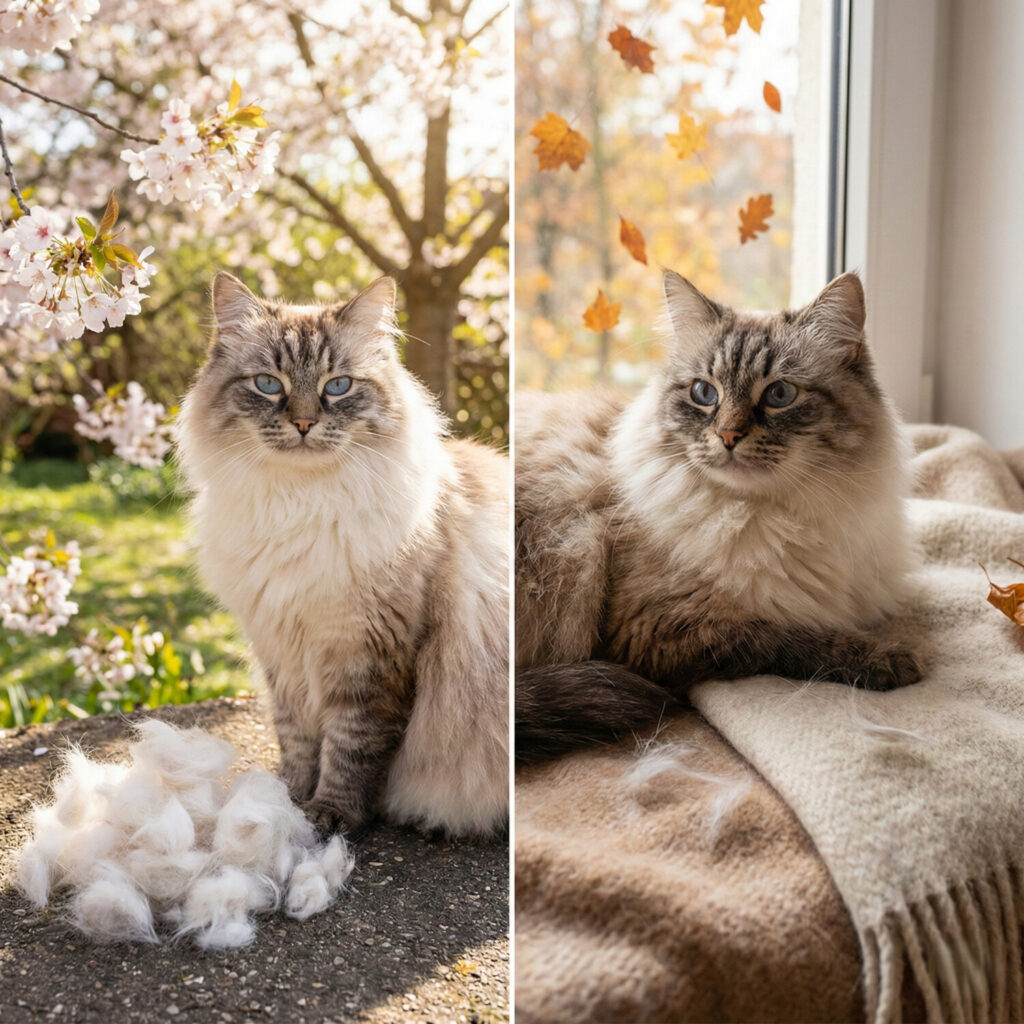
Cats shed more in spring and autumn due to a biological response to the amount of daylight, known as the photoperiod. In spring, increased daylight triggers cats to shed their heavy winter undercoat to stay cool. In autumn, decreased daylight signals them to shed their lighter summer coat to make room for a thick, insulating winter layer. This process is most distinct in outdoor cats, while indoor cats often shed year-round due to artificial lighting.
Summary Table: Seasonal Shedding Patterns in Cats
| Season | Shedding Intensity | Primary Cause | Coat Change | Recommended Action |
| Spring | Very High | Increasing daylight | Losing winter undercoat | Daily brushing with a deshedding tool |
| Summer | Moderate | High heat | Replacing a summer coat with winter fur | Weekly brushing; hydration focus |
| Autumn | High | Decreasing daylight | Replacing a summer coat with a winter fur | Frequent brushing to clear space for new growth |
| Winter | Low | Cold temperatures | Retaining thick insulation | Occasional brushing to prevent mats |
Why Do Cats Shed More in Certain Seasons?
If you own a cat, you are likely familiar with finding fur on your furniture, clothes, and even in your morning coffee. While shedding is a normal part of a healthy cat’s life, you might notice that the amount of hair they lose changes drastically depending on the time of year. This is not random. It is a complex biological process driven by nature to keep your pet comfortable and safe.
Understanding why your cat sheds more during specific seasons can help you manage the mess and keep your cat’s skin and coat healthy.
Read Also: Common Dental Problems in Cats
This guide explores the science behind shedding, the differences between indoor and outdoor cats, and practical ways to handle the fur.
The Science Behind the Shed
To understand seasonal shedding, you first need to understand the cat’s coat. Most cats have a double coat.
- The Undercoat: This is the soft, downy layer closest to the skin. It acts as insulation to keep the cat warm in winter.
- The Topcoat (Guard Hairs): These are the longer, coarser hairs you see on the surface. They protect the skin from rain, dirt, and sunlight.
The primary driver of shedding is not temperature, as many people assume. It is actually light. This biological mechanism is called the photoperiod.
Animals, including cats, have a circadian rhythm that detects changes in the duration of sunlight. When the days get longer or shorter, the cat’s body receives hormonal signals to adjust its fur density.
The Spring Shed: Blowing the Coat
Spring is arguably the most intense shedding season for cat owners. As winter ends and the days become longer, your cat’s body recognizes that it no longer needs heavy insulation. The thick, woolly undercoat that grew to protect them from freezing temperatures becomes a liability as the weather warms up.
During this time, cats undergo a massive shed often called “blowing the coat.” They rapidly lose the dense undercoat to prevent overheating during the upcoming summer months. You might notice clumps of soft fur drifting around your floors or sticking to your cat’s hindquarters.
This is a critical time for grooming. If this loose fur is not removed, it can become trapped within the remaining hair. This leads to painful mats and tangles that pull on the skin. It also increases the risk of hairballs, as your cat will swallow significantly more fur during self-grooming.
The Autumn Shed: Preparing for the Chill
The second major shedding event occurs in autumn. As the days grow shorter and sunlight decreases, the cat’s biology shifts again. This time, the goal is to prepare for the cold.
You might wonder why they shed if they need to get warmer. The answer is simple. They need to get rid of the light, breathable summer coat to make room for the new, thick winter undercoat. The summer hair is not dense enough to trap heat effectively. By shedding the old coat, the skin makes space for fresh, insulating growth.
While the autumn shed can be heavy, it is often less noticeable than the spring shed because the summer hairs are generally finer and lighter than the thick winter wool being lost in spring.
Read Also: Can Cats Eat Fish Sticks?
Summer and Winter: The Maintenance Phases
Summer and winter are generally periods of maintenance rather than transition.
Summer: After the heavy spring shed, your cat will have a lighter coat designed for airflow. Shedding continues, but it is usually at a lower, steady rate. The goal here is to replace dead hairs and protect the skin from sunburn.
Winter: Once the autumn transition is done, your cat will hold onto its thick coat to conserve heat. Shedding is typically at its lowest point during the coldest months. However, the air inside homes can be very dry during winter due to heating systems. This dryness can cause static electricity and dry skin, which may lead to some flaky shedding or dandruff.
Indoor vs. Outdoor Cats: The Artificial Light Factor
The seasonal patterns described above are most distinct in feral cats or pets that spend the majority of their time outdoors. These cats are fully exposed to the natural rise and fall of the sun. Their bodies stay perfectly in sync with the seasons.
Indoor cats are different. They live in a climate-controlled environment where the temperature is roughly the same year-round (68 to 72 degrees Fahrenheit). More importantly, they are exposed to artificial light.
Light bulbs, television screens, and computer monitors trick the indoor cat’s biological clock. Because the lights are on well past sunset, their bodies do not receive strong signals that winter is coming or that spring has arrived.
As a result, indoor cats often experience a continual low-level shedding all year long. They may still have minor peaks in spring and fall, but they never truly stop shedding because their body is in a constant state of confusion regarding the season.
Read Also: Can Cats Eat Almonds?
The Four Stages of Hair Growth in Cats
To manage shedding, it helps to know that hair growth is a cycle. Not all hairs are growing at the same time. If they were, your cat would go bald all at once. The cycle consists of four phases:
- Anagen (Growth Phase): New hair is actively growing from the follicle.
- Catagen (Transition Phase): The hair stops growing and the follicle shrinks.
- Telogen (Resting Phase): The hair is fully formed but stays in the follicle. It is not growing, but it is not falling out yet either.
- Exogen (Shedding Phase): The hair falls out, and the follicle re-enters the Anagen phase to start over.
In seasonal shedding, the changing light shifts a large percentage of hair follicles into the Exogen phase simultaneously.
Breed Differences in Shedding
Not all cats shed equally. Genetics play a massive role in how much fur you will find on your sofa.
High Shedding Breeds
Cats with dense double coats shed the most. This includes breeds like the Maine Coon, Norwegian Forest Cat, Siberian, and Persian. Even short-haired cats with dense coats, like the British Shorthair or Russian Blue, can be prolific shedders.
Low Shedding Breeds
Some breeds have very little undercoat or no hair at all. The Sphynx is the most obvious example, though they still produce oils that need to be cleaned. The Cornish Rex and Devon Rex have curly coats with little to no guard hair, resulting in significantly less shedding.
The Siamese often has a single coat rather than a double coat, meaning they shed less volume than a Maine Coon, though they still lose hair.
Read Also: How much hair does a cat shed in a day?
When Shedding Indicates a Health Problem
While seasonal shedding is normal, excessive hair loss can sometimes signal a medical issue. You should observe your cat closely if the shedding seems extreme or unusual.
Signs of Abnormal Shedding
- Bald Patches: Seasonal shedding is generalized. If your cat is losing hair in specific clumps that leave bald spots (alopecia), this is not normal.
- Skin Irritation: Redness, scabs, bumps, or open sores on the skin.
- Excessive Scratching: If your cat is biting, chewing, or scratching at their fur, they may have parasites.
- Dull Coat: A healthy coat should be shiny and smooth. A dry, brittle, or greasy coat indicates poor health.
Common Medical Causes
- Stress: Cats are sensitive creatures. Moving to a new house, a new pet, or loud noises can cause psychogenic alopecia, where a cat over-grooms due to anxiety.
- Parasites: Fleas, mites, and lice cause intense itching. The shedding results from the cat scratching the hair out.
- Allergies: Food allergies or environmental allergies (pollen, dust) can cause skin inflammation and hair loss.
- Poor Diet: A lack of protein or essential fatty acids will result in a weak coat that sheds excessively.
- Hormonal Imbalances: Thyroid issues (Hyperthyroidism) are common in older cats and can degrade coat quality.
How to Manage Seasonal Shedding in Cats
You cannot stop a cat from shedding. It is a necessary bodily function. However, you can significantly reduce the amount of hair floating around your home with the right strategy.
1. Establish a Grooming Routine
Brushing is the most effective way to control shedding. It removes the loose hair before it falls onto your carpet.
- For Short-Haired Cats: Use a rubber grooming mitt or a soft bristle brush. These tools gently remove dead hair and distribute natural skin oils. Aim for brushing 2 to 3 times a week.
- For Long-Haired Cats: You need more heavy-duty tools. A slicker brush is excellent for grabbing loose fur. A metal comb is necessary to get down to the skin and prevent mats. During spring and fall, you should brush these cats daily.
- Deshedding Tools: Tools like the Furminator are designed specifically to reach through the topcoat and pull out the loose undercoat. Use these carefully and only once or twice a week to avoid irritating the skin.
Read Also: Why Is My Cat Losing Hair Around His Eyes?
2. Upgrade Their Diet
Hair is made of protein (keratin). If your cat’s diet is low in high-quality animal protein, their body will conserve protein for vital organs and neglect the coat. This leads to weak hair that sheds easily.
Look for wet foods rich in Omega-3 and Omega-6 fatty acids. These nutrients improve skin elasticity and follicle health. Fish oils or specific coat supplements can also be added to their food, but consult your vet before adding supplements.
3. Hydration is Key
Dehydration leads to dry, flaky skin. Dry skin cannot hold onto hair follicles as effectively as healthy, hydrated skin. Because cats have a low thirst drive, they often do not drink enough water.
To improve hydration, incorporate more wet food into their diet. You can also invest in a cat water fountain. The moving water attracts cats and encourages them to drink more than standing water in a bowl.
4. Create a Stress-Free Environment
Since stress causes shedding, keeping your cat calm helps their coat. Ensure they have safe spaces to hide, vertical territory (cat trees), and a consistent routine. Pheromone diffusers can also help calm anxious cats.
Cleaning Tips for Cat Owners
Even with the best grooming, some hair will escape. Here are a few quick tips for managing the environment:
- Lint Rollers: Keep one in your car, one by the door, and one in the bedroom.
- Rubber Gloves: Put on a damp rubber dishwashing glove and wipe your hand over your sofa. The friction generates static and balls up the cat hair instantly.
- Vacuum Frequently: Use a vacuum with a HEPA filter to trap dander and allergens.
- Wash Bedding: Wash your cat’s bedding regularly in hot water to remove hair, oils, and flea eggs.
Conclusion
Shedding is a natural, healthy process for your feline companion. It allows them to adapt to changing temperatures and keeps their skin protected. While the spring and autumn “blow outs” can be frustrating for owners, understanding the biological necessity of the photoperiod helps us appreciate how amazing our cats’ bodies are.
By recognizing the seasons of high shedding and adjusting your grooming routine accordingly, you can keep your cat comfortable and your home relatively fur-free. A healthy coat is a sign of a healthy cat, so embrace the fluff and keep that brush handy.