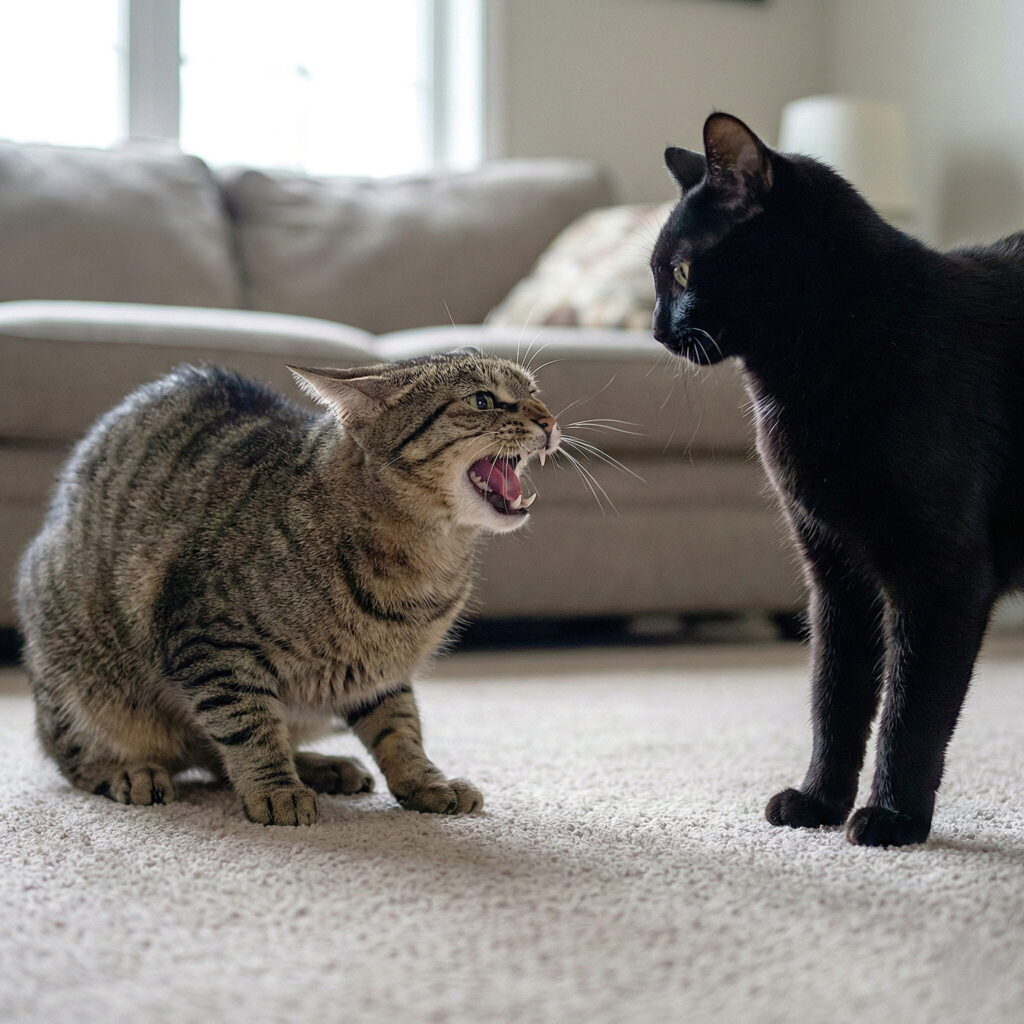
Cats hiss at other cats primarily as a defensive warning signal. It is not an act of aggression but a request for distance. The most common causes include fear, territorial stress, pain, or redirected aggression. When a cat hisses, they feel threatened and are communicating that they want to avoid a physical fight. If the warning is ignored, the situation may escalate to swatting or biting.
Summary Table: Why Do Cats Hiss at Other Cats?
| Common Cause | Primary Trigger | What It Means | Immediate Action |
| Fear or Anxiety | Strangers, loud noises, new environments | “I am scared and need space.” | Give the cat a safe hiding spot. |
| Territorial Defense | New cat entering the home, limited resources | “This is my space/food.” | Separate resources like bowls and litter boxes. |
| Pain or Illness | Arthritis, dental pain, injury | “I hurt, do not touch me.” | Consult a veterinarian immediately. |
| Redirected Aggression | Seeing an outdoor cat, loud startle | “I am agitated and lashing out.” | Separate the cats until calm returns. |
| Maternal Instinct | Nursing kittens | “Stay away from my babies.” | Give the mother cat total privacy. |
| Non-Recognition | Vet visits, grooming smells | “You smell different/wrong.” | Reintroduce the cats slowly. |
7 Reasons Cats Hiss at Other Cats?
Hissing is one of the most misunderstood sounds in the feline world. Many owners assume a hissing cat is being mean or aggressive. In reality, the hiss is a defensive tool. It is an involuntary emotional reaction triggered by the anticipation of pain or a threat.
When your cat hisses at another cat, they are actually trying to prevent a fight rather than start one. They are using their voice to say back off before they are forced to use their claws.
Understanding the root cause of the hissing is the only way to solve the problem. You cannot train a cat to stop hissing, but you can change the environment to make them feel safe again.
Read Also: Why Do Cats Avoid Eye Contact?
This guide covers the biological, psychological, and environmental reasons for this behavior and how to manage it.
1. Fear and Social Anxiety
The single most common reason for hissing is fear. Cats are both predators and prey animals. This dual nature makes them highly cautious about their safety.
When a cat feels cornered or trapped by another cat, the fight or flight response activates. If there is nowhere to run, the cat will hiss to create distance.
The Role of Socialization
Cats that were not properly socialized as kittens often use hissing more frequently. If a kitten does not interact with other cats between the ages of two and seven weeks, they may lack the social skills to handle greetings calmly.
A well socialized cat might sniff a new friend. An unsocialized cat will hiss because the new cat represents a scary unknown variable.
Personality Clashes
Just like humans, some cats simply do not get along. You might have a high energy kitten and a senior cat who just wants to sleep. The senior cat will hiss to set a boundary.
This tells the kitten that play time is over. This type of hissing is actually healthy communication if the kitten respects the warning.
2. Territorial Instincts and Resource Guarding
Cats are territorial by nature. In the wild, a territory equals survival. It contains their food, water, and shelter. When a house cat feels their territory is threatened, they react defensively.
The intruder
Bringing a new cat into the home is a major disruption. The resident cat sees the newcomer as an intruder who is there to steal resources. Hissing is the resident cat’s way of claiming ownership over the house.
Resource Scarcity
Even cats that have lived together for years can start hissing if resources are scarce. This often happens in multi-cat households where there are not enough litter boxes or food bowls.
If three cats have to share one litter box, the dominant cat may hiss to block access. This is known as resource guarding.
Scent Marking
Cats rely heavily on scent. They mark their territory by rubbing their cheeks on furniture. If a new cat enters and covers those scents with their own, the resident cat feels anxious. The hiss is a reaction to the loss of their established scent profile in the home.
Read Also: Why Do Cats Stare at Walls?
3. Pain and Medical Issues
A sudden onset of hissing in a usually friendly cat is a major red flag. Cats are masters at hiding pain. By the time they verbalize it with a hiss, the pain is often severe.
Arthritis and Touch Sensitivity
Older cats often suffer from arthritis. If a younger cat jumps on them to play, the impact causes pain. The senior cat hisses to stop the contact. This is not hatred. It is physical protection.
Dental Disease
Dental issues are rampant in cats. A cat with a toothache is irritable and has a short fuse. If a housemate bumps into them or tries to groom them, the pain can trigger an immediate hiss.
Internal Discomfort
Issues like urinary tract infections or gastrointestinal distress make cats feel vulnerable. They know they are weak and cannot defend themselves well. Hissing keeps potential threats away while they try to recover. If hissing appears suddenly without an obvious environmental trigger, a vet visit is mandatory.
4. Redirected Aggression
This is one of the most confusing behaviors for cat owners. Redirected aggression happens when a cat sees a threat they cannot reach and takes their frustration out on the nearest living thing.
The Window Trigger
Imagine your cat is sitting in the window. They see a stray cat walking through the yard. Your cat gets agitated and wants to chase the intruder but is blocked by the glass. Their arousal level spikes. At that exact moment, your other cat walks into the room. The agitated cat turns and hisses or attacks their friend.
The Mechanism
The cat is in a state of high physiological arousal. Adrenaline is pumping. They are not really mad at the housemate. They are mad at the stray cat outside.
However, the housemate becomes the victim of that pent-up energy. This can damage the bond between two cats who were previously best friends.
Read Also: Why Do Cats Bring You “Gifts”?
5. Non-Recognition Aggression
Cats identify each other primarily by smell, not sight. If a cat’s scent changes, they become a stranger to their housemates.
The Vet Visit
This is a classic scenario. You take one cat to the vet. They come home smelling like antiseptic, latex, and other animals. You release them from the carrier and the stay-at-home cat immediately hisses.
Why It Happens
To the stay-at-home cat, this new arrival looks like their friend but smells like a threat. This causes “non-recognition aggression.”
The hiss signals that the resident cat does not recognize the returnee and is treating them as an invader. This usually resolves once the vet smell fades and the cat grooms themselves back to their normal scent.
6. Maternal Aggression
A mother cat, or queen, has a fierce instinct to protect her litter. This is hormonal and biological. Even if the mother cat loves the other cats in the house, she will hiss if they get too close to the kittens.
Protective Bubble
The mother creates a protective zone around the nesting box. Hissing serves as a perimeter alarm. She is warning other cats that crossing the line will result in a fight.
This behavior usually fades as the kittens grow older and become more independent. It is crucial to respect this boundary and keep other cats away from the nursing mother.
Read Also: Can Cats Eat Ice Cream?
7. Play Aggression vs Warning Hiss
Sometimes it is hard to tell if cats are playing or fighting. Rough play is normal, but there is a line.
The Pause Button
During wrestling, one cat might get too rough or use claws. The victim will hiss. In this context, the hiss acts like a whistle blowing in a sports game. It signals “Time out, that hurt.”
Respecting the Signal
In a healthy relationship, the aggressor will back off immediately when they hear the hiss. They might pause or walk away. If the aggressor ignores the hiss and continues to attack, it is no longer play. It is bullying. This requires intervention from the owner to separate the cats.
How to Handle Hissing Between Cats
Do not punish a hissing cat. Punishment increases fear and anxiety, which leads to more hissing. You cannot discipline an emotion. Instead, you must manage the situation.
Step 1: Stop the Interaction
If the hissing is intense or accompanied by growling, separate the cats immediately. Use a piece of cardboard or a blanket to block their line of sight. Do not use your hands or you may get bitten.
Step 2: Identify the Trigger
Look at the context. Did a loud noise just happen? Is one cat cornered? Is there a stray cat outside? Identifying the cause helps you prevent it next time.
Step 3: Increase Vertical Space
Cats feel safer when they are high up. Add cat trees, shelves, or clear off the tops of cabinets. This gives the cats more territory. A nervous cat can retreat to a high shelf and watch the room without feeling threatened. This reduces the need to hiss.
Step 4: The Reintroduction Process
If the cats are fighting constantly, you need to hit the reset button. Separate them into different rooms for a few days. Swap their scents by exchanging bedding. Feed them on opposite sides of a closed door. This helps them associate each other’s scent with the positive reward of food.
Step 5: Resource Availability
Follow the “N+1” rule for resources. If you have two cats, you need three litter boxes, three food bowls, and multiple water stations. Spread these out across the house. This prevents the dominant cat from guarding all the resources at once.
Read Also: Can Cats Eat Peanut Butter?
Body Language Signs to Watch
Hissing rarely happens in isolation. It is part of a larger communication package. Reading the rest of the body language tells you how serious the threat is.
Defensive Posture (Fear)
- Ears flattened against the head (airplane ears)
- Crouching low to the ground
- Tail tucked between the legs
- Dilated pupils
- Result: The cat wants to escape.
Offensive Posture (Aggression)
- Direct stare without blinking
- Ears turned sideways but not flat
- Stiff legs and upright stance
- Tail twitching or thrashing
- Result: The cat is ready to attack.
When to See a Professional
Occasional hissing is normal communication. However, chronic conflict affects the quality of life for your pets.
Consult a Vet If:
- A friendly cat starts hissing suddenly.
- The cat is hiding, not eating, or missing the litter box.
- The hissing is accompanied by signs of pain like limping.
Consult a Behaviorist If:
- The reintroduction process fails after several weeks.
- One cat is constantly stalking or bullying the other.
- Blood has been drawn during fights.
Conclusion
Hissing is a vital part of feline language. It is a request for space and safety. By respecting the hiss and addressing the underlying cause, you can restore peace to your multi-cat household. Remember that patience is key. Changing emotional responses takes time, but creating a secure environment is the best way to help your cats feel confident and calm.