
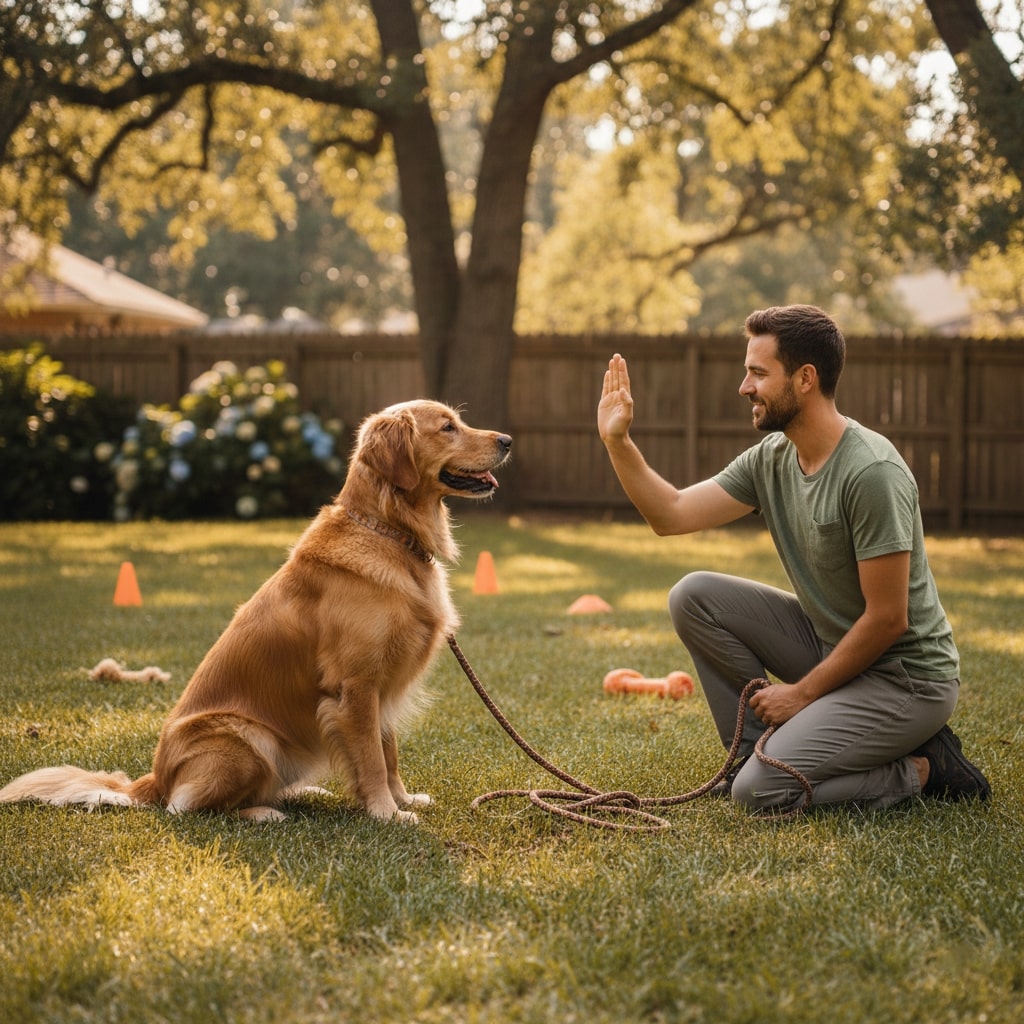
Consistency is the most critical factor in dog training because dogs learn through pattern recognition and association. When rules, commands, and consequences remain constant, a dog understands what is expected, leading to faster learning and reduced anxiety. Inconsistency creates confusion, causing behavioral issues and reinforcing bad habits through intermittent reinforcement.
Summary Table: Why Consistency Is Key in Dog Training?
| Concept | Description | Benefit |
| Clear Communication | Using the exact same word and tone for commands every time. | Eliminates confusion and speeds up command retention. |
| Rule Stability | Keeping boundaries (like “no furniture”) the same every single day. | Prevents the dog from testing limits and reduces frustration. |
| Unified Front | Ensuring every family member enforces the same rules. | prevents the dog from playing favorites or ignoring specific people. |
| Immediate Timing | Delivering rewards or corrections within seconds of the behavior. | Helps the dog clearly link the action to the consequence. |
| Routine | Feeding, walking, and training at similar times daily. | builds confidence and reduces behavioral anxiety. |
Why Consistency Is Key in Dog Training?
Imagine trying to learn a new language where the word for “hello” changes every day. On Monday, it means hello, but on Tuesday, it means “go away,” and on Wednesday, you get shouted at for saying it. You would quickly become confused, frustrated, and scared to speak at all. This is exactly how your dog feels when you are inconsistent in your training.
Many dog owners make the mistake of thinking their dog is stubborn or not smart enough to learn. In reality, the dog is often just confused. Dogs crave structure and predictability.
They need to know that Action A will always result in Result B. When you provide that stability, you unlock your dog’s full potential.
This guide will explain exactly why consistency matters, the science behind it, and how you can apply it to build a happy, well-behaved companion.
Read Also: Common Dog Training Mistakes
Understanding How Dogs Learn
To understand why consistency is non-negotiable, you first need to understand canine psychology. Dogs are not capable of complex abstract reasoning in the same way humans are.
They cannot sit down and think, “My owner is tired today, so that is why the rule about jumping on the couch is suspended.”
Dogs learn primarily through two methods: association and consequence.
1. Association (Classical Conditioning)
Dogs predict the future based on past events. They learn that the sound of the leash jingling means a walk is coming. If you are inconsistent, for example, if you jingle the leash but then leave for work without them, you break that trust and understanding.
2. Consequence (Operant Conditioning)
This is the core of obedience training. A dog performs a behavior, and a consequence follows.
- Positive Consequence: If they sit and get a treat, they are likely to sit again.
- Negative Consequence: If they jump and get ignored, they are less likely to jump again.
If the consequence changes randomly, the dog cannot learn the pattern. If jumping on you results in a scolding one day but a belly rub the next, the dog has learned nothing except that jumping is a gamble worth taking.
The Danger of Mixed Signals
Inconsistency often manifests as “mixed signals.” These are subtle differences in how we interact with our dogs that seem insignificant to us but are massive hurdles for them.
Verbal Command Confusion
Human language is flexible; dog language is not. You might use “Down,” “Get down,” “Off,” and “No” interchangeably to tell your dog to get off the sofa. To your dog, these are four completely different sounds.
- The Fix: Pick one specific word for every specific action. “Down” should mean lie down on the floor. “Off” should mean get your paws off the furniture or person. Never mix them.
Tone and Body Language
Dogs read body language better than they understand words. If you say “No” while giggling and pushing the dog away playfully, your body is saying “Game on!” while your mouth is saying “Stop.” The dog will always believe your body. Consistency requires your emotional tone to match your intent.
The “Just This Once” Syndrome
This is the most common trap. You have a strict “no dogs on the bed” rule. But one night, there is a thunderstorm, and you feel bad, so you let the dog up “just this once.”
In your mind, this is a compassionate exception. In your dog’s mind, the rule has been abolished. The next night, when you scold them for jumping on the bed, they will be confused and anxious.
Read Also: Can Dogs Eat Oatmeal?
The Slot Machine Effect: Why Bad Habits Stick
There is a scientific concept called the Variable Ratio Schedule of Reinforcement, often referred to as the “Slot Machine Effect.” This explains why inconsistent enforcement actually makes bad behavior stronger, not weaker.
Think about a vending machine versus a slot machine.
- Vending Machine (Consistent): You put a dollar in and get a soda. If you put a dollar in and the machine is broken, you might try one more time, but then you stop. You give up quickly because the pattern is broken.
- Slot Machine (Inconsistent): You put a dollar in and get nothing. You do it again and get nothing. The third time, you win $50. You will keep putting money in for hours, hoping for that win again.
If you ignore your dog’s begging at the dinner table 29 times, but on the 30th time you give them a piece of steak, you have turned into a slot machine. You have taught the dog that persistence pays off.
They will now beg longer and harder than ever before because they know that eventually, they might win the jackpot. To stop the behavior, you must be the broken vending machine: the behavior must never result in a reward.
The Three Pillars of Consistent Training
To implement consistency effectively, you need to focus on three specific areas.
1. Consistency in Rules (Boundaries)
Rules must be black and white. Gray areas do not exist for dogs.
- Furniture: Is the dog allowed on the couch? Yes or No. Not “only on Sundays” or “only when he is clean.”
- Greeting: Is the dog allowed to jump on guests? No. This means they cannot jump on you either, even when you are wearing gym clothes and don’t mind.
- Begging: Does the dog get fed from the table? If the answer is no, it must be no even during Thanksgiving or when guests are over.
2. Consistency in Cues (Commands)
Your vocabulary must be disciplined. Create a “glossary” for your dog and stick to it.
- Sit: Bottom on the floor.
- Down: Belly on the floor.
- Stay: Don’t move until released.
- Come: Return to me immediately.
- Drop It: Spit out whatever is in your mouth.
Ensure that you do not repeat commands. Saying “Sit, sit, sit, sit” teaches the dog that they don’t have to listen the first time. Say it once, wait, and if they know the command but refuse, follow through with a gentle reminder or lure.
3. Consistency in Enforcement (Consequences)
This is the hardest part for humans. We get tired, we get busy, and we let things slide. However, for a dog to feel secure, the environment must be predictable.
- If pulling on the leash means the walk stops, the walk must stop every single time they pull. If you let them drag you for five minutes because you are in a rush, you have undone weeks of training.
- Rewards must also be consistent initially. When teaching a new trick, reward every single success. Once learned, you can switch to intermittent rewards to maintain interest, but the praise should always be there.
Getting the Household on Board
One of the biggest saboteurs of dog training is a lack of consistency among family members. If Dad forbids begging but the kids sneak food under the table, the dog will simply learn who the “easy mark” is. This creates a dog that listens to one person but ignores everyone else.
The Family Meeting
Before you bring a dog home, or if you are starting a new training regimen, hold a family meeting. Agree on the vocabulary. If Mom says “Down” for lying down, and Dad says “Lay,” the dog will take twice as long to learn.
Key Agreements for Families:
- The Vocabulary List: Write down the official command words and post them on the fridge.
- The “No” List: Agree on what is absolutely forbidden (e.g., chewing shoes, sleeping on pillows).
- Reaction Protocol: Agree on how to react to bad behavior. If the dog nips, does everyone turn their back and ignore, or does someone yell? The reaction must be uniform.
Consistency Reduces Anxiety
We often think of training as “control,” but for a dog, training is “communication.” A dog that lives in an inconsistent environment is chronically stressed. They live in a state of uncertainty, never knowing if their actions will bring praise or punishment.
This anxiety often manifests as destructive behavior, excessive barking, or aggression. By being consistent, you remove the guesswork from your dog’s life.
A confident dog knows exactly how to earn rewards and how to avoid corrections. This clarity leads to a relaxed, happy animal that looks to you for guidance rather than reacting out of fear.
Read Also: Can Dogs Eat Pineapple?
How to Maintain Consistency: A Practical Guide
Maintaining consistency is a habit for the owner, not just the dog. Here is a step-by-step plan to keep yourself on track.
Step 1: Define Your Goals
Write down exactly what you want. Do you want a dog that walks by your side? A dog that goes to their bed when the doorbell rings? Be specific.
Step 2: Create a Schedule
Dogs have an internal clock. Try to keep feeding times, potty breaks, and walk times consistent. This regulates their energy levels and digestion, making potty training and behavioral management much easier.
Step 3: Keep Training Sessions Short
It is easier to be consistent for 5 minutes than for an hour. Do three 5-minute training sessions a day. This prevents you from getting frustrated and “sloppy” with your commands.
Step 4: Use a Release Word
Many people forget to tell their dog when the command is over. If you say “Sit,” the dog should stay sitting until you say “Free” or “Okay.” If you let them wander off whenever they want, the command “Sit” loses its power.
Troubleshooting Common Consistency Issues
“My dog listens at home but not at the park.”
This is a context consistency issue. Dogs do not generalize well. They think “Sit” means “sit on the kitchen rug.” You must re-train your commands in new environments (the yard, the street, the park) to teach them that “Sit” applies everywhere.
“I’m too tired to train today.”
If you cannot enforce a command, do not give it. If you are too exhausted to make your dog come to you if they refuse, do not call them.
It is better to remain silent than to give a command you cannot back up. Manage the situation (use a leash or a gate) rather than relying on commands you can’t enforce.
Conclusion
Consistency is the secret sauce of dog training. It is the bridge between a chaotic, stressful home and a peaceful, cooperative relationship with your pet. It requires patience and self-discipline from you, but the payoff is immense.
When you are consistent, you are fair. You are telling your dog exactly how to succeed in your world. In return, your dog will offer you their focus, obedience, and trust.
Remember, every time you interact with your dog, you are training them. Make sure the message you are sending is the one you want them to receive today, tomorrow, and forever.