
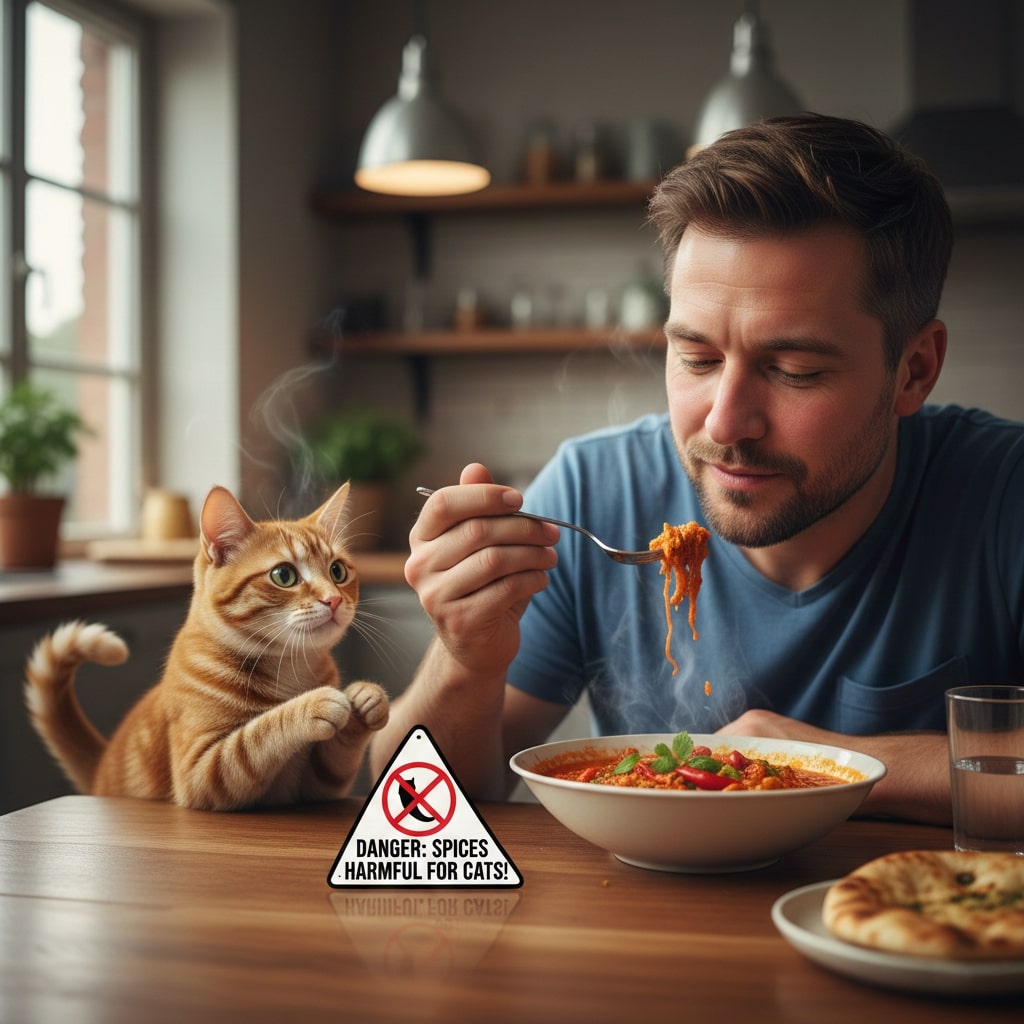
Cats beg for harmful food primarily because they are opportunistic hunters driven by a powerful sense of smell. They are biologically wired to seek out fats and proteins, which are abundant in many human foods (like seasoned meats or dairy). They do not instinctively know which ingredients, like onions, garlic, or chocolate, are toxic. Furthermore, begging is often a learned behavior; if they have received a scrap in the past, they will continue to ask for it.
Summary Table: Why Cats Want Your Food
| Reason | Description | What They Want |
| Smell | Cats have 200 million scent receptors. | The aroma of meat, fat, or fish. |
| Instinct | In the wild, they eat whenever food is available. | High-calorie energy sources. |
| Curiosity | They want to see what “the pack” is doing. | To participate in your activity. |
| Habit | You fed them once, so they expect it again. | A reward for meowing/staring. |
| Nutritional Need | Rare, but can indicate a deficiency. | Unusual items (like plastic or dirt). |
Why Cats Beg for Food That’s Bad for Them
Every cat owner knows the look: you sit down to eat a burger or a bowl of pasta, and suddenly your cat is staring at you with wide eyes, pawing at your leg. It seems strange because cats are carnivores, and much of what we eat (grains, vegetables, heavy spices) isn’t part of their natural diet.
Even worse, some of the food they beg for, like onions, garlic, grapes, or chocolate, can be deadly. So, why do they do it? Here is a breakdown of why your cat wants what is on your plate.
Read also: Common Human Foods Toxic to Cats
1. Their Nose Knows (Mostly)
A cat’s sense of smell is roughly 14 times stronger than a human’s. When you cook dinner, you smell a general aroma. Your cat, however, smells the specific fats and proteins within the dish.
- The Trap: A cat smells the protein in a piece of garlic chicken or the fat in a creamy sauce.
- The Problem: Their nose detects the “good” stuff (meat/fat) but ignores the toxic ingredients (garlic/onions). They rely on smell to decide what is edible, and the strong scent of meat often masks the smell of danger.
2. They Are Opportunistic Eaters
In the wild, cats don’t know when their next meal is coming. They are biologically wired to be “opportunistic feeders.”
- This means if food is available, their instinct screams, “Eat it now!”
- They naturally crave high-calorie foods to store energy. Human food is often calorie-dense, salty, and fatty, a jackpot for a survival-focused animal.
3. Neophilia (Love of the New)
While some cats are picky, many suffer from “neophilia,” which is an attraction to new things.
- If you are eating something new and interesting, their curiosity takes over.
- They see you interacting with an object (food) and putting it in your mouth. They want to investigate the texture, temperature, and taste simply because it is novel.
4. It’s a Social Activity
For house cats, you are the leader of their group. In the wild, cats (specifically lions, though house cats are more solitary) or other pack animals might share a kill.
- When you sit down to eat, your cat sees this as a social event.
- They aren’t always hungry; sometimes, they just want to bond and participate in what you are doing.
5. You Taught Them to Beg
This is the most common reason. This is called conditioned behavior.
- The Scenario: You are eating a sandwich. The cat meows. You give them a tiny piece of turkey.
- The Lesson: The cat learns that “Meowing + Staring = Turkey.”
- The Result: Even if you say “no” ten times, if you say “yes” once, they will keep trying. This is known as “intermittent reinforcement,” and it makes the habit very hard to break.
Foods You Must Never Share
Even if your cat begs, you must be the responsible guardian. Never give in to begging for these items:
- Onions, Garlic, Chives: These damage red blood cells and cause anemia.
- Chocolate and Caffeine: Can cause heart arrhythmias and seizures.
- Grapes and Raisins: Can cause sudden kidney failure.
- Dairy (Milk/Cheese): Most adult cats are lactose intolerant and will get an upset stomach.
- Alcohol: Even a tiny amount is extremely dangerous for a cat’s liver and brain.
- Dough with Yeast: It can expand in the stomach and produce alcohol.
How to Stop the Begging
If your cat’s begging has become annoying or dangerous, you can fix it.
- Ignore It Completely: Do not look at them, talk to them, or push them away (touch is attention). Pretend they aren’t there.
- Feed Them First: Feed your cat their meal right before you sit down to eat yours. A full cat is a less annoying cat.
- Use Puzzle Feeders: Put their dry food in a puzzle ball while you eat dinner. This keeps them busy and mentally stimulated.
- Consistency is Key: Everyone in the house must agree: No human food. If one person sneaks them a treat, the begging will never stop.
When to See a Vet
If your cat suddenly starts begging aggressively and acting like they are starving despite eating normal meals, see a vet. This can be a sign of:
- Hyperthyroidism
- Diabetes
- Parasites (Worms)