
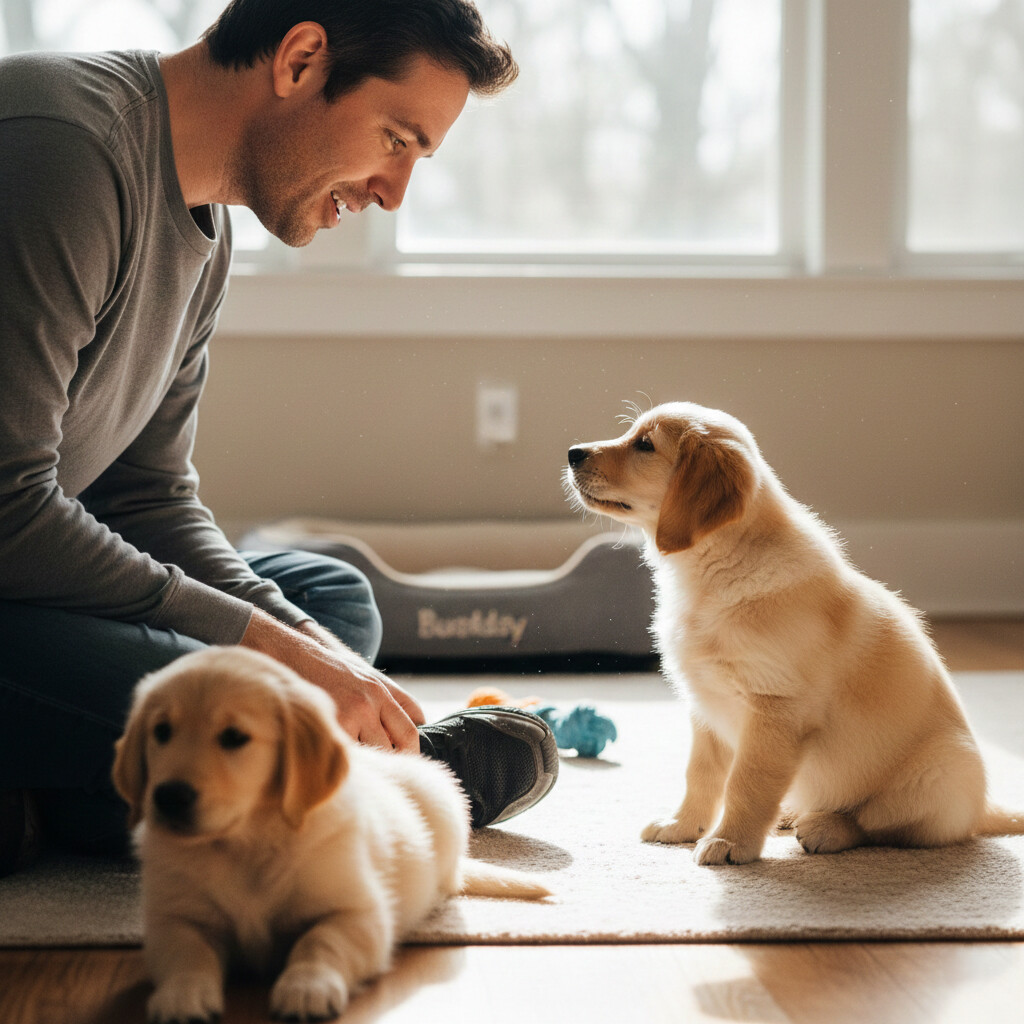
Most puppies begin to recognize their name between 6 and 12 weeks of age. However, they do not understand the name as a personal identity like humans do. Instead, they learn through association that the specific sound of their name predicts a reward, attention, or food. With consistent training, a puppy can reliably respond to their name within a few days to a week of focused practice.
Summary Table
| Milestone | Typical Timeframe | Key Factor |
| Ears Open | 2–3 Weeks | Puppies are born deaf; hearing develops now. |
| Brain Processing | 3–6 Weeks | They begin to distinguish different sounds. |
| First Recognition | 6–12 Weeks | The “sweet spot” for learning their name. |
| Reliable Response | 3–6 Months | Depends heavily on training consistency. |
| Training Method | Positive Reinforcement | Pairing the name with treats/praise. |
| Common Barrier | “Poisoned Cue” | Using the name while scolding the dog. |
When Do Puppies Start Recognizing Their Name
Bringing a new puppy home is a mix of excitement and chaos. You have picked out the perfect name, bought the collar, and are ready to bond. You call out to them, expecting a movie-style moment where they run into your arms, but they stare blankly at the wall instead.
Do not panic. Your puppy isn’t broken, and they aren’t ignoring you on purpose. Understanding when and how a puppy learns their name requires looking at their physical development and how they learn.
This guide covers the biology of puppy hearing, the psychology of learning, and a step-by-step plan to teach your dog their name quickly.
Read Also: How Long Does Puppy Training Take?
The Biology: Why They Can’t Hear You Yet
Before a puppy can learn a name, they need the physical ability to hear it. Puppies are born altricial, meaning they are undeveloped and fully dependent on their mother.
0 to 2 Weeks: The Silent World
Newborn puppies are functionally deaf and blind. Their ear canals are sealed shut to protect their delicate internal structures while they develop. During this phase, their world is defined entirely by smell and touch. Calling a puppy’s name at this age is useless because the sound waves literally cannot reach their eardrums.
2 to 3 Weeks: The Awakening
Around the two-week mark, the ear canals begin to open. However, hearing is not perfect immediately. It is similar to waking up with clogged ears; sounds are muffled and indistinct. They might startle at loud noises, but they cannot decipher complex sounds like human speech.
3 to 6 Weeks: The Sensory Boom
This is a critical socialization period. Their hearing sharpens rapidly. They start to recognize the sounds of their mother, their littermates, and the humans who care for them. While they can hear you clearly now, their brain is still figuring out how to categorize sounds. They are learning the difference between a door slamming, a dog barking, and a human voice.
The Psychology: It Is Not a Name, It Is a “Cue”
This is the most important concept for new owners to understand: Dogs do not understand names the way humans do.
When you introduce yourself to a person, they understand that the name is part of your identity. To a dog, their name is just a specific sound. It is a “cue” or a signal.
The Science of Association
Puppies learn through a process called Classical Conditioning. This is the same concept made famous by Ivan Pavlov and his dogs.
- The Stimulus: The sound of the name (e.g., “Bella”).
- The Event: Something great happens (a treat, a belly rub, dinner).
- The Result: The puppy feels happy when they hear “Bella.”
If you say “Bella” and nothing happens, the sound is just background noise, like the hum of a refrigerator. If you say “Bella” and give them a piece of chicken, the sound becomes the most important noise in the world.
Therefore, puppies recognize their name only when they realize that Sound = Reward.
Read Also: Why Puppies Chew Everything
Step-by-Step Guide to Teaching the Name
You can start training as soon as you bring your puppy home (usually around 8 weeks). The goal is to create a “whiplash” reaction where the dog turns to look at you immediately upon hearing the sound.
The “Name Game” Exercise
What you need:
- A quiet room with no distractions (no TV, no other pets).
- High-value treats (tiny pieces of boiled chicken, cheese, or soft puppy training treats).
- Your puppy.
Step 1: The Setup
Wait for your puppy to be looking away from you or wandering around the room. You want to catch them when they are not already paying attention to you.
Step 2: The Cue
Say their name one time in a clear, happy, upbeat voice. Do not shout, and do not repeat it yet.
- Correct: “Cooper!”
- Incorrect: “Cooper, Cooper, look here, Cooper!”
Step 3: The Mark and Reward
The second your puppy turns their head to look at you, mark the behavior. You can use a clicker or a verbal marker word like “Yes!” or “Good!”
Immediately after marking, give them the treat.
Step 4: Reset and Repeat
Let the puppy look away again. Throw a treat on the floor to get them to turn away if needed. Repeat the process.
Training Schedule
- Duration: Do this for 3 to 5 minutes at a time. Puppies have short attention spans.
- Frequency: Aim for 3 to 5 sessions per day.
- Consistency: Within a week, you should see your puppy snap their head toward you whenever you say the name in a quiet environment.
Moving to the Real World (Generalization)
Dogs are terrible at “generalizing.” This means if they learn their name in the kitchen, they might think their name only works in the kitchen. If you go to the backyard, they might act like they have never heard it before.
Once they master the name in a quiet room, you must increase the difficulty. This is often where owners get frustrated.
Adding Distractions
Start practicing in the living room with the TV on. Then, move to the backyard. Eventually, practice on walks.
- The Rule: If the environment is harder (more distractions), the reward must be better. Use boring kibble in the kitchen, but use steak or hot dogs at the park.
Read Also: Puppy Growth Spurts Explained
5 Common Mistakes That Ruin Name Recognition
If your puppy is 12 weeks or older and still ignoring you, you are likely making one of these five common errors.
1. Poisoning the Cue
This is the number one reason dogs ignore their owners. “Poisoning the cue” means you have associated the name with something negative.
- Example: You shout “Buster, NO!” when he pees on the rug.
- Example: You say “Buster, come here!” and then lock him in his crate or clip his nails.
If the name predicts punishment or the end of fun, the puppy will learn to avoid the sound. Never use the name to scold.
2. The Nagging Repeat
You say, “Daisy… Daisy… Daisy… Daisy!”
The puppy learns that the first three “Daisys” are just noise, and they don’t need to respond until the tenth time.
The Golden Rule: Say the name once. If they don’t look, do not repeat it. Make a kissy noise or clap your hands to get their attention, then reward them. Make the name sacred.
3. Nickname Overload
Your dog’s name is “Max.”
But you call him “Maxie,” “Maximillian,” “Puppy,” “Bubba,” and “Good Boy.”
To a human, these are affectionate variations. To a puppy learning English as a second language, these are five different words. Stick to one name until they know it perfectly.
4. Tone of Voice
Dogs are masters of tone. If you sound stressed, angry, or frustrated, a sensitive puppy will avoid looking at you to avoid conflict (this is an appeasement signal). Always use a happy, inviting tone when saying their name.
5. Asking for Too Much Too Soon
If your puppy is sniffing a very interesting tree or playing with another dog, they likely cannot hear you. Their brain is blocking out the sound to focus on the smell or play. If you call them when you know they won’t listen, you are teaching them to ignore you. Only call them when you have a reasonable chance of success.
Troubleshooting: “Is My Puppy Deaf?”
It is a valid concern. If you have been training consistently for weeks with high-value treats and see zero reaction, you should check for hearing loss.
Simple At-Home Test
Wait until the puppy is asleep or looking away. Stand behind them (so they can’t feel air movement or see a shadow) and clap your hands loudly or bang two pots together.
- Normal: The puppy starts, wakes up, or turns its ears toward the sound.
- Concern: The puppy does not react at all.
Certain breeds with white pigmentation (like Dalmatians, Boxers, and Bull Terriers) are genetically more prone to congenital deafness. If you suspect deafness, a vet can perform a BAER (Brainstem Auditory Evoked Response) test.
Frequently Asked Questions
Can I change my puppy’s name?
Yes, absolutely. Since the name is just a sound association, you can change it at any time. If you adopt a dog with a name you dislike, or if you have “poisoned” the old name by using it angrily, picking a new name is actually a great training strategy. It gives you a fresh start.
How long does it take for a puppy to learn their name?
With 3 to 5 short training sessions a day, most puppies understand the basics in 2 to 3 days. However, getting them to respond reliably outdoors or around distractions can take 2 to 4 months of consistent practice.
Should I use a clicker?
Using a clicker is highly effective for name recognition. The “click” is a distinct sound that marks the exact moment the dog did the right thing (looking at you). It acts as a bridge between the behavior and the treat. If you don’t have a clicker, a consistent word like “Yes!” works just as well.
Why does my puppy listen to my partner but not me?
Dogs often bond differently with different family members. If your partner is the one who feeds the dog, plays with the dog, and does the training, the dog will value their voice more. To fix this, the person who is being ignored needs to become the source of all good things (food, walks, play) for a few days.
Conclusion
Puppies start recognizing their name between 6 and 12 weeks, but only if you teach them that the name pays well. It is not about intelligence; it is about motivation and clarity.
Be patient. Your puppy is an infant of a different species trying to navigate a human world. Keep your training sessions short, keep your tone happy, and keep your pockets full of treats. If you stay consistent, you won’t just have a dog that knows their name, you’ll have a dog that loves hearing it.